



















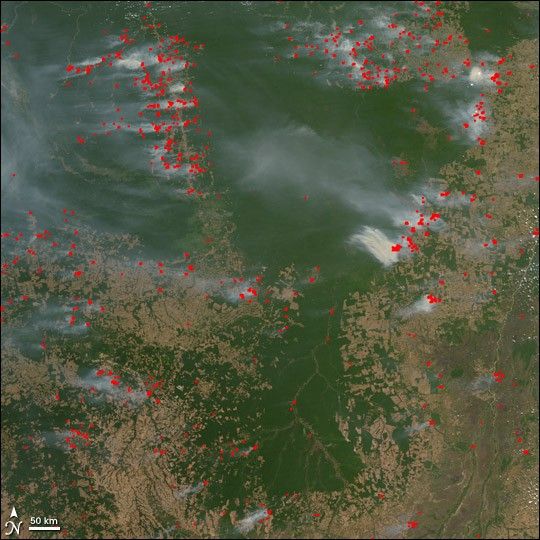
Like the forests of eastern North America in previous centuries, the Amazon Rainforest of South America is rapidly falling as people colonize and develop a new frontier. Where there was once no such thing as an “Amazon fire season,” fires are now widespread in the dry season as people clear forest or manage already cleared plots of crop or grazing land.
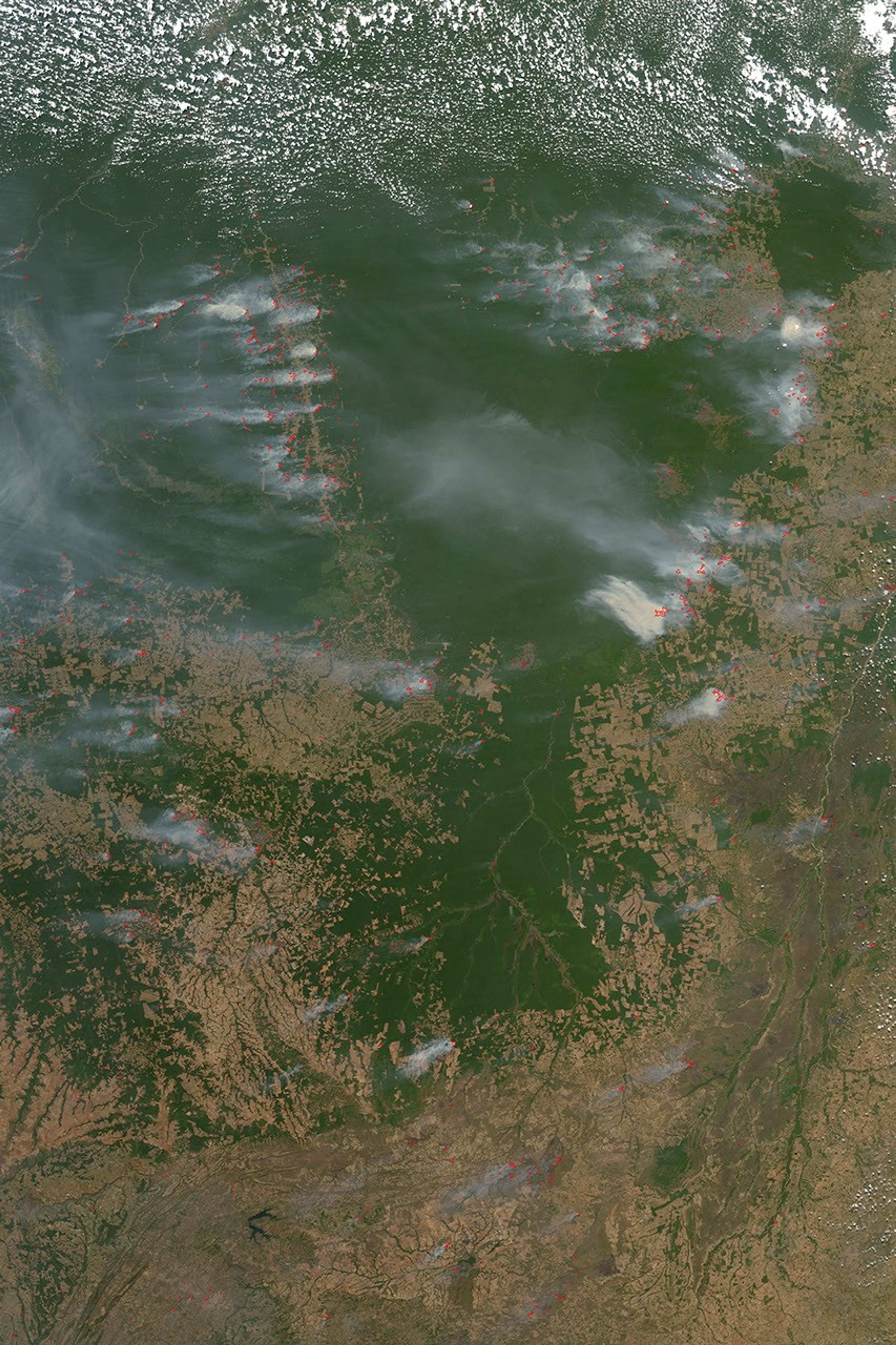
This image of Mato Grosso state in Brazil shows deforestation and fires (marked in red) in the southern Amazon on August 12, 2007. The image and fire detections were collected by the Moderate Resolution Imaging Spectroradiometer (MODIS) on NASA’s Aqua satellite. Like a green pendulum, the Xingu National Park and Indigenous Peoples Reserve swings down from a broader area of intact forest. Checkerboard deforestation (more obvious in the large image) surrounds the reserve on all sides. A northwest-running road into the heart of the forest is a magnet for land clearing. Fires line the road.
The large image provided above has a spatial resolution (level of detail) of 250 meters per pixel. The MODIS Rapid Response Team provides twice-daily images of the region in additional resolutions.
References & Resources
NASA image by Jesse Allen, using data provided courtesy of the MODIS Rapid Response team.