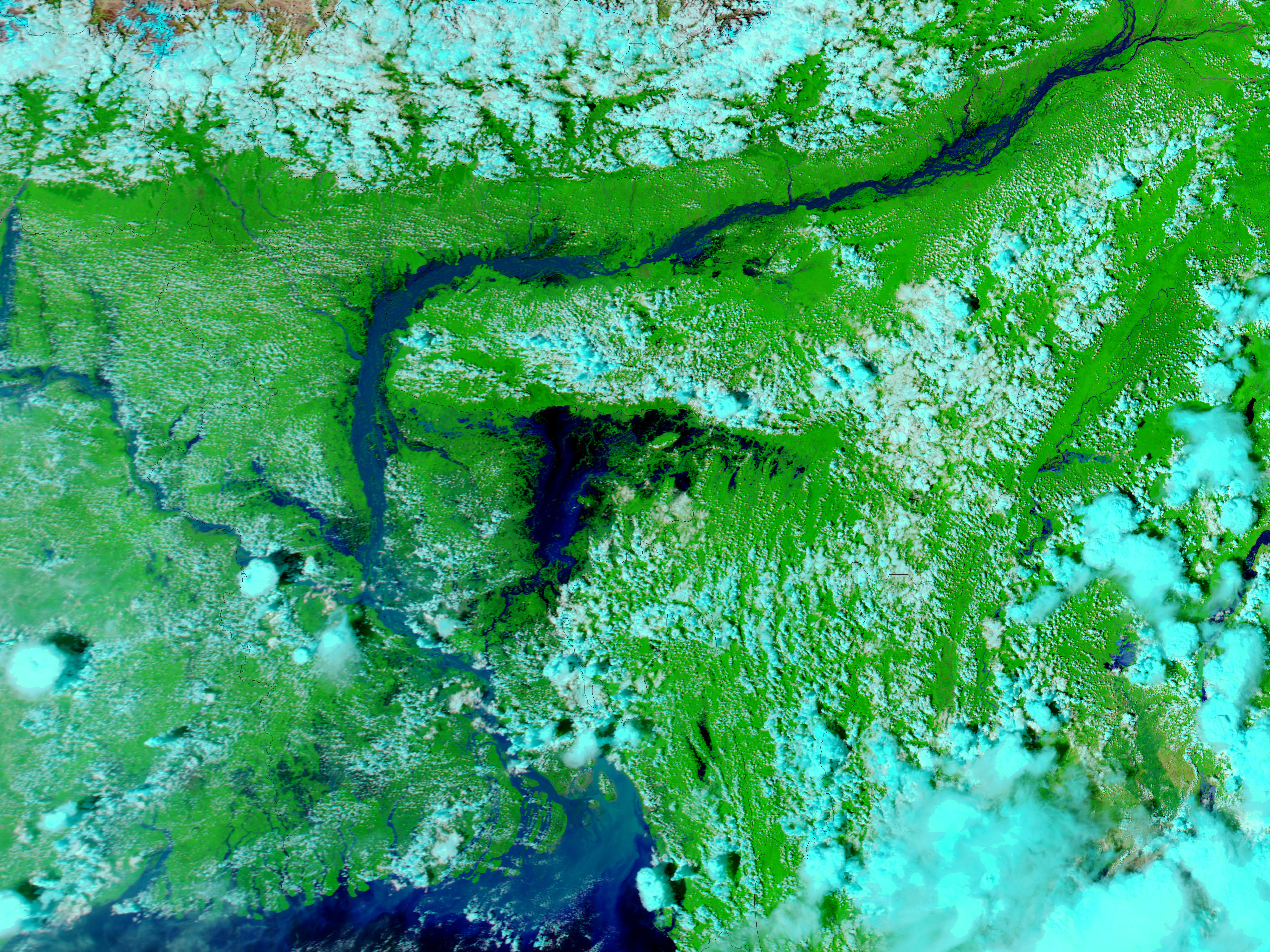























- September 7, 2008 (5.75 MB JPG)
- August 8, 2008 (3.60 MB JPG)
More than 1.2 million people felt the impact when the Brahmaputra River of northeastern India and Bangladesh pushed over its banks in September 2008, said the International Federation of Red Cross and Red Crescent Societies (IFRC). The river floods regularly during the annual monsoon rains. It had reached a dangerous peak when the Moderate Resolution Imaging Spectroradiometer (MODIS) on NASA’s Aqua satellite acquired this rare cloud-free view on September 7, 2008. The river was just starting to swell above dry-season levels when Aqua MODIS captured the lower image on August 8, 2008, provided here for context.
The images were made with infrared and visible light so that water is dark blue or black in contrast to the bright green plant-covered land. When seen from above by human eyes, the muddy water and the land would blend together, but this combination of light, not normally seen by people, creates contrast between water and land. In both images, clouds (light blue and white) dot the sky on either side of the river, but the view of the river is unobstructed.
The flooded river buried nearly 170 villages in waist-deep water, reported BBC news. Kaziranga National Park, home to tigers, elephants, panthers, bears, and the world’s largest population of one-horned rhinoceroses, was also more than 50 percent flooded, said BBC.
References & Resources
- References
- BBC News. (2008, September 4). Assam towns threatened by floods. Accessed September 8, 2008.
- International Federation of Red Cross and Red Crescent Societies. (2008, September 8). India floods information bulletin number six. Published on ReliefWeb. Accessed September 8, 2008.
NASA images courtesy the MODIS Rapid Response Team at NASA GSFC. Caption by Holli Riebeek.