










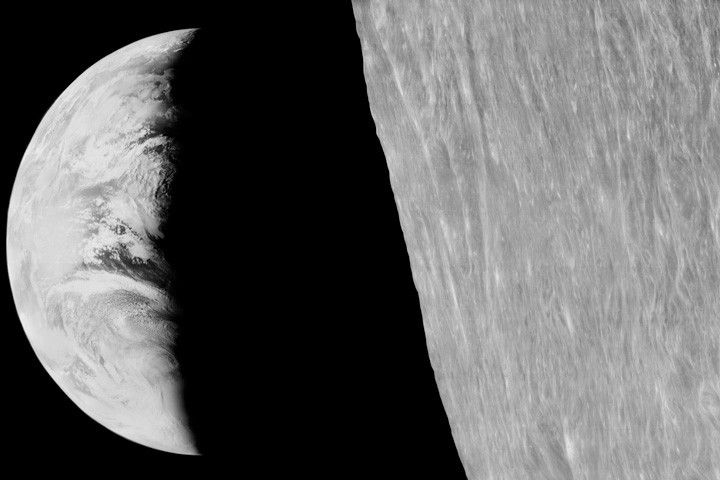
Long before man journeyed to the moon and looked back at the tiny, fragile planet that houses humanity, remote orbiters were sending back pictures of home. Sent to scope out potential landing sites on the Moon, the series of five Lunar Orbiters also sent back the earliest views of Earth from another celestial body. This image, taken in 1966 by Lunar Orbiter 1, is among the first views of Earth from the Moon. In the black-and-white image, a crescent Earth floats majestically behind the lumpy surface of the Moon. Though clouds swirl across the atmosphere, hiding nearly all identifying features on the surface beneath, the western edge of Africa is faintly visible in the upper left. The Earth's North Pole points toward the top of the image. (For an illustration of Earth’s orientation in the image, see Earth’s orientation.)
When the orbiter sent back the data in 1966, the technology did not exist to produce a full-resolution image. For decades, the image existed as a grainy black-and-white photo. More than forty years later, NASA recreated the image from the original data, producing for the first time a high-resolution view of the Moon and Earth from the Lunar Orbiter Missions. The image was released on November 13, 2008.
To create the image, the Lunar Orbiter Image Recovery Project at NASA Ames Research Center had to convert data stored on magnetic tapes into a digital format using a combination of modern digital imaging technology and restored 1960s-era machinery. This image showed that it is possible to retrieve the archived data and reprocess it with modern technology. The work is ongoing, and additional images will be available to the public as they are processed.
References & Resources
- NASA. (2008, November 13). Lunar Orbiter Image Recovery Project Overview. Accessed November 14, 2008.
- Newton, K. Hautaluoma, G. (2008, November 13). NASA restores historic Lunar Orbiter image. NASA Ames Research Center. Accessed November 14, 2008.
NASA image courtesy the Lunar Orbiter Image Recovery Project at NASA Ames Research Center. Caption by Holli Riebeek.