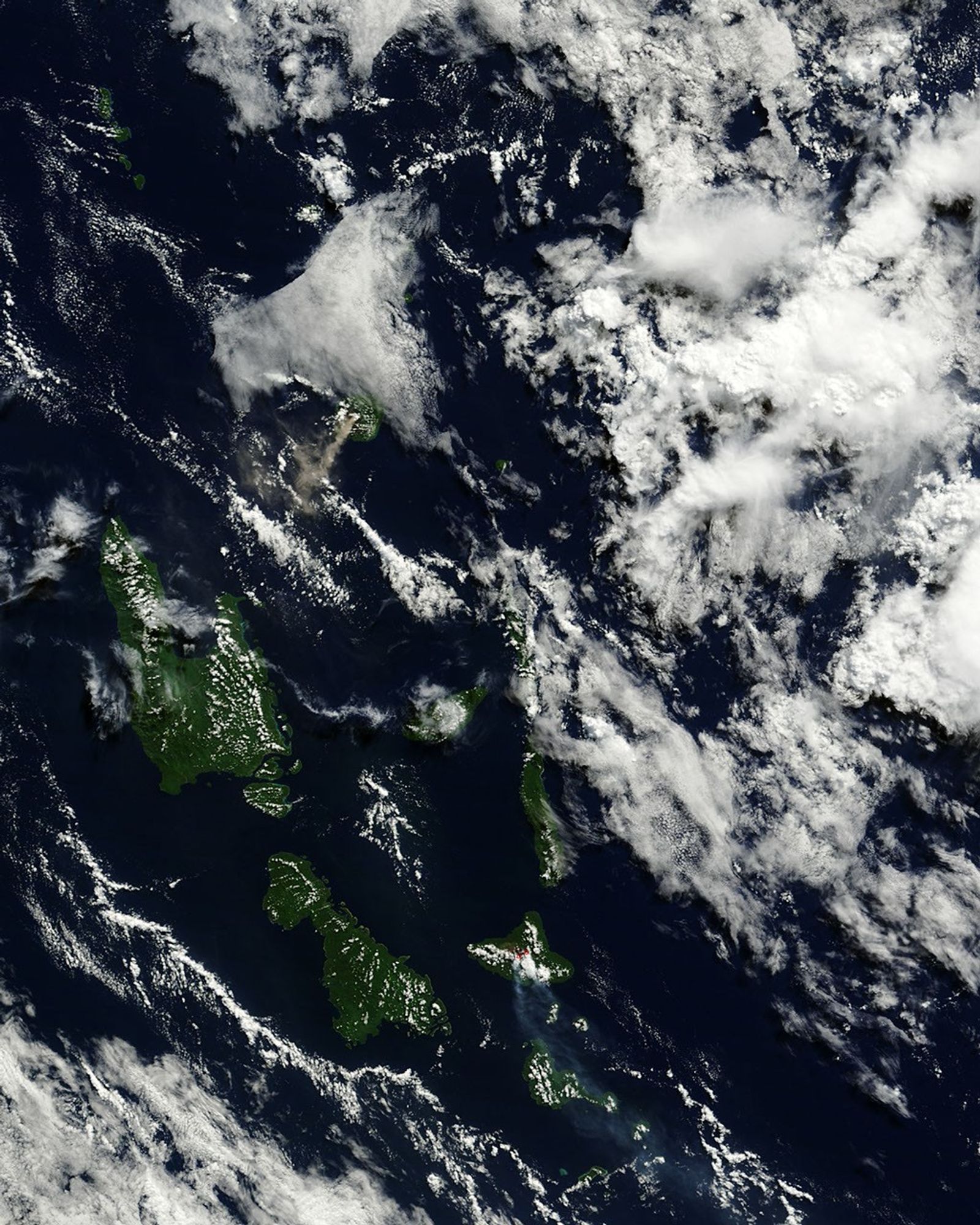



















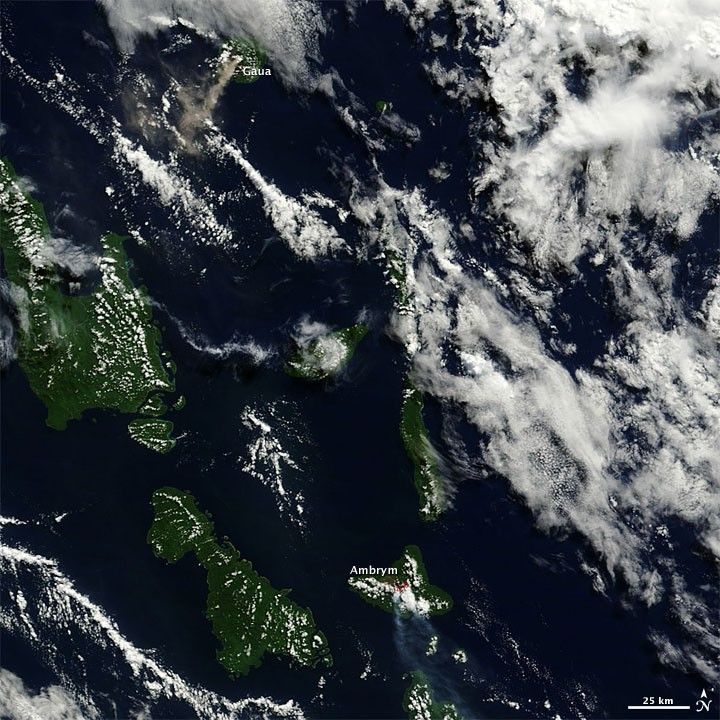
Two volcanoes in Vanuatu, Gaua and Ambrym, emitted simultaneous plumes as the Moderate Resolution Imaging Spectroradiometer (MODIS) on NASA’s Terra satellite passed overhead and took this picture on June 6, 2010.
Gaua emits a thick, tan plume that blows toward the southwest. The plume’s color indicates the presence of volcanic ash. Ambrym emits a faint plume that blows toward the south and appears blue-gray, probably because the blue of the ocean shows through the nearly transparent plume. This plume’s pale color suggests steam. The two red outlines on Ambrym are hotspots associated with high surface temperatures, and almost certainly result from volcanic activity.
Gaua is a stratovolcano that comprises the island of the same name. (The island is also known as Santa María Island.) The island is 20 kilometers (12 miles) in diameter with a crescent-shaped caldera lake.
Ambrym is a pyroclastic shield volcano. The volcano has a large caldera that resulted from a major eruption roughly 1,900 years ago. Subsequent eruptions have partially filled the caldera floor.
References & Resources
NASA image by Jeff Schmaltz, MODIS Rapid Response Team at NASA GSFC. Caption by Michon Scott.