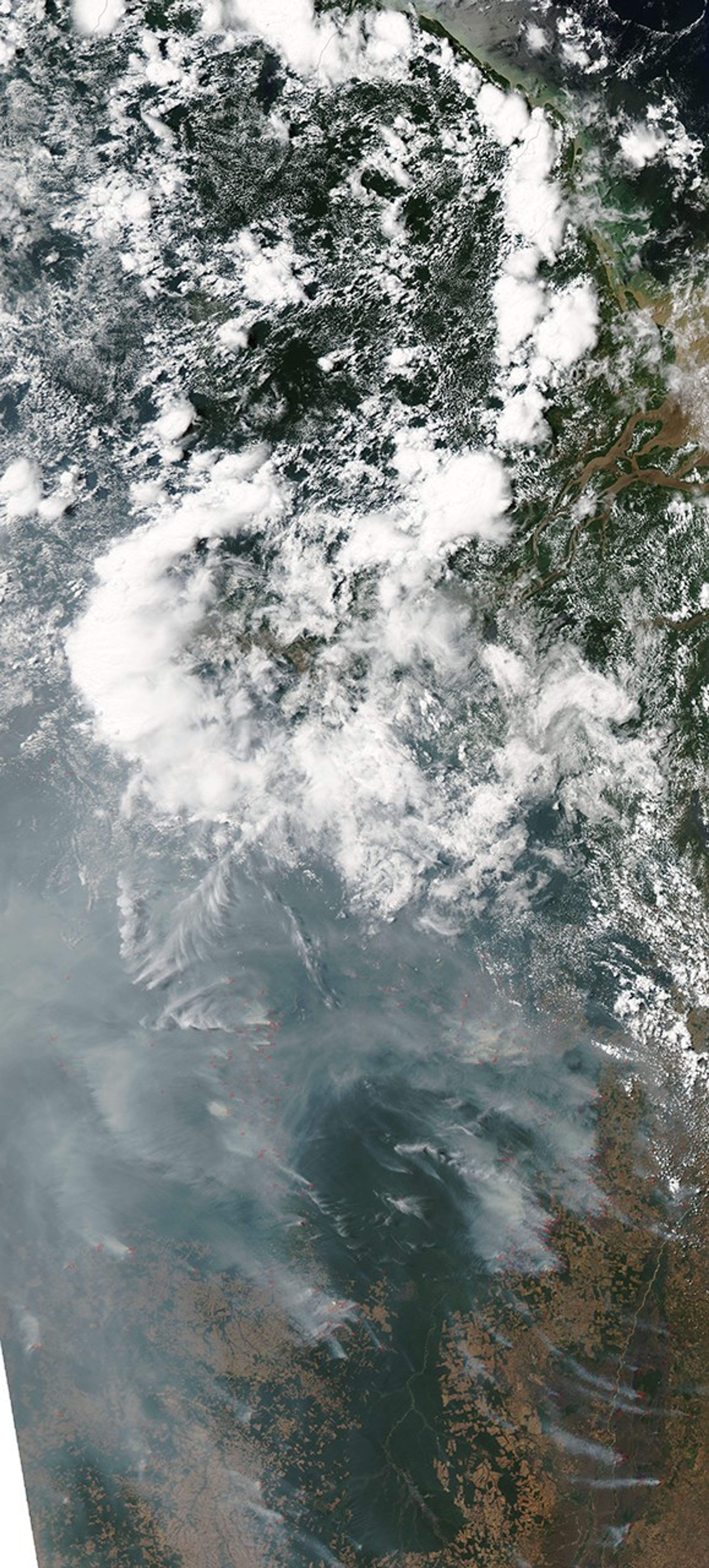
























Fires burn along the southeast fringe of the Amazon Rain Forest in this image, taken by the Moderate Resolution Imaging Spectroradiometer (MODIS) on NASA’s Aqua satellite on August 17, 2010. Red outlines the places where the MODIS sensor detected a thermal spike, most likely a fire. Thick smoke veils the dark green forest in gray.
Fire is frequently used to clear trees for grazing or crop land. Most of the fires in this image are clustered along the edge of the forest bordering on previously cleared land, which is tan. It is not possible to tell why the fires started from this image alone, but their location on the edge of the forest suggests that they may have been deliberately set.
Satellite measurements of fire provide an overview of the extent of fire in an area as large and remote as the Amazon Basin. While fires are routinely set during the dry season, 2010 proved to be an unusual year. Satellites detected a three-fold increase in the number of fires burning in five Brazilian states, reported BBC News. Drought created more dangerous fire conditions, particularly in northern and eastern Brazil where wildfires destroyed large areas of national parks and hundreds of homes.
The MODIS Rapid Response System provides twice-daily images of eastern Brazil.
References & Resources
- BBC News. (2010, August 15). Brazil wildfires threaten homes and national parks. Accessed August 18, 2010.
NASA image courtesy the MODIS Rapid Response Team at NASA GSFC. Caption by Holli Riebeek.