











In late October and early November 2010, eruptions at Indonesia’s Mount Merapi produced ash plumes, lahars, and pyroclastic flows. The volcano also released sulfur dioxide, a colorless gas that can harm human health and cool Earth's climate.
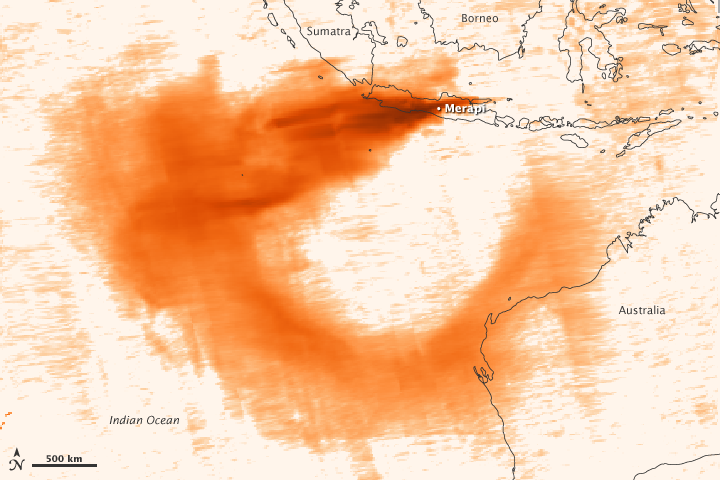
This image shows concentrations of sulfur dioxide on November 4–8, 2010, as observed by the Ozone Monitoring Instrument (OMI) on NASA’s Aura spacecraft. Sulfur dioxide is measured here in Dobson Units: The greatest concentrations appear in dark red-brown; the lowest in light peach. Typically used to measure ozone, the Dobson Unit is the number of molecules of gas that would be required to create a layer 0.01 millimeters thick at a temperature of 0 degrees Celsius and a pressure of 1 atmosphere (the air pressure at the surface of the Earth).
On November 9, 2010, the Volcanic Ash Advisory Centre in Darwin, Australia, reported a sulfur dioxide cloud over the Indian Ocean between 40,000 and 50,000 feet (12,000 and 15,000 meters), in the upper troposphere.
The effects of sulfur dioxide vary depending on the amount emitted, the latitude where the emission occurs, the altitude where the gas is concentrated, and regional wind and weather patterns. At ground level, sulfur dioxide irritates human skin, eyes, and the upper respiratory tract. At higher altitudes, sulfur dioxide can undergo a series of chemical reactions affecting the environment. For instance, by reacting with water vapor, sulfur dioxide can create sulfate ions, precursors to sulfuric acid. Besides elevating the risk of acid rain, the ions can also react to form particles that reflect sunlight.
If a volcano near the equator injects a sufficient quantity of sulfur dioxide into the stratosphere, the resulting chemical reactions can create reflective aerosols that linger for months or even years, cooling climate by reflecting sunlight. At just 7.5 degrees south of the equator, Mount Merapi is positioned to have such an impact. But as of early November, Merapi had emitted just 1 percent of what was released by Mount Pinatubo in 1991. That eruption had a measurable effect on global temperatures, said OMI scientist Simon Carn from Michigan Technological University.
For more information on aerosols and their effect on our planet, see the Earth Observatory fact sheet Aerosols: Tiny Particles, Big Impact.
References & Resources
- Darwin Volcanic Ash Advisory Center. (2010, November 9). Volcanic ash advisory: Merapi. Accessed November 9, 2010.
- Klemetti, E. (2010, November 8). Merapi update for 11/8/2010: Death toll climbs as activity calms. Eruptions. Accessed November 9, 2010.
- Volcanic Hazards Program. (2010, June 11). Volcanic gases and their effects. U.S. Geological Survey. Accessed November 9, 2010.
NASA Earth Observatory image created by Jesse Allen, using OMI data provided courtesy of Simon Carn, Department of Geological and Mining Engineering and Sciences , Michigan Technical University. Caption by Michon Scott.