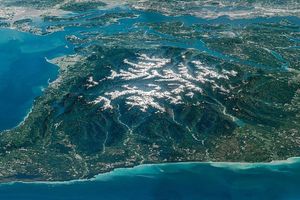
















The Biokovo Range in Croatia is part of the Dinaric Alps that extend northwest-southeast along the coastline of the Adriatic Sea. The range itself is the location of a national park; the nearby city of Makarska, located between the mountains and the sea, is a popular tourist destination. The highest peak in the range is Sveti Jure (1,762 meters above sea level). The Biokovo Range is comprised mainly of Mesozoic-age carbonate rocks, primarily limestone, that were deposited in relatively warm, shallow waters. Later tectonic processes uplifted and exposed the carbonate rocks to erosion, leading to a distinctive geological surface known as karst topography.
Karst topography occurs when naturally occurring acids in surface and ground water dissolve the carbonate rocks. As the rock dissolves, underground networks of drainages and caves form. As more empty space develops underground, the overlaying rock and soil collapse to form a variety of landforms including sinkholes, blind valleys, and towers. In the Biokovo Range, much of the karst surface has a pitted appearance, easily visible in the early morning light in this astronaut photograph. The pitted appearance is produced by numerous circular or semi-circular collapse valleys known locally as vrtače. While this image captures Sveti Jure covered with snow, there are no glaciers or ice fields in the Biokovo Range.
References & Resources
Astronaut photograph ISS018-E-15908 was acquired on December 29, 2008, with a Nikon D2Xs digital camera fitted with a 180 mm lens. It is provided by the ISS Crew Earth Observations experiment and the Image Science & Analysis Laboratory, Johnson Space Center. The image was taken by the Expedition 18 crew. The image in this article has been cropped and enhanced to improve contrast. Lens artifacts have been removed. The International Space Station Program supports the laboratory to help astronauts take pictures of Earth that will be of the greatest value to scientists and the public, and to make those images freely available on the Internet. Additional images taken by astronauts and cosmonauts can be viewed at the NASA/JSC Gateway to Astronaut Photography of Earth. Caption by William L. Stefanov, NASA-JSC.