












At night, Earth’s surface is covered with a delicate tracery of lights, particularly in regions that have a long history of urban development (such as Europe). Large urban areas are recognizable from orbit due to extensive electric lighting and distinct street patterns. With smaller urban areas spread across the land surface and coastlines, the outlines of continental land masses are easily discernable at night.
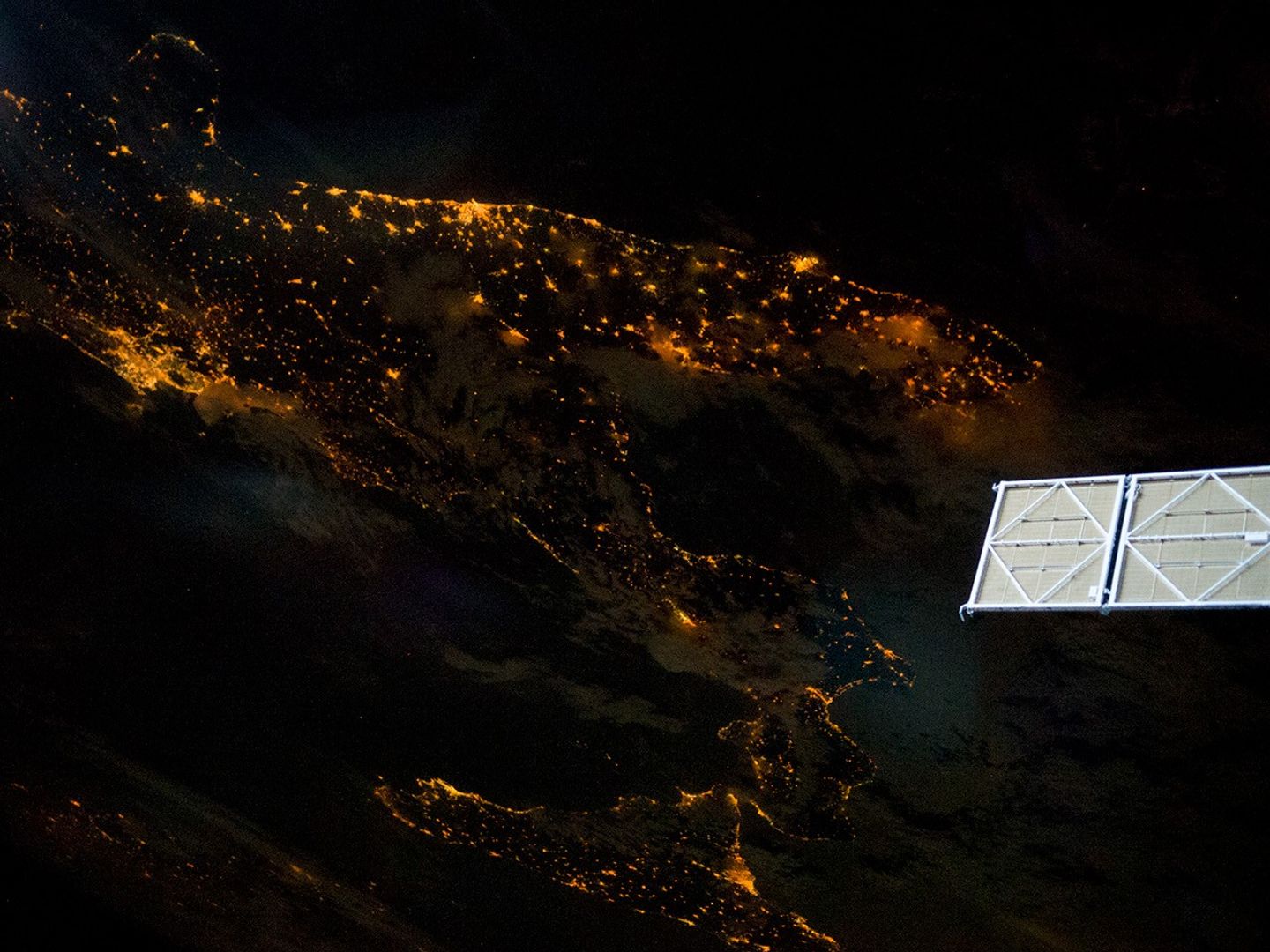
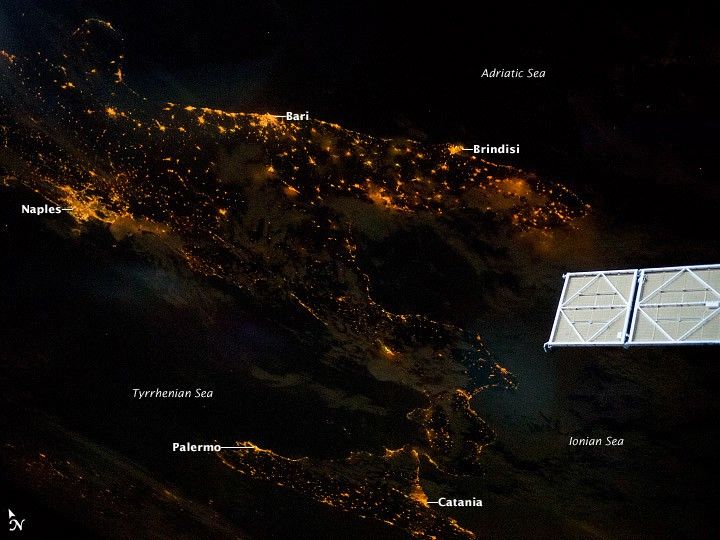
This astronaut photograph highlights the nighttime appearance of the southern Italian Peninsula. The toe and heel of Italy’s “boot” are clearly defined by the lights of large cities such as Naples, Bari, and Brindisi, as well as numerous smaller cities and towns. The bordering Adriatic, Tyrrhenian, and Ionian Seas appear as dark regions to the east, west, and south. The city lights of Palermo and Catania, Sicily, are also visible.
The International Space Station (ISS) was located over an area of Romania, close to the capital city of Bucharest (approximately 945 kilometers to the northeast) at the time this image was taken. Part of a solar panel array on a docked Russian spacecraft is visible in the foreground. The distance between the image subject area and the position of the photographer, as well as the viewing angle looking outwards from the ISS, contributes to the foreshortened appearance of the Italian Peninsula and Sicily.
References & Resources
Astronaut photograph ISS028-E-8604 was acquired on June 11, 2011, with a Nikon D3S digital camera using a 35 mm lens, and is provided by the ISS Crew Earth Observations experiment and Image Science & Analysis Laboratory, Johnson Space Center. The image was taken by the Expedition 28 crew. The image has been cropped and enhanced to improve contrast. Lens artifacts have been removed. The International Space Station Program supports the laboratory as part of the ISS National Lab to help astronauts take pictures of Earth that will be of the greatest value to scientists and the public, and to make those images freely available on the Internet. Additional images taken by astronauts and cosmonauts can be viewed at the NASA/JSC Gateway to Astronaut Photography of Earth. Caption by William L. Stefanov, Jacobs/ESCG at NASA-JSC.