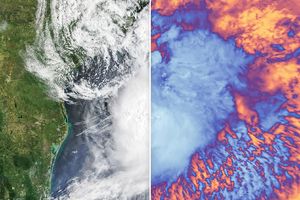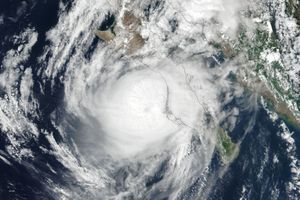





















After making landfall in North Carolina on August 27, 2011, Hurricane Irene traveled northward. By August 28, the storm was over the U.S. Northeast. The Moderate Resolution Imaging Spectroradiometer (MODIS) on NASA’s Aqua satellite captured this natural-color image the same day. Irene extends far inland, covering several states. The U.S. coastline and state borders are delineated in black.
Although damage from Irene was less than feared and the storm largely spared big cities, it nevertheless caused severe destruction in multiple states. Some of the worst damage actually occurred hundreds of miles inland, in the form of heavy rains and floods.
The U.S. Federal Emergency Management Agency stated that Vermont and New York had both experienced record flooding, according to multiple news reports. Rivers and creeks bursting their banks had swept away trees, automobiles, and even parts of some historic bridges. Concern for the U.S. Northeast was heightened by the fact that some rivers had not yet crested by August 29.
The PBS NewsHour reported that the storm had disrupted power to almost 7.5 million homes and businesses along the East Coast, and some people could be without power for a week or longer. As of August 29, the Associated Press reported, Irene had caused at least 40 deaths in 11 states.
On August 29, 2011, National Geographic Daily News reported that Irene “accumulated a rare combination of meteorological lucky breaks” that enabled it to last longer than expected and cover an unusually large area. Over the Bahamas, Irene encountered low atmospheric pressure that pushed warm, moist air upward, fueling the storm. Once Irene made landfall in the continental United States, dry air diffused the storm, causing it to affect a wider area. Meanwhile, the jet stream—a narrow band of high-atmosphere winds that can weaken or dissipate cyclones—kept far enough away to avoid weakening Irene, and close enough to actually enhance its power.
At 11:00 p.m. Eastern Daylight Time on August 28, Irene finally became a post-tropical cyclone near the U.S.-Canadian border, the U.S. National Hurricane Center reported.
References & Resources
- Drye, W. (2011, August 29). Why Irene was more dangerous than it should have been. National Geographic Daily News. Accessed August 30, 2011.
- Goodnough, A., Hakim, D. (2011, August 29). Storm’s push north leaves punishing inland floods. The New York Times. Accessed August 30, 2011.
- National Hurricane Center. (2011, August 29). Hurricane Irene Advisory Archive. Accessed August 30, 2011.
- PBS NewsHour. (2011, August 29). Hurricane Irene’s cost may hit $7B as pricey East Coast cleanup begins. Accessed August 30, 2011.
- Voice of America. (2011, August 29). Record floods affect U.S. Northeast after Irene. Accessed August 30, 2011.
NASA image courtesy MODIS Rapid Response Team, Goddard Space Flight Center. Caption by Michon Scott.