










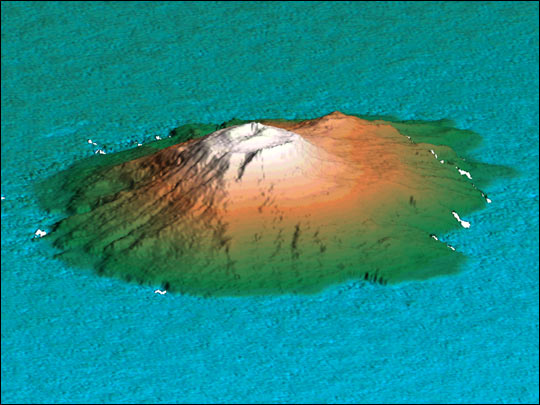
This 3D perspective view shows the Japanese island called Miyake-Jimaviewed from the northeast. This island—about 180 kilometers (110miles) south of Tokyo—is part of the Izu chain of volcanic islandsthat runs south from the main Japanese island of Honshu. Dominated bythe 820-meter-high (2,700 feet) volcano Mount Oyama, Miyake-Jima is hometo 3,800 people. In late June 2000, a series of earthquakes alertedscientists to possible volcanic activity and on June 27 authoritiesevacuated 2,600 people. On July 7, the island was hit by a typhoonpassing overhead, and on July 8 the volcano began erupting. The volcanoerupted five times over the next week, spreading gray ash oversurrounding areas. Detailed topographic information can be used topredict the directions that lava flows will take. The previous majoreruption of Mount Oyama occurred in 1983, when lava flows destroyedhundreds of houses, and an earlier eruption in 1940 killed 11 people.
This three-dimensional perspective view was generated using topographicdata from the Shuttle Radar Topography Mission. A computer-generatedartificial light source illuminates the elevation data to produce apattern of light and shadows, while colors show the elevation asmeasured by SRTM. Slopes facing the light appear bright, while thosefacing away are shaded. On flatter surfaces, the pattern of light andshadows can reveal subtle features in the terrain. The elevation isindicated by colors. Lowest elevation areas appear blue, mediumelevations appear green, while higher elevations appear brown and white.
The Shuttle Radar Topography Mission (SRTM), launched on February 11,2000, used the same radar instrument that comprised the SpaceborneImaging Radar-C/X-Band Synthetic Aperture Radar (SIR-C/X-SAR) that flewtwice on the Space Shuttle Endeavour in 1994. SRTM was designed tocollect three-dimensional measurements of the Earth's surface. Tocollect the 3-D data, engineers added a 60-meter-long (200-foot) mast,installed additional C-band and X-band antennas, and improved trackingand navigation devices. The mission is a cooperative project between theNational Aeronautics and Space Administration (NASA), the NationalImagery and Mapping Agency (NIMA) of the U.S. Department of Defense(DoD), and the German and Italian space agencies. It is managed byNASA's Jet Propulsion Laboratory, Pasadena, CA, for NASA's Earth ScienceEnterprise, Washington, DC.
Site name: Miyake-Jima, Japan
Size: Scale varies in this perspectiveimage, island has an area of 55 square kilometers (21 square miles).Vertical scale approximately equal to horizontal scale.
Center Location:34.1 deg. North lat., 139.5 deg. East lon.
Orientation: perspective viewis looking from northeast towards the southwest Original Data
Resolution: 30 m
Date Acquired: February 20, 2000
References & Resources
Image by NASA/JPL/NIMA
None