













Not all glaciers are made of ice. Some glaciers are made of rock. More accurately, they are composed of a combination of ice and rock. Opinions vary on how rock glaciers form, but geologists generally agree that one condition necessary for the formation and longevity of these natural formations is a climate cold enough to sustain permafrost. Rock glaciers that are big enough to have their own internal microclimates can maintain cool temperatures for some time, even when local temperatures are rising. Compared to ordinary glaciers, rock glaciers are rare, and may look like a rocky field shaped like a glacier. While regular glaciers flow, rock glaciers “creep.”
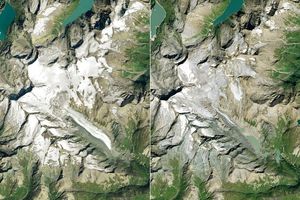
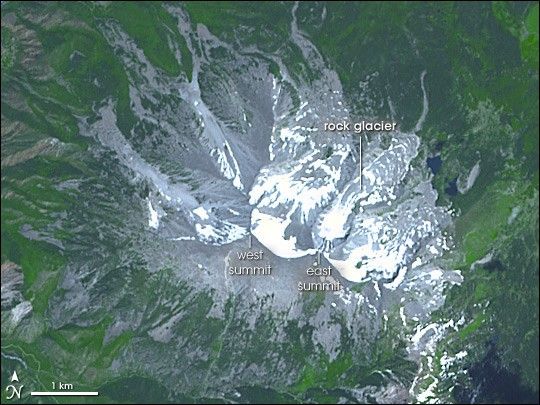
Some fine examples of rock glaciers live in Colorado, including this glacier on the slope of Mount Sopris in the Elk Mountains, in the western part of the state. The Advanced Spaceborne Thermal Emission and Reflection Radiometer (ASTER) on NASA’s Terra satellite acquired this image on July 8, 2006. This is a false-color image that mimics photo-like, natural color. Green indicates vegetation, dark blue indicates water, gray indicates bare rock, and white indicates ice or snow. Shaped vaguely like an amphitheatre but stretched out like putty, the rock glacier stretches off the northeast slope of Mount Sopris’s east summit. Not far from the glacier’s tip is lush-looking vegetation. Off the east edge of the glacier are some small bodies of water. The rate of movement for rock glaciers can vary, depending on each glacier’s composition, underlying slope, and local weather conditions. In Colorado, the creep rates of rock glaciers range from less than 20 centimeters (8 inches) to more than 61 centimeters (24 inches) per year.
- Matthews, V., KellerLynn, K., and Fox, B., Eds. (2003). Messages in Stone: Colorado’s Colorful Geology. Denver: Colorado Geological Survey.
- About Geology. Rock Glacier. Accessed August 24, 2006.
- Frauenfelder, R. Regional-scale Modelling of the Occurrence and Dynamics of Rockglaciers and the Distribution of Paleopermafrost. Accessed October 11, 2006.
References & Resources
NASA image created by Jesse Allen, Earth Observatory, using data provided courtesy of the NASA/GSFC/MITI/ERSDAC/JAROS, and U.S./Japan ASTER Science Team.