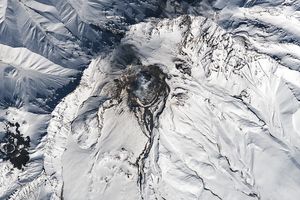

























There are subtle signs of a new eruption brewing on Russia’s Kamchatka Peninsula. The Earth-Observing 1 satellite captured ash above Zhupanovsky Volcano on November 5, 2013 (top image). According to the Global Volcanism Program, the explosions at Zhupanovksy are phreatic, caused by the nearly instantaneous vaporization of water with hot material below the surface.
In this natural-color image, snow on the high-altitdue ridges is white, ash is light gray, bare rock is tan, and the deeply shadowed northern slopes of Zhupanovsky Massif are blue.
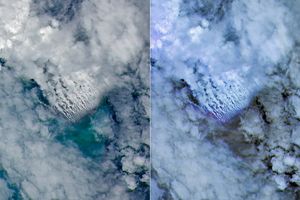
On October 26, 2013, the Moderate Resolution Imaging Spectroradiometer (MODIS) aboard the Terra satellite spied a streak of dark material on Zhupanovsky’s north face. The Kamchatka Volcanic Eruption Response Team reported ash plumes up to 5 kilometers (3 miles) high and a weak “thermal anomaly” (infrared heat detected by satellite) from October 23 through 26. The explosions were followed by gas and steam emissions from fumaroles—a common feature of Zhupanovsky.
References & Resources
NASA Earth Observatory image by Jesse Allen and Robert Simmon, using EO-1 ALI data from the NASA EO-1 team. Caption by Robert Simmon.