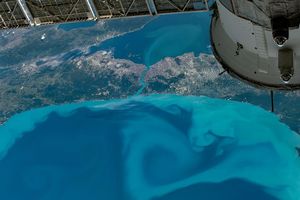




























This brilliant cyan pattern scattered across the surface of the Black Sea is a bloom of microscopic phytoplankton. The multitude of single-celled algae in this image are most likely coccolithophores, one of Earth’s champions of carbon pumping. Coccolithophores constantly remove carbon dioxide from the atmosphere and slowly send it down to the seafloor, an action that helps to stabilize the Earth's climate.
This image of this swirling blue bloom was captured on July 15, 2012, by the Moderate Resolution Imaging Spectroradiometer (MODIS) on NASA’s Aqua satellite. Note that the image is rotated so that north is to the right. Ocean scientist Norman Kuring of NASA’s Goddard Space Flight Center suggested the bloom was likely Emiliania huxleyi, though it is impossible to know the species for sure without direct sampling of the water.
Coccolithophores use carbon, calcium, and oxygen to produce tiny plates of calcium carbonate (coccoliths). Often called “stones” by researchers, coccoliths resemble hubcaps. During their lifespan, coccolithophores remove carbon from the air, “fix” or integrate it into what is effectively limestone, and take it with them to the seafloor when they die and sink or when they are consumed (and eventually excreted) by zooplankton and fish.
These micro-stones are thought to speed up the ocean’s biological pump, according to William Balch, a senior research scientist at the Bigelow Laboratory for Ocean Sciences and a member of the Suomi NPP science team. Without this dense calcium carbonate ballast for sinking particles to the depths, less carbon dioxide would be drawn down into the ocean. The net result would be higher atmospheric concentrations of carbon dioxide.
But as Balch points out, the ever-increasing amount of carbon dioxide in our air could upset this biological pump. Excess carbon dioxide is making the ocean more acidic, which may change the conditions that promote coccolithophore growth. “Ocean acidification is highly relevant to coccolithophores,” said Balch. “We are trying to understand if it would slow the ocean’s biological pump by inhibiting coccolithophore calcification. If they can’t calcify, they can’t make their limestone plates that pull all the sinking particulate carbon to the seafloor.”
Further Reading
- NASA Earth Observatory (2010, July 13) What are Phytoplankton?
- NASA Earth Observatory (2012, May 19) Bloomin' Black Sea
- NASA Earth Observatory (2011, June 16) The Carbon Cycle
References & Resources
NASA image courtesy Norman Kuring, Ocean Color Web. Caption by Laura Betz, with image interpretation by Norman Kuring.