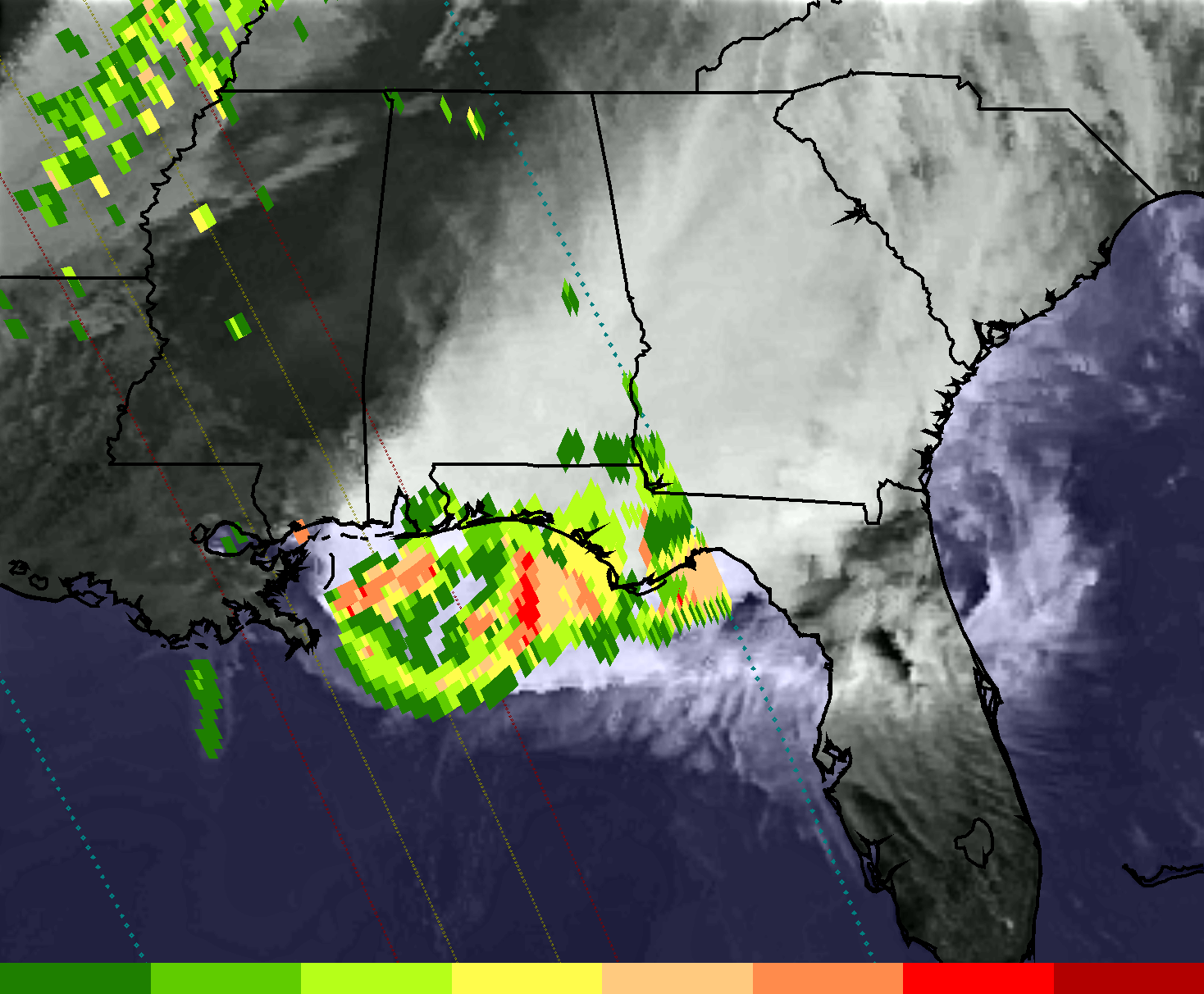

























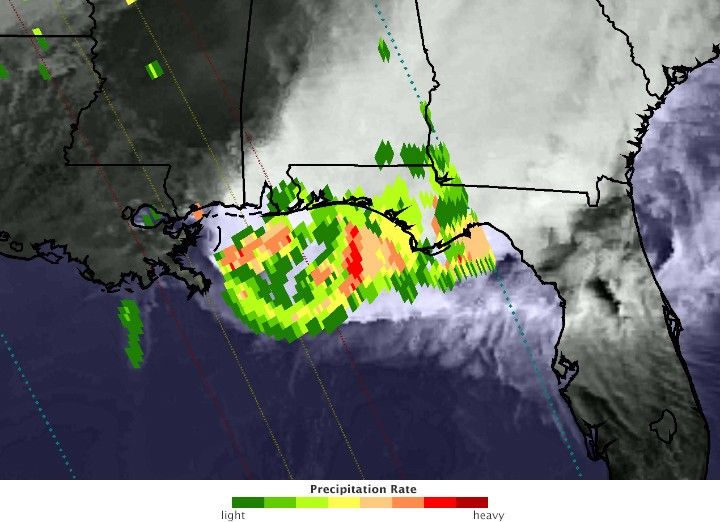
On April 29, 2014, the Global Precipitation Measurement (GPM) satellite observed the heavy rain thatinundated the southeastern and eastern United States and produced floods near Pensacola, Florida. The National Weather Service reported record-setting rainfall of more than 380 mm (15 inches) in Pensacola.
This image shows GPM Microwave Imager (GMI) rainfall estimates (green to red) superimposed on infrared observations (showing clouds and land) over the southeastern United States. Because the GPM satellite was launched only two months ago, rainfall-estimation algorithms are currently undergoing a checkout period. For this reason, the scale indicates only qualitative information with green for light rain and red for heavy rain.
This GPM data was collected during a single satellite overpass shortly after noon local time, providing a snapshot of rain rates at that time. The outer blue dotted lines show the width of observations from the GMI instrument, while the two inner lines represent the area measured by the Ka-band (inner lines) and Ku-band (outer lines) of the Dual-Frequency Precipitation Radar. Once the radar data become available, they will help provide a three-dimensional view of rain, ice, and snow in the atmosphere.
References & Resources
GPM data courtesy of NASA and JAXA. Image and caption by Owen Kelley.