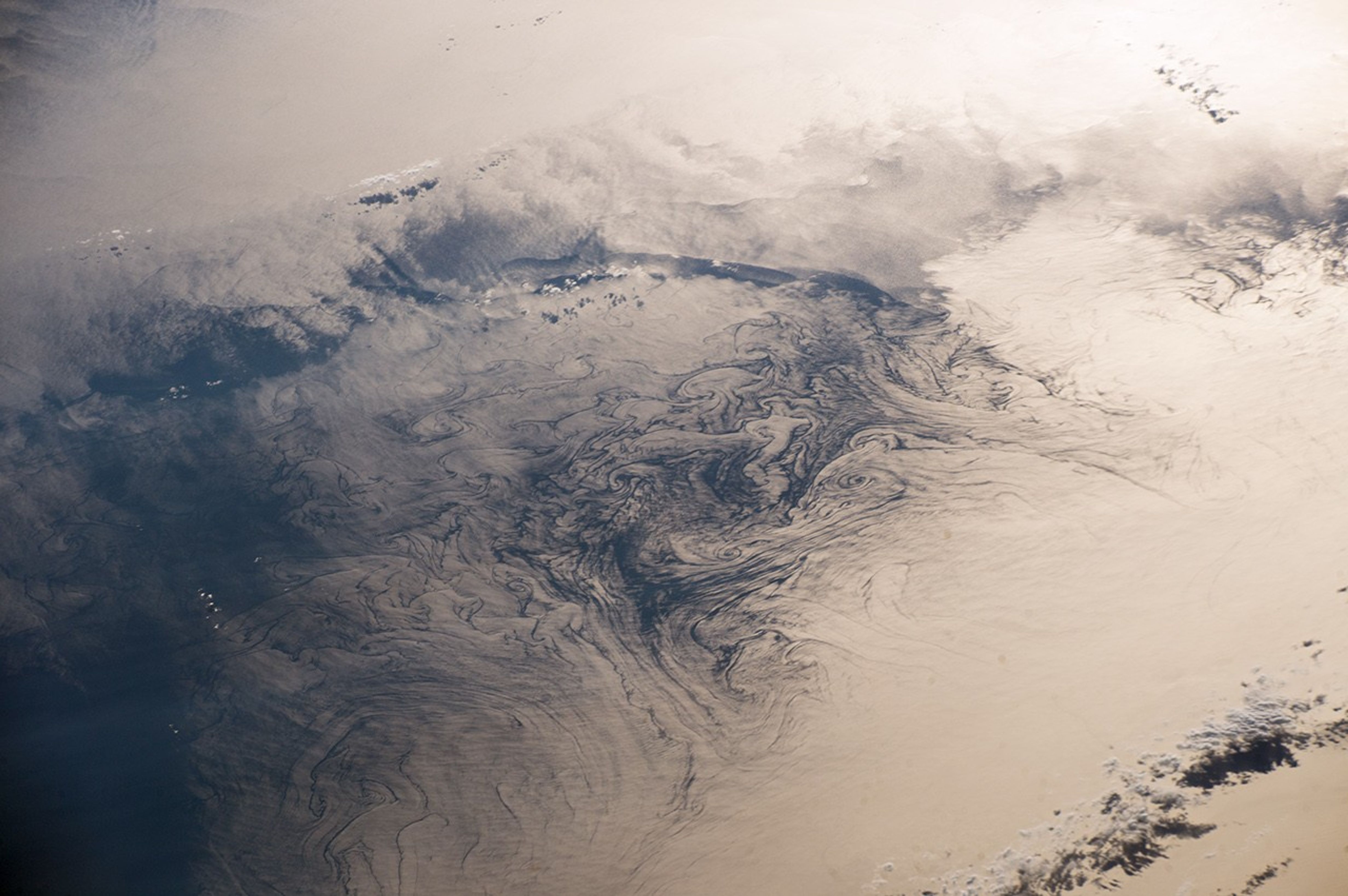

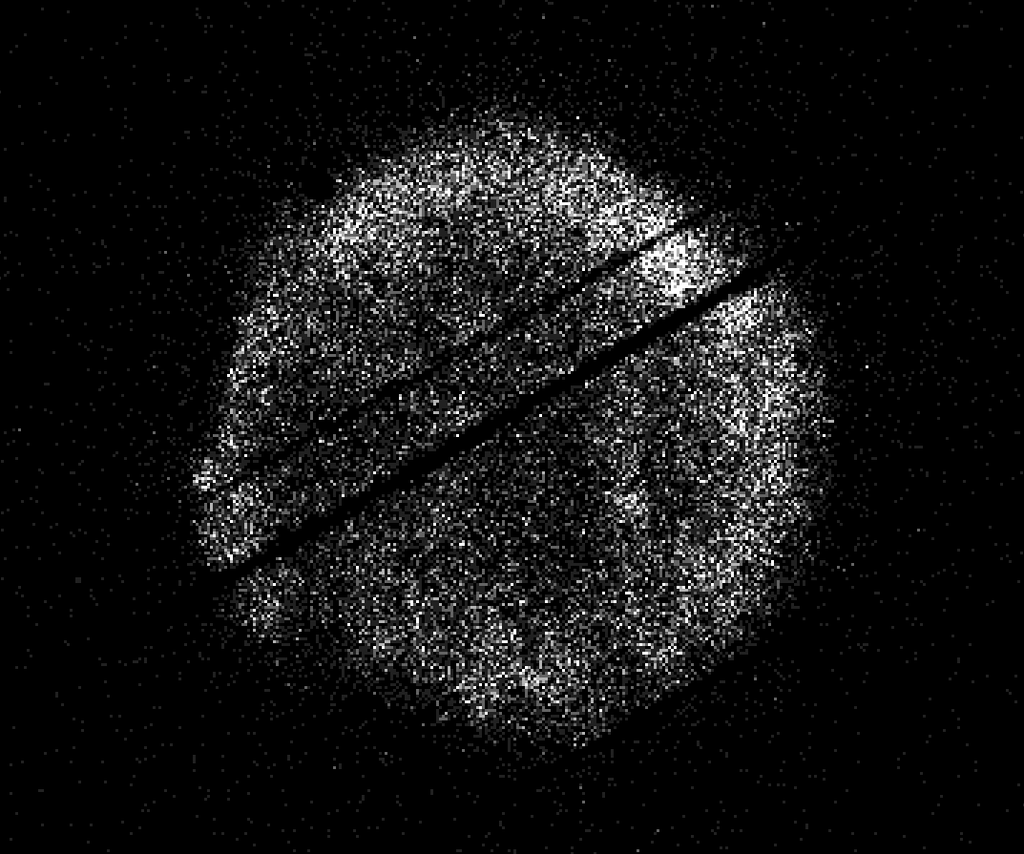












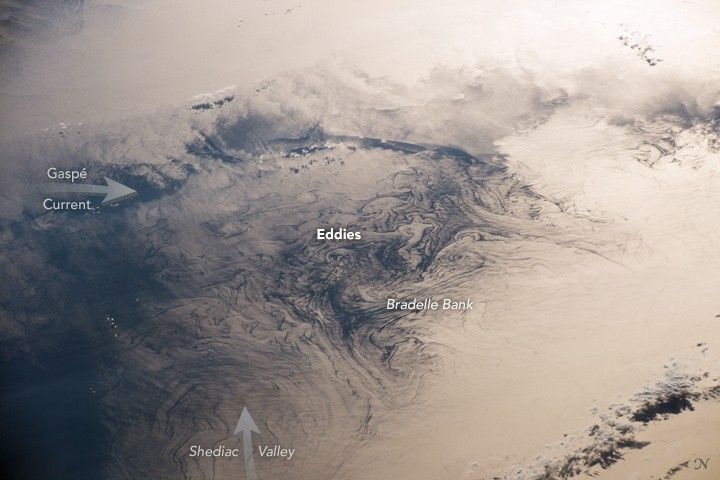
Orbiting above eastern North America, a crew member on the International Space Station photographed a dense pattern of eddies in the Gulf of St. Lawrence. Caught briefly in the Sun’s “glint point,” reflections off the water surface show an interlinked mass of swirls and eddies in the shallow water north of Prince Edward Island. The swirls are generated by the complicated flows in the Gulf.
The stronger flow at the time of this image was coming out of an underwater channel known as the Shediac Valley. This flow appears as a broad mushroom-head of concentric lines (lower middle). Weaker flows appear as smaller, tighter swirls, all with a counterclockwise rotation, in the center and top right of the image. These eddies formed on the shallow part of the Gulf known as the Bradelle Bank; they are caught up in the slow drift of the main west-to-east Gaspé Current.
The swirls disappear across the top and lower right of the image because the brilliant center of the Sun’s reflection point washes out all detail. Astronauts are trained to focus on the half-glint zone—such as the image center—where water features appear with greater clarity.
Small lines of cloud (lower right and upper left) cast shadows on the water in the dawn light.
Sunglint is a constant part of the view from the space station, so sunglint photography is part of an astronauts’ training. A comparison of astronaut images taken 30 seconds apart shows how the view of a place can change, and how astronauts must adapt during photographic sessions.
References & Resources
Astronaut photograph ISS048-E-71829 was acquired on September 4, 2016, with a Nikon D4 digital camera using a 400 millimeter lens, and is provided by the ISS Crew Earth Observations Facility and the Earth Science and Remote Sensing Unit, Johnson Space Center. The image was taken by a member of the Expedition 48 crew. The image has been cropped and enhanced to improve contrast, and lens artifacts have been removed. The International Space Station Program supports the laboratory as part of the ISS National Lab to help astronauts take pictures of Earth that will be of the greatest value to scientists and the public, and to make those images freely available on the Internet. Additional images taken by astronauts and cosmonauts can be viewed at the NASA/JSC Gateway to Astronaut Photography of Earth. Caption by M. Justin Wilkinson, Texas State University, Jacobs Contract at NASA-JSC.