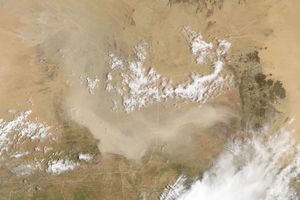



















When the Moderate Resolution Imaging Spectroradiometer (MODIS) on NASA’s Aqua satellite passed over the Mediterranean Sea on November 7, 2014, a storm churned off the coast of Libya. The weather front stirred up southwest winds that blew plumes of Saharan dust over the sea.
Dust storms can have significant local effects. Large amounts of airborne dust contribute to air pollution, reduce visibility, cause airport closures, and increase the risk of traffic accidents. They also can reduce soil fertility, damage crops, decrease the efficiency of solar devices, and damage telecommunications equipment.
Dust also plays important roles in the global environment. It provides the ocean with minerals and nutrients that affect water chemistry and marine food webs. Dust aerosols also affect Earth’s radiative balance through the absorption and scattering of incoming sunlight and outgoing terrestrial radiation.
References & Resources
- Scheuvens, D. (2013, January) Bulk composition of northern African dust and its source sediments—A compilation. Earth-Science Reviews. 16, 170-194.
- NASA Earth Observatory (2012, May 21) What controls the Thickness of a Storm’s Dust?
- Washington Post (2014, November 7) Wicked Mediterranean storm whips up 95 mph wind gusts in Malta. Accessed November 11, 2014.
NASA image courtesy Jeff Schmaltz, LANCE MODIS Rapid Response Team at NASA GSFC. Caption by Adam Voiland.