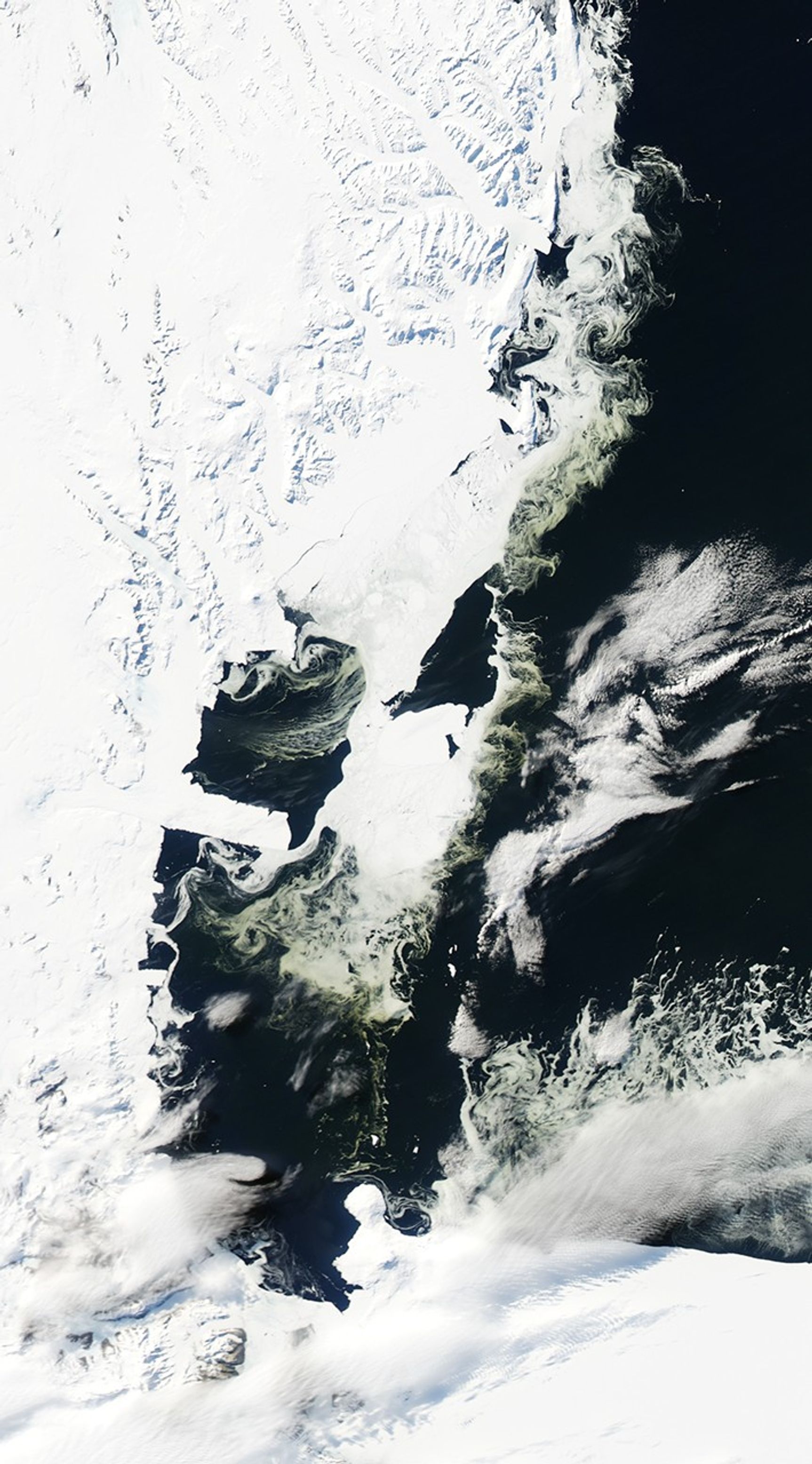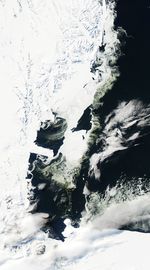





















It was late summer in the Southern Hemisphere when the Moderate Resolution Imaging Spectroradiometer (MODIS) on NASA’s Aqua satellite captured this photo-like image of Antarctica’s Ross Sea (left). Although the sea’s ink-black waters and snow-blanketed terrain hardly resemble the lush greenscape that says “summer” to those who live in the mid-latitudes, the image does reveal a subtler sign of the growing season: the yellowish-green tinge of some of the sea ice is probably a bloom of algae.
In polar environments, tiny algae and other plant-like organisms that are the foundation of the ocean food web grow not just in the open ocean, but also within brine-filled pores and cracks in the sea ice. In the winter, sea ice insulates the water below, keeping it above freezing. Algae growing on the bottom of the ice can grow into long filaments that trail into the water. As the ice melts, and currents and tides jostle and crush the sea ice into slush and small pieces, the algae are released into the surface water. Blooms of algae and phytoplankton often occur along the ice edge.
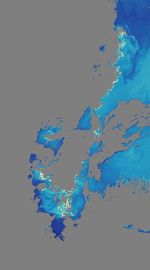
Although the bloom of phytoplankton is not apparent in the water in the photo-like image on the left, a matching image of the chlorophyll concentration in the open water tells a different story. Sea ice and clouds have been masked out with dark gray. Chlorophyll concentrations appear in shades of light blue (low amounts) to yellow (high amounts). A yellow border of high chlorophyll concentrations outlines the ice that appears yellowish green in the photo-like image. A line of elevated chlorophyll stretches from the edge of the ice to the tip of Ross Island, matching the line of yellow-green ice that is visible in the same place of the photo-like image.
In addition to their importance to the marine food web in the Antarctic and the carbon cycle, these ice-bound algae and other organisms that make their homes in Antarctic sea ice are intriguing to NASA scientists because they are an example of an extremophile, a living creature that lives in an extremely harsh environment. Scientists study these organisms’ adaptations to their hostile environments to gain clues to where and how life may exist elsewhere in the universe.
References & Resources
NASA images by Jesse Allen, using MODIS data obtained courtesy of the Goddard Land Processes data archives (LAADS) and the SeaWiFS Project . Caption by Rebecca Lindsey, based on interpretation provided by Robert Massom, Australian Antarctic Division and Antarctic Climate and Ecosystems CRC, Australia; and Claire Parkinson, NASA-GSFC.