





















Wild ginseng is an inconspicuous understory plant that grows in shady, moist hardwood forests in Asia and North America. In many Asian cultures, ginseng is thought to have curative properties, a long-held belief that has driven demand so high that it is rare for the plant to be found in the wild in most of Asia.
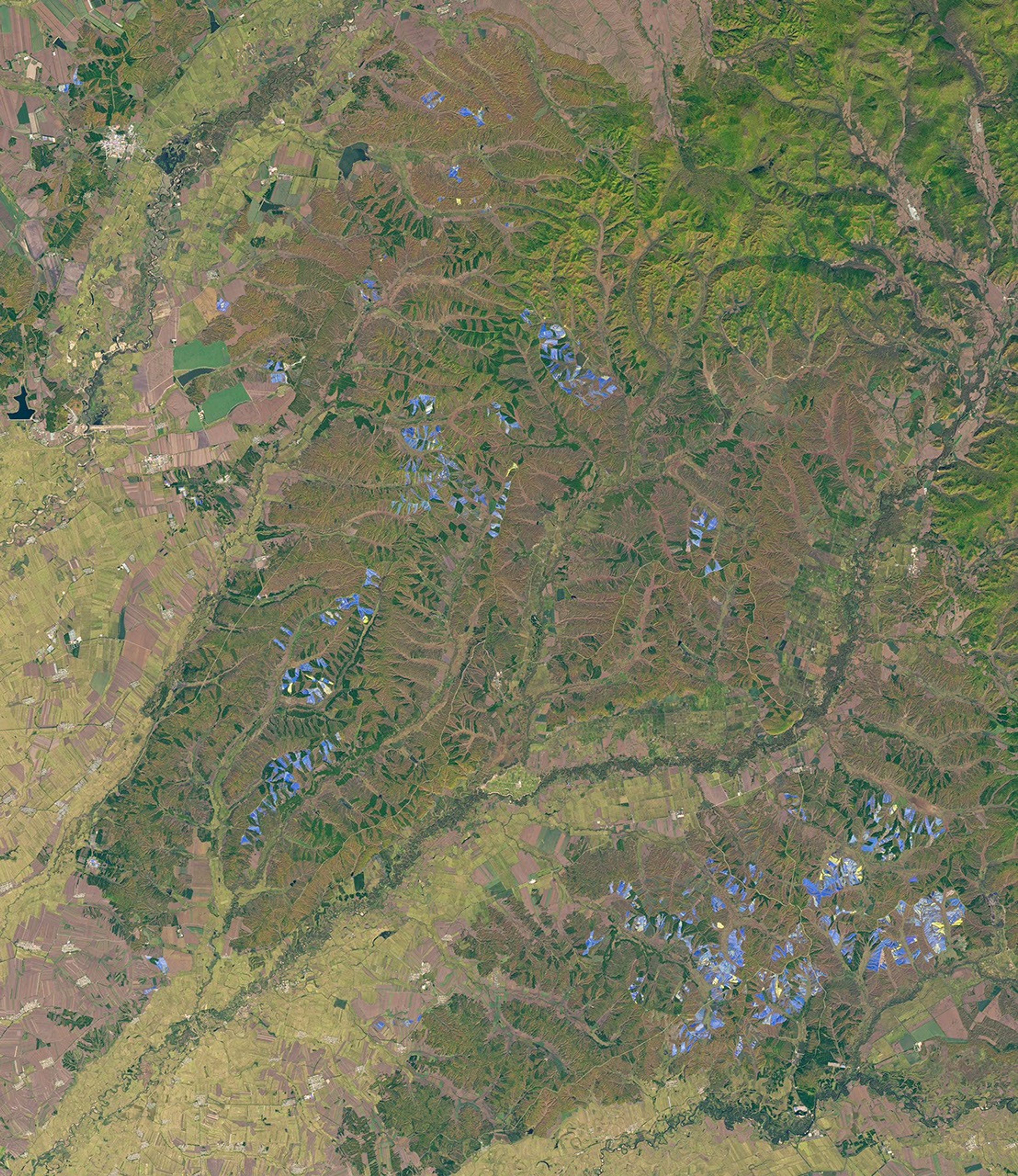
Instead, a multi-billion dollar market for farmed ginseng has emerged. In some parts of China, ginseng farming is easily visible from space. On September 25, 2017, the Operational Land Imager (OLI) on Landsat 8 captured this image of purple and yellow shade covers for ginseng crops amidst browning hills and farmland in Heilongjiang province in northeastern China. Shade covers are used because the plants cannot tolerate direct sunlight. The image is centered on fields about 20 kilometers northwest of Tieli.
China is the world’s leading producer of ginseng. Much of China’s crop comes from northeastern China, particularly Jilan and Heilongjiang provinces. Other leading producers include Korea, Canada, and the United States.
Beneath the shade covers, it is possible that growers are raising American ginseng (Panax quinquefolius)—a type that is native to North America but popular in China. American ginseng has higher concentrations of ginsenosides—the active ingredients thought to be associated with health benefits—than the species that is indigenous to Asia (Panax ginseng).
The trend toward the cultivation of American ginseng in China has had an effect on American growers, many of whom are located in Wisconsin. As production in Heilongjiang and other parts of China and the world expanded in the 1990s, prices for American-grown ginseng dropped, according to a report from Virginia State University. However, demand for wild American ginseng is as high as ever because it is thought to be particularly potent.
References & Resources
- Baeg, I. & So, H. (2013) The world ginseng market and the ginseng (Korea). Journal of Ginseng Research, 37 (1), 1-7).
- Davis, J. & Persons, S. (2014) Growing and Marketing Ginseng, Goldenseal and other Woodland Medicinals Paperback. (New Society Publishers: Gabriola Island, Canada).
- Foreign Policy (2016, September 7) China’s Gold Rush in the Hills of Appalachia. Accessed November 3, 2017.
- Li, T. (1995) Asian and American Ginseng — A Review. Hort Technology, 5 (1).
- Smithsonian (2016, April 21) The Fight Against Ginseng Poaching in the Great Smoky Mountains. Accessed November 3, 2017.
- University of Arkansas Ginseng. Accessed November 3, 2017.
- Vice (2015, March 2) China Is Paying Top Dollar for American Ginseng That Might Be Chinese. Accessed November 3, 2017.
- Virginia Cooperative Extension Producing and Marketing Wild Simulated Ginseng in Forest and Agroforestry Systems. Accessed November 3, 2017.
- Wisconsin State Journal (2015, October 25) Ginseng continues rebound in central Wisconsin. Accessed November 9, 2017.
NASA Earth Observatory image by Joshua Stevvens, using Landsat data from the U.S. Geological Survey . Story by Adam Voiland, with information from Jinwei Dong (University of Oklahoma).