

























Although some red tides form a healthy part of phytoplankton production,recurrent harmful or toxic blooms also occur, with results depending upon thetype of plankton and on atmospheric and oceanic conditions. At Elands Bay inSouth Africa’s Western Cape province, about 1000 tons of rock lobsters beachedthemselves during February 2002, when the decay of dense blooms of phytoplanktoncaused a rapid reduction in the oxygen concentration of nearshore waters. Thelobsters (or crayfish, as they are known locally) moved toward the breaking surfin search of oxygen, but were stranded by the retreating tide.
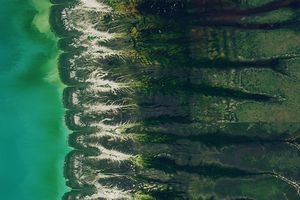
The Multi-angle Imaging SpectroRadiometer’s nadir camera acquired these red,green, blue composites on February 2 and 18, 2002, during Terra orbits 11315 and11548. The colors have been accentuated to highlight the bloom, and land andwater have been enhanced separately. The two views show the shoreward migrationof the algal bloom. Each image represents an area of about 205 kilometers x 330kilometers. Elands Bay is situated near the mouth of the Doring River, about 75kilometers northeast of the jutting Cape Columbine.
The term “red tide” is used to refer to a number of different types ofphytoplankton blooms of various hues. The wine color of certain parts of thisbloom are consistent with the ciliate species Mesodinium rubrum, which has beenassociated with recurring harmful algal blooms along the Western Cape coast.Under these conditions, the lobsters are not poisoned. During the recent event,government and military staff transported as many of the living lobsters aspossible to areas that were less affected by the red tide. At the same time,people came from across South Africa to gather the undersized creatures forfood. The effects of the losses on the maritime economy are expected to be feltover the next few years.
References & Resources
Image courtesy NASA/GSFC/LaRC/JPL, MISR Team.