

























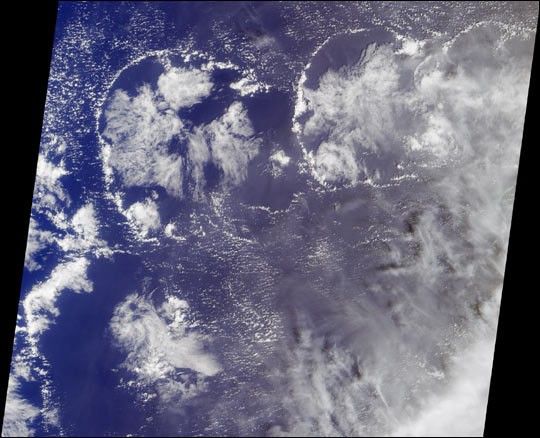
Small cumulus clouds in this natural-color view from the Multi-angle ImagingSpectroRadiometer (MISR) have formed a distinctive series of quasi-circular arcs. Cluesregarding the formation of these arcs can be found by noting that larger cloudsexist in the interior of each arc.
The interior clouds are thicker and likely to be more convectively activethan the other clouds, causing much of the air near the centers of the arcs torise. This air spreads out horizontally in all directions as it rises andcontinues to spread out as it begins to sink back to the surface. This pushesany existing small cumulus clouds away from the central region of convection.
As the air sinks, it also warms, preventing other small clouds from forming,so that the regions just inside the arcs are kept clear. At the arcs, thehorizontal flow of sinking air is now quite weak and on meeting the undisturbedair it can rise again slightly—possibly assisting in the formation of newsmall cumulus clouds. Although examples of the continuity of air, in which everyrising air motion must be compensated by a sinking motion elsewhere, are verycommon, the degree of organization exhibited here is relatively rare, as thewind field at different altitudes usually disrupts such patterns. The degree ofself organization of this cloud image, whereby three or four such circularevents form a quasi-periodic pattern, probably also requires a relativelyuncommon combination of wind, temperature and humidity conditions for it tooccur.
The image was acquired by MISR’s nadir camera on March 11, 2002, and iscentered west of the Marshall Islands. Enewetak Atoll is discernible throughthin cloud as the turquoise band near the right-hand edge of the image.
The Multi-angle Imaging SpectroRadiometer observes the daylit Earthcontinuously from pole to pole, and views almost the entire globe every 9 days.This image covers an area of about 380 kilometers x 345 kilometers.
References & Resources
Image courtesy NASA/GSFC/LaRC/JPL, MISR Team.