



























July 29, 2024-February 22, 2025
The Making of Ski Troopers at Camp Hale
Today’s story is the answer to the April 2025 puzzler.
During the Winter War of 1939-1940, Finnish troops used their skiing prowess to their advantage against Soviet troops. The U.S. Army took note and later established a division of winter-ready troops of its own.
The 87th Mountain Infantry conducted initial winter training on Mount Rainier in Washington, but in 1942 the Army began construction on a larger high-elevation training base in Pando, a small town in Colorado situated at 9,200 feet (2,800 meters). At the time, Pando consisted of only a few cabins scattered across an alpine meadow in the Eagle River Valley. Yet it had rail access, steep mountains, and received more than 20 feet (6 meters) of snow per year.
To create Camp Hale, engineers cleared and drained wetland meadows along the river, imported millions of cubic yards of fill, and constructed hundreds of buildings. The 87th Mountain Infantry was transferred there and served as the backbone for a larger, reconstituted unit—the 10th Mountain Division. This division trained at Camp Hale for two years before deploying to Europe.
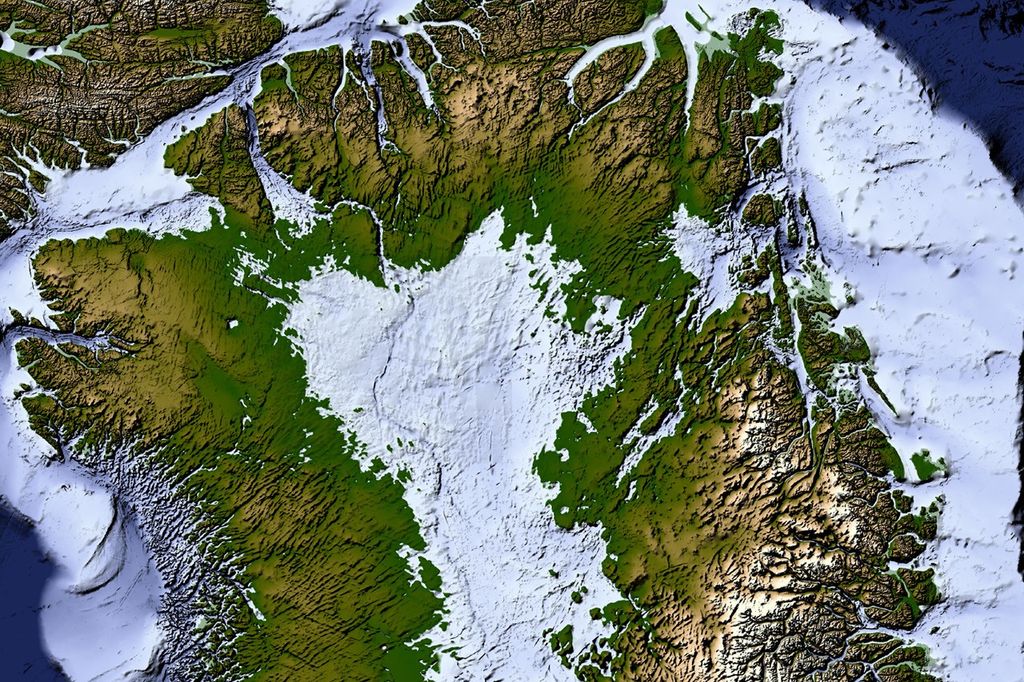
In these satellite images, the rugged terrain surrounding the historic Camp Hale site is shown in the summer and winter. The OLI (Operational Land Imager) on Landsat 8 acquired the summer image (left) on July 29, 2024; the same sensor acquired the winter image (right) on February 22, 2025.
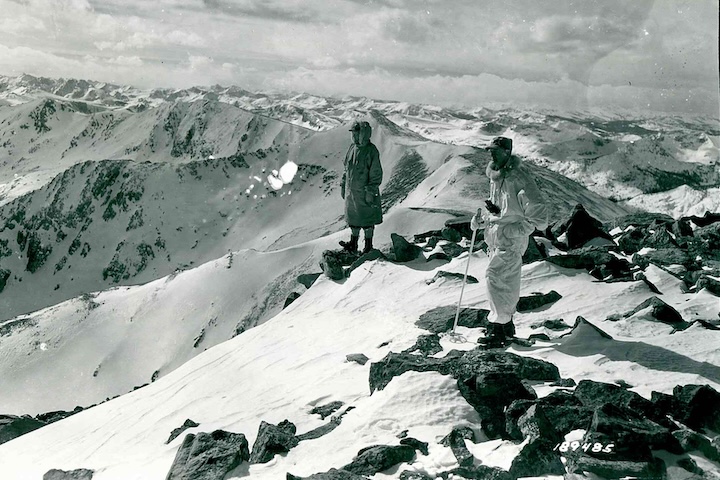
The harsh environment made the site an ideal place to acclimate recruits to thin, high-elevation air and to train them for combat in snowy, inhospitable terrain. When it was in full operation, more than 15,000 men trained at Camp Hale, with recruits honing their downhill and Nordic skiing, mountain climbing, and cold-weather survival skills. In the photograph below, taken in spring 1943, two men who trained at Camp Hale look out from above the timberline.
After being deployed to Italy, thousands of troops from the division fought in winter conditions during the Battle of Riva Ridge and the Battle of Mount Belvedere in the Apennine Mountains in 1945. Among them were hundreds of men who, during the dark of night, scaled a 1,500-foot cliff that was considered unclimbable on the way to defeating five German divisions in the final months of the war. Although the 10th Mountain Division suffered heavy casualties, they never lost a battle or ground during combat.
Most of Camp Hale’s buildings were torn down after the war, but remnants of the original layout and the ski slope where soldiers trained (now called Ski Cooper) a few miles south of the site are still visible in the Landsat images. Also prominent in the summer scene is an open-pit mine and nearby tailings ponds. The mine, served by the same railroad as Camp Hale, has long been a source of molybdenum, which is used to make high-strength steel. During World War II, demand for molybdenum ballooned because it was widely used in ships, tanks, aircraft, and ammunition.
The area was designated Camp Hale-Continental Divide National Monument in 2022. It honors the division’s military contributions and its role in launching U.S. skiing and outdoor recreation. Veterans of the 10th Mountain Division went on to establish dozens of ski resorts across the U.S. after returning from the war, including in Vail, Aspen, and Arapahoe Basin.
References & Resources
- The Army University Press (2020) Art of War Papers: Forging the 10th Mountain Division for War, 1940-45. Accessed April 9, 2025.
- The Center for Land Use Interpretation Camp Hale. Accessed April 9, 2025.
- Colorado Encyclopedia Climax Molybdenum Mine. Accessed April 9, 2025.
- GovInfo (2022, October 12) A Proclamation on Establishment of the Camp Hale-Continental Divide National Monument. Accessed April 9, 2025.
- History Colorado (2022, October 7) Building Camp Hale: A Deeper History of America’s High-Altitude Army Training Ground. Accessed April 9, 2025.
- Mountain Town Magazine (2013) The 10th Mountain Division and the Ski Trooper. Accessed April 9, 2025.
- National Archives (2023, January 10) Camp Hale, Colorado: Training the 10th Mountain Division During World War II. Accessed April 9, 2025.
- National Forests Camp Hale: Eagle River Headwaters Restoration Project. Accessed April 9, 2025.
- U.S. Army (2015, February 19) Bootprints in History: Mountaineers take the Ridge. Accessed April 9, 2025.
- U.S. Forest Service Camp Hale-Continental Divide National Monument. Accessed April 9, 2025.
NASA Earth Observatory images by Michala Garrison, using Landsat data from the U.S. Geological Survey . Mountain troops photograph courtesy of the National Archives. Story by Adam Voiland .