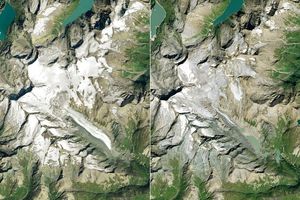




















Decades of retreat at the Steller Glacier in Southcentral Alaska have left Berg Lake, one of the region’s glacier-dammed lakes, with new plumbing. Remote sensing instruments have observed the glacier’s thinning and retreat since the 1970s. Satellite imagery now reveals that this retreat has reworked the outflow of Berg Lake, which fills and drains annually.
These images show the changes in the Steller Glacier and Berg Lake between July 2003 (left) and June 2024 (right). They were acquired with the TM (Thematic Mapper) on Landsat 5 and the OLI (Operational Land Imager) on Landsat 8, respectively. Located in the Chugach Mountains, the Steller Glacier lies adjacent to the Bering Glacier (visible in the lower right), one of the largest and longest in North America.
From the 1980s through 2013, Berg Lake drained periodically through a gorge on its southwest side, according to Mauri Pelto, a glaciologist at Nichols College. This pathway is well-defined in the 2003 image. The 2024 image, however, shows how the northern edge of the glacier’s terminus, which impounds the lake, had retreated appreciably and the outlet had been abandoned. Vegetation appears in parts of the former drainage path and fills in areas north and east of Starodubtsov Lake.
Now, the outflow from Berg Lake runs to the south under the glacial ice and then toward Lake Ivanov and the southern end of Starodubtsov Lake. When the image above (right) was acquired on June 29, 2024, the lake was still undergoing its summer fill. It would begin to release in late July that year, according to the Alaska-Pacific River Forecast Center of the National Weather Service. Records from recent years indicate that as Berg Lake drains, water levels in Lake Ivanov and adjacent waterbodies rise.
Pelto noted that a decline in the lake’s maximum level since the mid-1980s contributed to the abandonment of the southwestern drainage channel. The rapid retreat of the glacier’s terminus—including a loss of about 1 kilometer on the western side from 2016 to 2018—has also played a part in changes to the outflow, he added.
The glacial retreat apparent in the images above is a continuation of a decades-long melting trend. An analysis incorporating data from the Shuttle Radar Topography Mission (SRTM) revealed that the Steller Glacier showed an overall thinning between 1972 and 1999, when it lost more than 100 meters (330 feet) in thickness near its terminus.
References & Resources
- From a Glaciers Perspective (2025, May 25) Berg Lake, Alaska Evolution Driven by Steller Glacier Retreat. Accessed July 31, 2025.
- Josberger, E. G., et al. (2006) Hydrography and Circulation of Ice-Marginal Lakes at Bering Glacier, Alaska, U.S.A. Arctic, Antarctic, and Alpine Research, 38(4), 547–560.
- Muskett R. R., et al. (2009) Airborne and spaceborne DEM- and laser altimetry-derived surface elevation and volume changes of the Bering Glacier system, Alaska, USA, and Yukon, Canada, 1972–2006. Journal of Glaciology, 55(190):316-326.
- NWS Alaska-Pacific River Forecast Center (2024) Glacial Dammed Lake Data. Accessed July 31, 2025.
- NWS Alaska-Pacific River Forecast Center Alaska Glacier Dammed Lakes. Accessed July 31, 2025.
NASA Earth Observatory images by Wanmei Liang, using Landsat data from the U.S. Geological Survey. Story by Lindsey Doermann.