




























The year 2025 was extraordinary for Lake Eyre (also called Kati Thanda-Lake Eyre) in South Australia. Water started flowing into the often-dry, salty plain at the continent’s lowest point in early May after torrential rains in Queensland flooded several rivers that drain toward it. The lake continued to fill in the ensuing months, reaching levels rarely seen.
The lake turned a corner in early October, spring in Australia. Tributaries feeding the basin slowed to a trickle, and evaporation started outpacing inflow from rivers, according to local observers. By the start of December, the Lake Eyre Yacht Club reported that the rivers had dried up, temperatures had warmed with the arrival of summer, and lake levels were dropping rapidly.
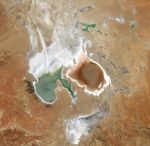
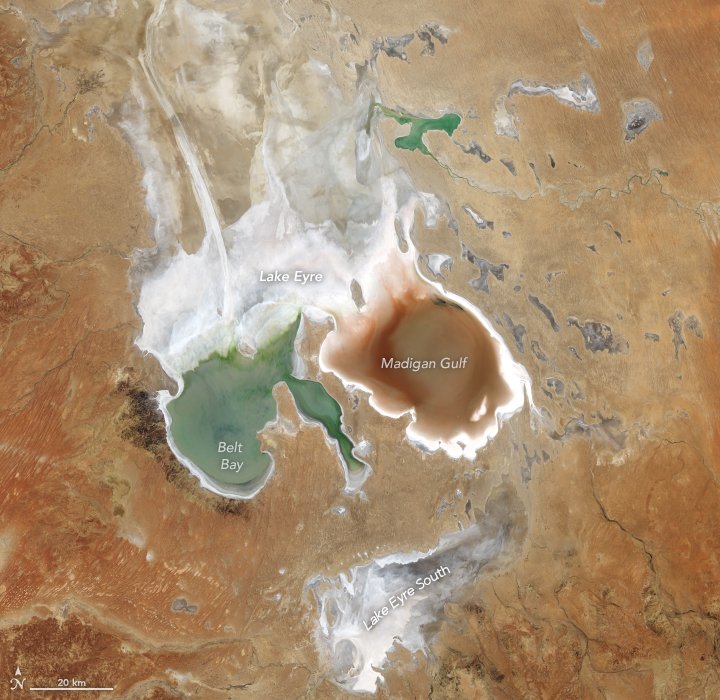
As it dried, Lake Eyre displayed more striking changes visible to satellites. The OLI (Operational Land Imager) on Landsat 8 acquired this natural-color image of Lake Eyre on December 15, 2025. The two deepest parts of the lake—Belt Bay and Madigan Gulf—still contained some water, which took on greenish and reddish hues, respectively. (From closer vantage points, Madigan Gulf can appear pink and even orange.)
As Lake Eyre evaporates, the remaining water becomes increasingly saline. Halophilic, or salt-loving, microorganisms thrive in these waters, enough to alter its color over large areas. Direct water samples are needed to identify what microbes are present in Lake Eyre. Past analyses have detected Dunaliella salina algae in samples, and studies of different pink-colored lakes have found the same algae, along with populations of other halophilic bacteria and archaea. Many of these species are known to produce pigmented compounds such as carotenoids that are colored pink, orange, or red.
Salt-loving algae and bacteria are sensitive to salinity levels and other environmental factors. Different conditions in Belt Bay and Madigan Gulf may support different microbial mixes, accounting for their contrasting colors. A similar-looking contrast between greenish and reddish waters sometimes occurs in Utah’s Great Salt Lake, where a causeway prevents water in the lake’s north and south arms from mixing. Varied salinity, water depth, and microbe populations also affect water color in San Francisco Bay-area salt ponds.
Just how long water will remain in Lake Eyre will depend largely on summer heat and evaporation rates. As an endorheic lake, it has no outflow, and this part of the outback receives very little rain. After complete fills of the lake, for example in 1950, 1974, and 1984, it took up to two years to dry out again.
NASA Earth Observatory image by Lauren Dauphin, using Landsat data from the U.S. Geological Survey. Story by Lindsey Doermann.
References & Resources
- ABC News (2025, October 6) Kati Thanda-Lake Eyre has reached its peak and is beginning to evaporate, local pilot says. Accessed December 18, 2025.
- ABC News (2022, January 4) Why Australia has so many pink lakes — and why some of them are losing their colour. Accessed December 18, 2025.
- Lake Eyre Yacht Club (2025, December 2) Current Lake Status. Accessed December 18, 2025.
- NASA Earth Observatory (2025, September 17) Cooper Creek Replenishes Lake Eyre. Accessed December 18, 2025.
- NASA Earth Observatory (2011, December 18) Lake Eyre Floods, South Australia. Accessed December 18, 2025.
- Teller, J.T. (1987) The pink colour of lakes, with an example from Australia. Journal of Arid Environments, 12(2), 101-103.
- Williams, W.D. (1990) 7 Salt Lakes: The Limnology of Lake Eyre. In Tyler, M.J., Twidale, C.R., et al. (Eds.), Natural History of the North East Deserts. Royal Society of South Australia, Adelaide, pp. 85-99.
- World Lake Database Lake Eyre. Accessed December 18, 2025.