




















Before and After
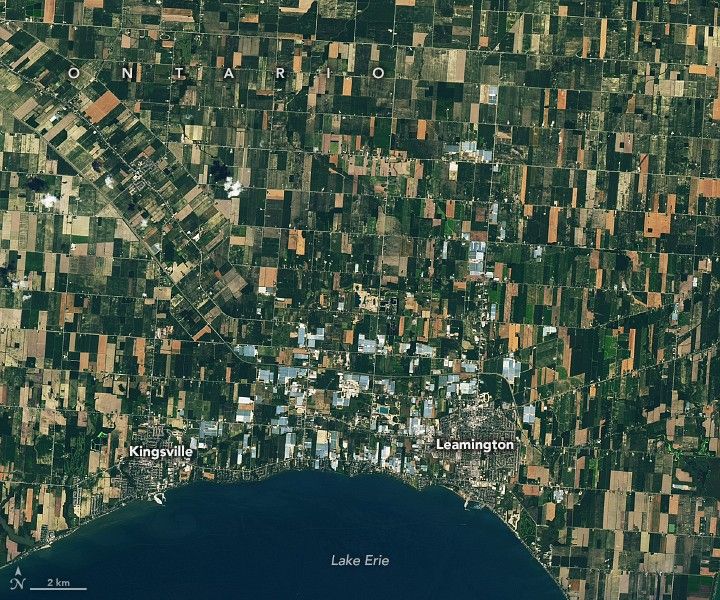
The southernmost extent of mainland Canada, along the northern shore of Lake Erie, lies at about the same latitude as Des Moines, Iowa. Though not a “breadbasket” like the grain-producing machine that is the U.S. Midwest, this part of southwestern Ontario holds its own as an agricultural powerhouse. In the Leamington area, growers cultivate vegetables and other crops within millions of square feet of greenhouse space.
Commercial greenhouse operations began to gain a foothold in this area in the 1960s and 1970s as technology advanced and regional demand for fresh vegetables increased. Since then, the industry has continued to grow, securing Leamington’s reputation as the “greenhouse capital of North America.”
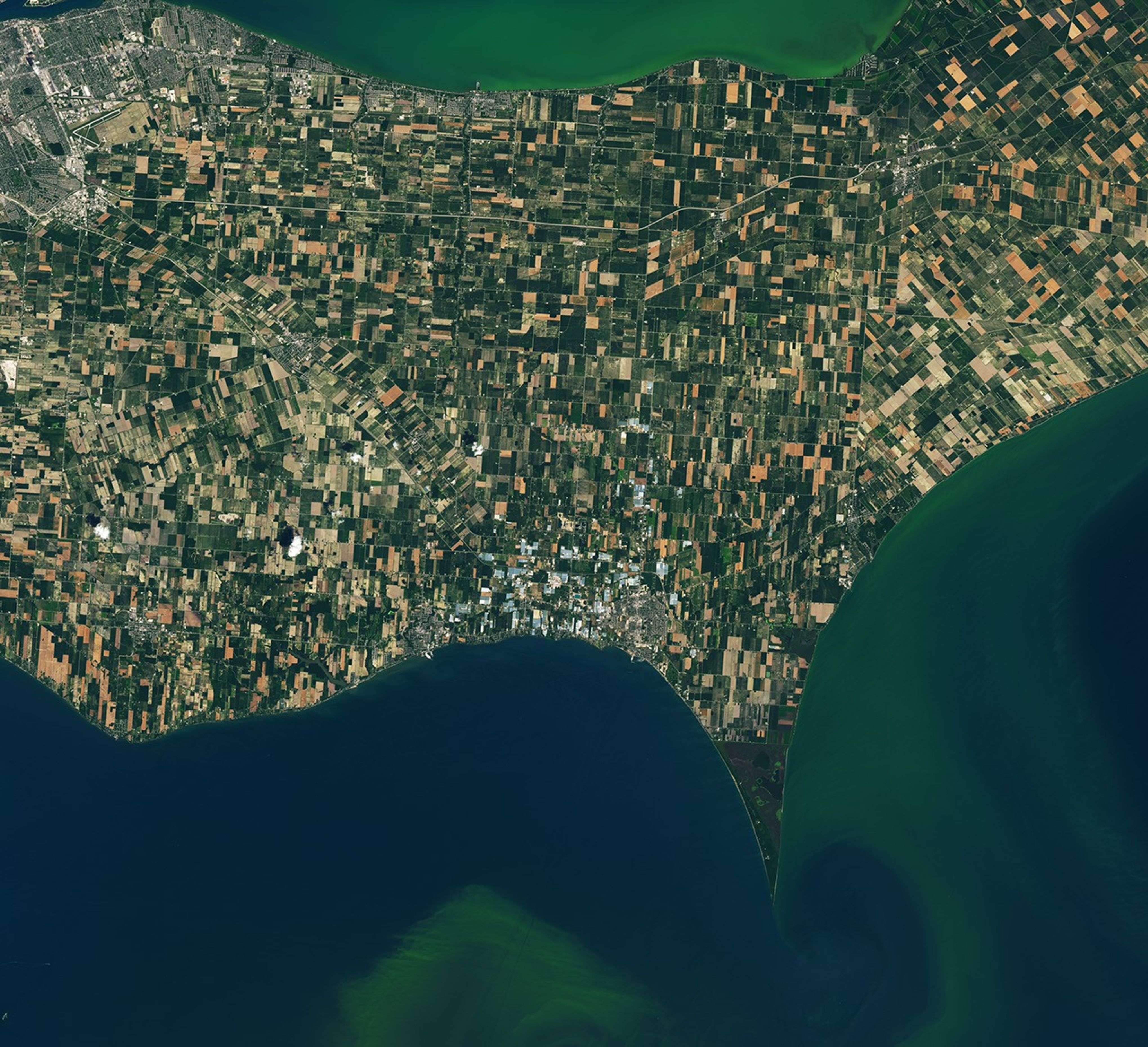
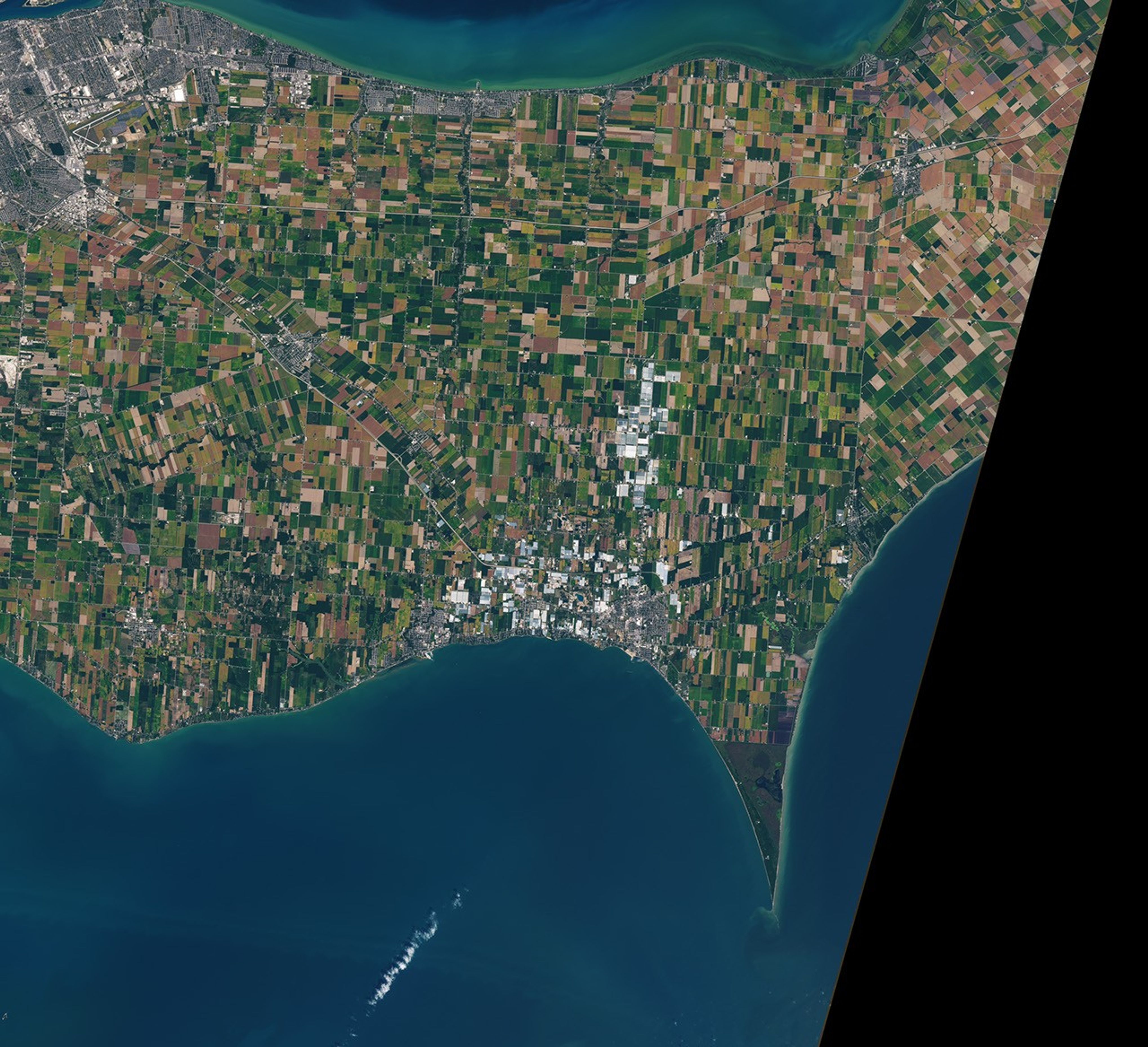
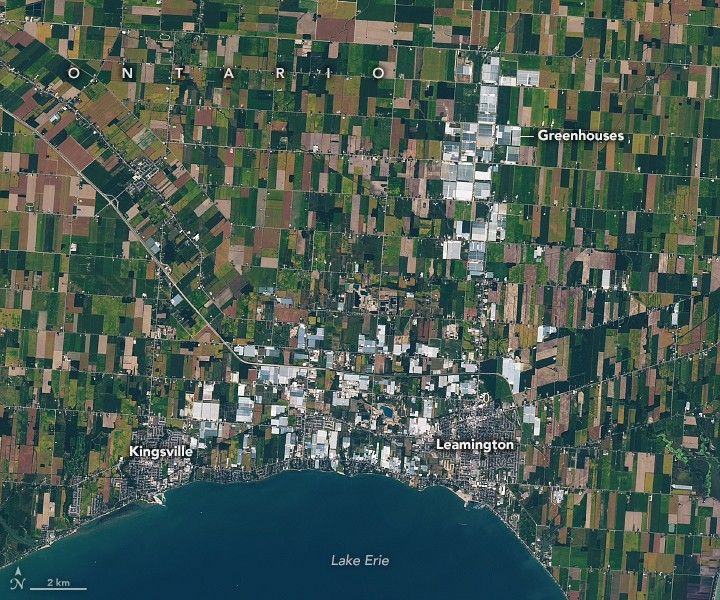
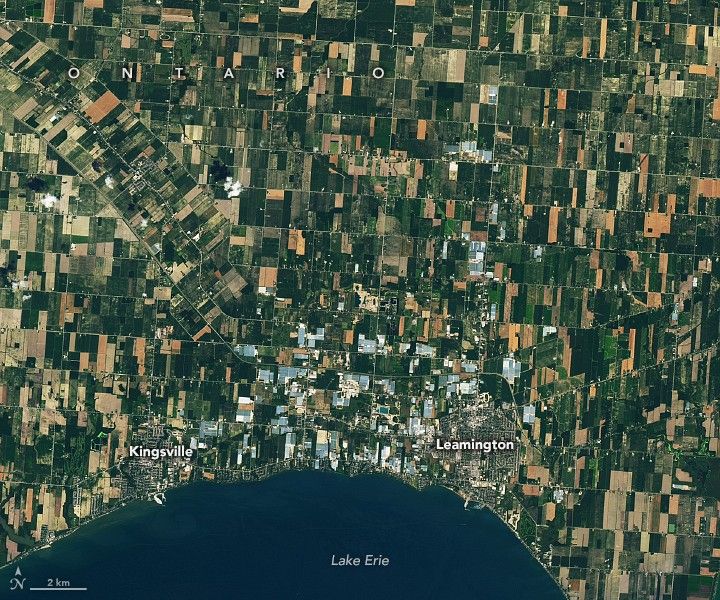
The growth in greenhouse extent in the past decade alone is apparent in satellite imagery. These images, acquired with the OLI (Operational Land Imager) on Landsat 8, show how the Leamington area changed between July 2015 (left) and September 2025 (right). By 2025, many more light-colored greenhouse roofs are visible, especially to the north and west of the town.
Greenhouses occupy nearly 8 square kilometers (2,000 acres) in the Leamington area, according to the municipality, representing the largest concentration of greenhouses in North America. The facilities primarily produce vegetables such as tomatoes, seedless cucumbers, and peppers, in addition to other crops including strawberries and cannabis.
The industry has changed not only the appearance of the daytime landscape but also the nighttime sky. Supplemental LED lighting, used to sustain growing operations year-round, emits purple, orange, and yellow glows that have been spotted as far away as Windsor, Ontario, and Detroit, Michigan, about 50 kilometers (30 miles) away, according to news reports.

Light pollution around Leamington concerns some ecologists because of its proximity to Point Pelee, about 10 kilometers (6 miles) to the southeast. This dagger-shaped piece of land jutting into Lake Erie lies along migration routes for many birds, as well as monarch butterflies. These winged travelers congregate on the peninsula before or after crossing the lake, and artificial light at night can affect their ability to navigate.
Recent measures around Leamington, however, have cut down on light pollution, according to reports. A town bylaw passed in 2022 requires greenhouses using lights to install light-blocking wall and ceiling curtains and to close them at night. Researchers from the University of Guelph collected sky brightness measurements in the region between fall 2022 and spring 2023. They found that the curtains were effective when used properly, though factors like cloud cover, fog, and the Moon’s phase still had a significant impact on brightness levels.
NASA Earth Observatory image by Lauren Dauphin, using Landsat data from the U.S. Geological Survey. Photo by Rob L’Ecuyer. Story by Lindsey Doermann.
References & Resources
- CBC (2018, November 29) It’s not the northern lights — it’s a borealis of greenhouse glows. Accessed October 23, 2025.
- Ecoation (2023, June 7) The Evolution of Greenhouses in the Leamington Area, Ontario: A Historical Perspective. Accessed October 23, 2025.
- Lubitz, W., et al. (2023) Comparative Assessment of Winter Night Sky Brightness in Southwestern Ontario. In: Ting, D.SK., Vasel-Be-Hagh, A. (eds) Engineering to Adapt. TELAC 2023. Springer Proceedings in Energy. Springer, Cham.
- Municipality of Leamington Key Industries. Accessed October 23, 2025.
- NASA Earth Observatory (2017, December 27) Observing Changes in Nighttime Lights. Accessed October 23, 2025.
- Parks Canada (2025, October 23) Point Pelee National Park. Accessed October 23, 2025.
- Planet Detroit (2024, February 8) Canadian greenhouses still shining but new laws have curbed Detroit’s midnight sun. Accessed October 23, 2025.
- Windsor Star (2024, February 2) Leamington greenhouse light bylaw can’t deliver ‘complete darkness’ — mayor. Accessed October 23, 2025.