


















NASA’s Juno Mission Redefines Size, Shape of Jupiter
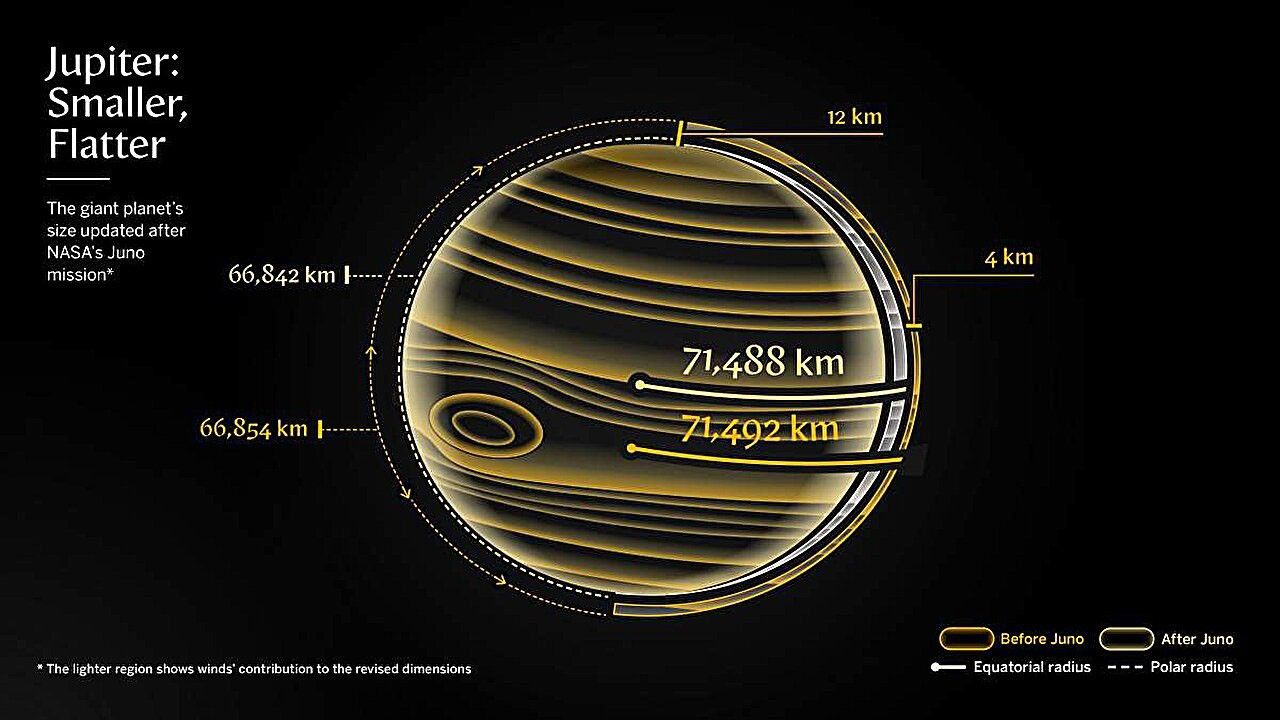
Data from NASA’s Juno mission has revealed that the solar system’s largest planet is slightly smaller and more “squashed” than previously believed.
By analyzing radio occultation data from 13 flybys of Jupiter and incorporating the effects of zonal winds, mission scientists have determined that Jupiter is about 5 miles (8 kilometers) narrower at the equator and 15 miles (24 kilometers) flatter at the poles.
Radio occultation is used to “see” through the dense, opaque clouds of Jupiter’s atmosphere to understand its internal structure. During an occultation experiment, Juno beams radio signals back to NASA’s Deep Space Network on Earth. As these signals pass through the charged upper layer of Jupiter’s atmosphere, called the ionosphere, gases bend and delay the signals. By measuring the change in frequency caused by this bending, scientists can calculate the temperature, pressure, and electron density of Jupiter’s atmosphere at different depths.
Previously, Jupiter’s physical dimensions were based on data from six radio occultation experiments performed by the agency’s Pioneer and Voyager missions in the 1970s.
Jupiter’s exact radius serves as a critical calibration standard for modeling giant exoplanets in other star systems. Having a more accurate shape will help astronomers better interpret data from planets spotted passing in front of their host star far beyond our own neighborhood.
The results were published in the Feb. 2, 2026, issue of Nature Astronomy.
The Juno mission is managed by NASA’s Jet Propulsion Laboratory, a division of Caltech in Pasadena, California, for the agency’s Science Mission Directorate in Washington.