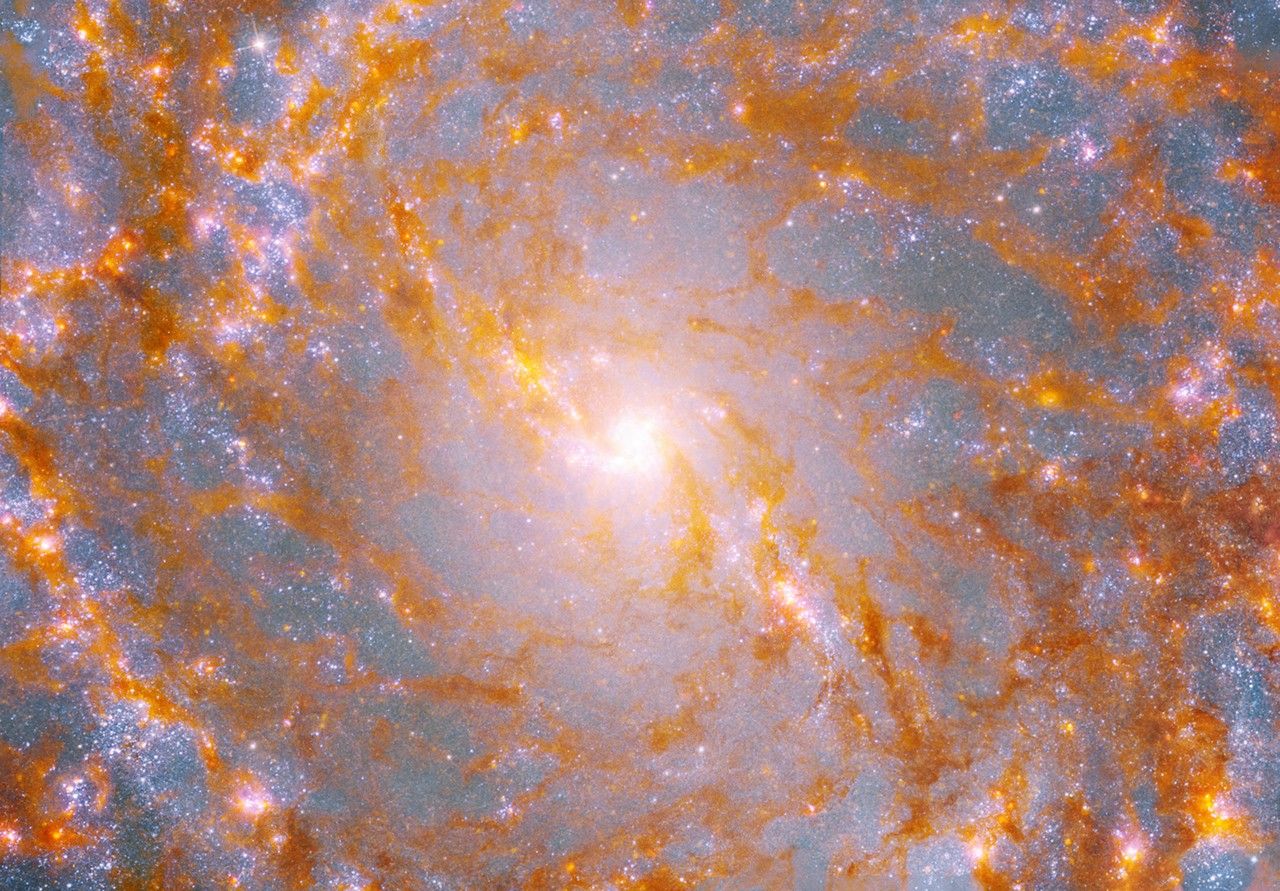





















Hubble and Webb image of M101's core
The heart of Messier 101, or the Pinwheel Galaxy, shines in this new image that combines data from NASA’s Hubble Space Telescope and James Webb Space Telescope. At 25 million light-years away, M101 is one of the closest “face-on” spiral galaxies to us. With that in mind, Hubble’s ultraviolet, visible, and near-infrared data were taken as part of studies to find out more about its stellar population and galactic structure. Webb’s near- and mid-infrared observations helped astronomers study the formation and evolution of polycyclic aromatic hydrocarbons – which are complex, carbon-based molecules, and the smallest dust grains that glow in infrared light.
Image Credit: NASA, CSA, ESA, D. Calzetti (University of Massachusetts - Amherst), C. Clark (Space Telescope Science Institute - ESA - JWST), K. Kuntz (The John Hopkins University), and B. Shappee (University of Hawaii) ; Processing: Gladys Kober (NASA/Catholic University of America)
- X
https://science.nasa.gov/image-detail/amf-466f4869-6ce3-4f2a-b108-e2ea6930e3f6/
Image CreditNASA, CSA, ESA, D. Calzetti (University of Massachusetts - Amherst), C. Clark (Space Telescope Science Institute - ESA - JWST), K. Kuntz (The John Hopkins University), and B. Shappee (University of Hawaii) ; Processing: Gladys Kober (NASA/Catholic University of America)
Size3029x2109px