


























NASA’s Parker Solar Probe Finds Surprises in an Explosion Near the Sun
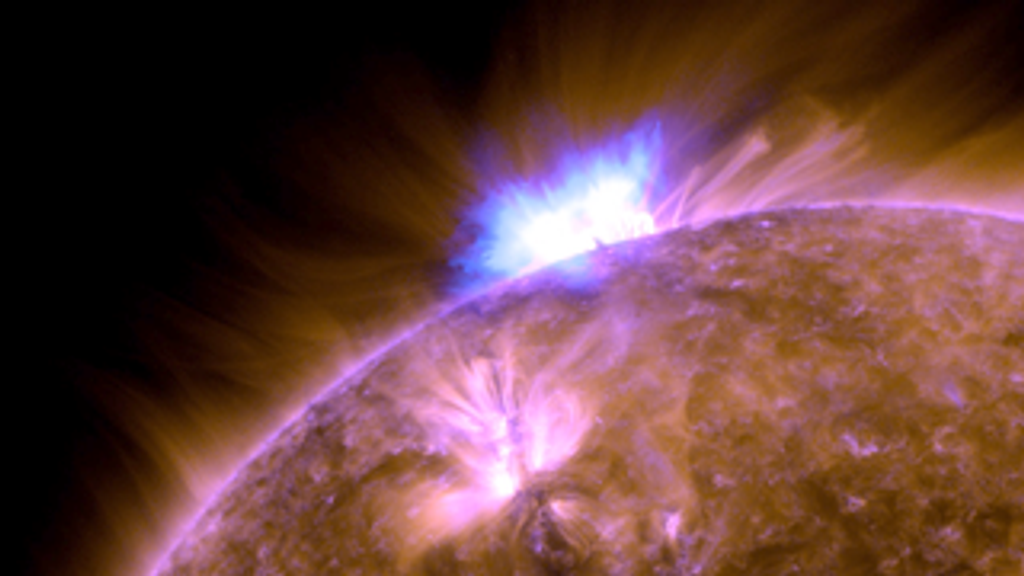
Before a solar storm races across space and impacts technology on Earth, it starts with an explosive process on the Sun known as magnetic reconnection. Now, observations from NASA’s Parker Solar Probe have uncovered new details about how these types of magnetic events fling particles to dangerous speeds.
On a 2022 solar flyby, Parker Solar Probe passed in between the Sun and the site of a magnetic reconnection event in the solar wind, the continual stream of particles and magnetic fields emitted by the Sun. Since the storm-causing reconnection events happen in the hard-to-access solar atmosphere, events occurring in the solar wind offer an opportunity to take direct measurements of particles accelerated by magnetic reconnection. And Parker Solar Probe did just that.

Parker Solar Probe observed a Sun-directed jet of particles made of protons and heavy ions — elements with extra electrons. But unexpectedly, analysis of the data revealed that protons and ions were accelerated in different manners. Magnetic reconnection theories expect these two types of particles to be accelerated in the same manner, but the new observations showed the protons formed a dispersed beam, like that from a flashlight, while the heavier ions were directed in a straight line like a laser beam.
The findings, published March 31 in the Astrophysical Journal, will help scientists refine theoretical models of magnetic reconnection to better understand how solar storms are powered.
By Mara Johnson-Groh
NASA’s Goddard Space Flight Center, Greenbelt, Md.
