























4.1. Where do life's building blocks come from?
A core learning question from the Astrobiology Learning Progressions
Astrobiology Learning Progressions Navigation


Grades K-2 or Adult Naive Learner
Your family may use a recipe to make dinner. This recipe explains how to put all of the ingredients together in order to make something healthy and delicious. Anything that is alive needs to have some kind of food that helps it to grow and move and live. All things that are alive may like different types of food, but it turns out that many of the ingredients for this food are the same.
Disciplinary Core Ideas
PS1.A: Structure and Properties of Matter: A great variety of objects can be built up from a small set of pieces. (2-PS1-3)
LS1.C: Organization for Matter and Energy Flow in Organisms: All animals need food in order to live and grow. They obtain their food from plants or from other animals. Plants need water and light to live and grow. (K-LS1-1)
ESS3.A: Natural Resources: Living things need water, air, and resources from the land, and they live in places that have the things they need. Humans use natural resources for everything they do. (K-ESS3-1)
LS2.A: Interdependent Relationships in Ecosystems: Plants depend on water and light to grow. (2-LS2-1)
Crosscutting Concepts
Energy and Matter: Objects may break into smaller pieces and be put together into larger pieces, or change shapes. (2-PS1-3)
Big Ideas: Livings things require energy to live, grow and move. The basic elements of all living things are very similar.
Boundaries: Students in this grade band make observations to construct an evidence-based account of how an object made of a small set of pieces can be disassembled and made into a new object. Examples of pieces could include blocks, building bricks, or other assorted small objects. (2-PS1-3)
No appropriate content for this grade level. Please use the navigation arrows to switch levels.

Grades 3-5 or Adult Emerging Learner
If you’ve ever helped to make dinner, you might have used a recipe that told you how to make the food. It tells you what ingredients to use and how to put them together to make something delicious. The food we eat gives us the energy to grow and move. Not all living things like the same type of food, but it turns out that most of the food for living things is made with the same ingredients.
There are living things all over Earth and even some things that live deep in the ground or up in the sky, so the ingredients needed for life must also be everywhere. The Earth is very old so the ingredients for living things must also have been around for many, many years. People who wonder if there is life somewhere other than Earth are investigating if the ingredients for living things are there or not.
Disciplinary Core Ideas
LS1.A: Structure and Function: Plants and animals have both internal and external structures that serve various functions in growth, survival, behavior, and reproduction. (4-LS1-1)
PS1.A: Structure and Properties of Matter: Matter of any type can be subdivided into particles that are too small to see, but even then the matter still exists and can be detected by other means. A model showing that gases are made from matter particles that are too small to see and are moving freely around in space can explain many observations, including the inflation and shape of a balloon and the effects of air on larger particles or objects. (5-PS1-1)
LS1.C: Organization for Matter and Energy Flow in Organisms: Food provides animals with the materials they need for body repair and growth and the energy they need to maintain body warmth and for motion. (5-PS3-1) Plants acquire their material for growth chiefly from air and water. (5-LS1-1)
LS2.A: Interdependent Relationships in Ecosystems: The food of almost any kind of animal can be traced back to plants. Organisms are related in food webs in which some animals eat plants for food and other animals eat the animals that eat plants. (5-LS2-1)
LS2.B: Cycles of Matter and Energy Transfer in Ecosystems: Matter cycles between the air and soil and among plants, animals, and microbes as these organisms live and die. Organisms obtain gases, and water, from the environment, and release waste matter (gas, liquid, or solid) back into the environment. (5-LS2-1)
Crosscutting Concepts
Patterns: Similarities and differences in patterns can be used to sort and classify natural phenomena. (3-LS3-1)
Systems and System Models: A system can be described in terms of its components and their interactions. (4-LS1-1, LS1-2)
Big Ideas: At the smallest level, all living things are very similar and share common characteristics. Living organisms all have the same basic building blocks. Looking for life beyond Earth requires looking for the ingredients needed for life on Earth.
Boundaries: Grade level appropriate examples of the particles that make up matter that are too small to be seen could include adding air to expand a basketball, compressing air in a syringe, dissolving sugar in water, and evaporating salt water. (5-PS1-1)
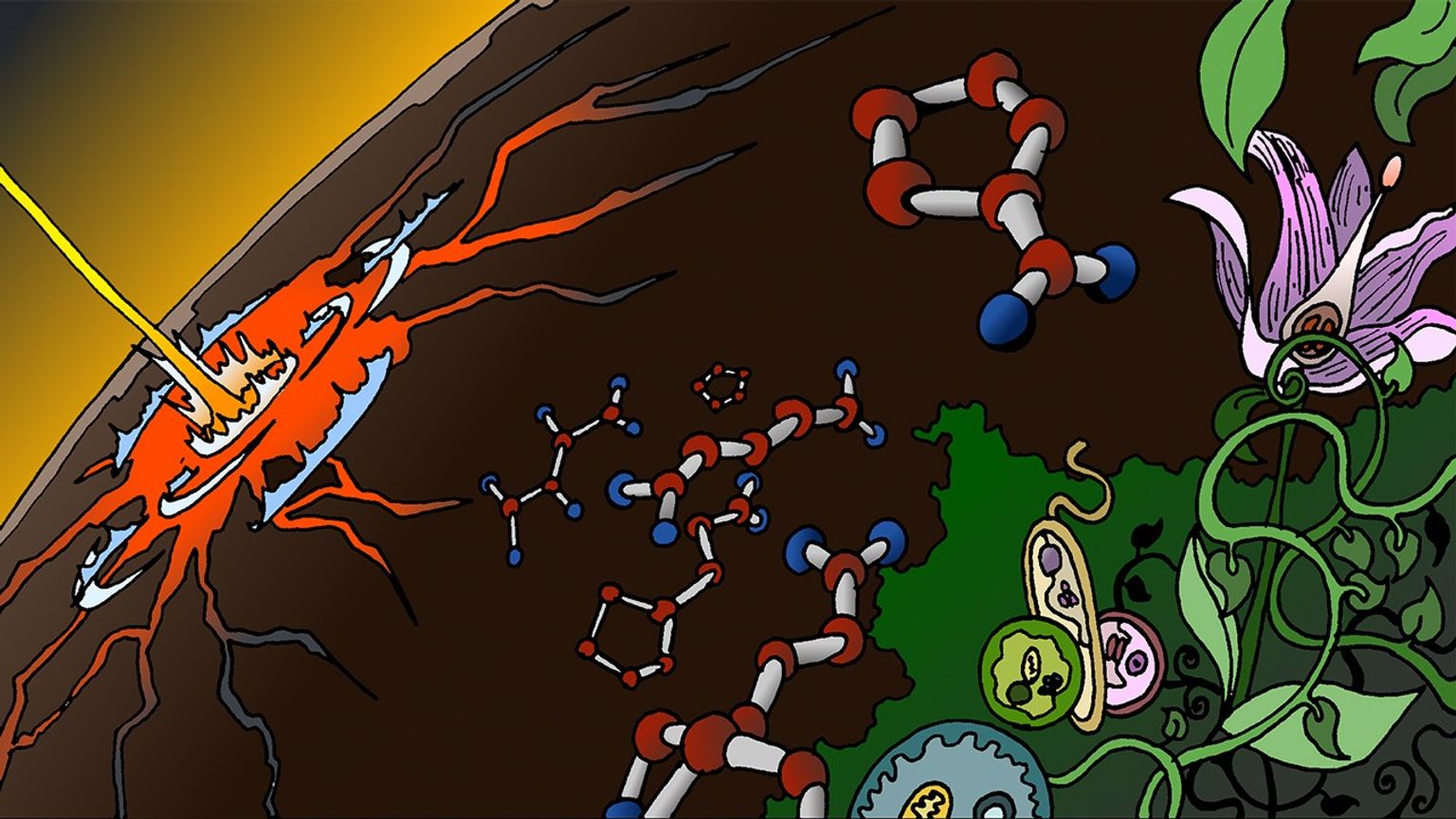
5-12 Astrobiology Graphic Histories: Issue 7: Prebiotic Chemistry and the Origin of Life. These astrobiology related graphic books are ingenious and artfully created to tell the story of astrobiology in a whole new way. The complete series illustrates the backbone of astrobiology from extremophiles, to exploration within and beyond the solar system. This issue illustrates prebiotic chemistry and the Origin of life on Earth. NASA . https://astrobiology.nasa.gov/resources/graphic-histories/
Grades 6-8 or Adult Building Learner
In order to better understand where life could exist beyond Earth, we need to consider what living things on Earth have in common. For instance, all living things on Earth need certain chemical elements in order to survive: carbon, hydrogen, nitrogen, oxygen, phosphorus, and sulfur. We sometimes abbreviate this list and call it CHNOPS (which is pronounced like “sh-nops”). Similar to cooking, the CHNOPS elements are very much like the ingredients for a recipe: you need to have the right ingredients to make the recipe.
Where did the CHNOPS atoms come from? Well, just like most of the atoms in our bodies, most of the CHNOPS atoms on Earth came from space! Hydrogen is the most common element in the universe and it was formed along with most of the helium during the big bang. Meanwhile, elements like carbon, nitrogen, oxygen, phosphorus, and sulfur were made inside of stars, during the explosions of stars known as supernovae, and even when two really heavy stars (known as neutron stars) bumped into each other. When our solar system formed, a large amount of the CHNOPS elements were included in the Sun, the planets and other things in our solar system. Since other solar systems, with their own stars and planets, likely form in similar ways as our own, they also likely have a lot of the CHNOPS elements. This means that the basic ingredients for life as we know it are almost everywhere!
So why don’t we see alien life all over the place, even in our own solar system? Well, having the ingredients for a recipe is just one important part. The other important part is putting those ingredients together in the right way to make the recipe work. An important step in figuring out if there are other living things out there in the cosmos is finding the places where the CHNOPS elements (and other possible ingredients for life) have come together in the right way to make the recipe of life work.
Disciplinary Core Ideas
PS1.A: Structure and Properties of Matter: Each pure substance has characteristic physical and chemical properties (for any bulk quantity under given conditions) that can be used to identify it. (MS-PS1-3)
LS1.A: Structure and Function: All living things are made up of cells, which is the smallest unit that can be said to be alive. An organism may consist of one single cell (unicellular) or many different numbers and types of cells (multicellular). (MS-LS1-1)
ESS1.B: Earth and the Solar System: The solar system consists of the Sun and a collection of objects, including planets, their moons, and asteroids that are held in orbit around the Sun by its gravitational pull on them. (MS-ESS1-2, MS-ESS1-3) The solar system appears to have formed from a disk of dust and gas, drawn together by gravity. (MS-ESS1-2)
Crosscutting Concepts
Scale, Proportion, and Quantity: Time, space, and energy phenomena can be observed at various scales using models to study systems that are too large or too small. (MS-ESS1-3)
Systems and System Models: Models can be used to represent systems and their interactions. (MS-ESS1-2)
Big Ideas: All living things on Earth have a need for the same elements- carbon, hydrogen, nitrogen, oxygen, phosphorus, and sulfur. These elements are born inside of stars and are the building blocks of life. Supernova produce heavier elements. Gravity causes the heavier elements, gaseous clouds and dust to form planets and stars incorporating various elements.
Boundaries: In this grade band, students are using models to describe the atomic composition of simple molecules and extended structures that vary in complexity. Examples of molecular-level models could include drawings, 3D ball and stick structures, or computer representations showing different molecules with different types of atoms. Does not include a complete depiction of all individual atoms in a complex molecule or extended structure. (MS-PS1-1)
5-12 Astrobiology Graphic Histories: Issue 7: Prebiotic Chemistry and the Origin of Life. These astrobiology related graphic books are ingenious and artfully created to tell the story of astrobiology in a whole new way. The complete series illustrates the backbone of astrobiology from extremophiles, to exploration within and beyond the solar system. This issue illustrates prebiotic chemistry and the Origin of life on Earth. NASA . https://astrobiology.nasa.gov/resources/graphic-histories/
6-12 Astrobiology Math. This collection of math problems provides an authentic glimpse of modern astrobiology science and engineering issues, often involving actual research data. Students explore concepts in astrobiology through calculations. Relevant topics include Organic Molecules Detected on a Distant Planet (page 93) and Atoms: How Sweet They Are? (page 9). NASA . https://www.nasa.gov/pdf/637832main_Astrobiology_Math.pdf
9-10 Voyages through Time: Origin of Life. Through the Origin of Life module students address questions such as: What is life? What is the evidence for early evolution of life on Earth? How did life begin? Sample lesson on the website and the curriculum is available for purchase. SETI . http://www.voyagesthroughtime.org/origin/index.html
Grades 9-12 or Adult Sophisticated Learner
In order to better understand where life could exist beyond Earth, we need to consider what living things on Earth have in common. For instance, all living things on Earth need certain chemical elements in order to survive. If we look at all of the organisms on Earth, from the microbes living in hot springs to Orchids to Blue Whales, we see that the fundamental building blocks of life are all the same: all living things contain primarily carbon, hydrogen, nitrogen, oxygen, phosphorus, and sulfur. We sometimes abbreviate this list of life’s building blocks and call it CHNOPS (which is pronounced like “sh-nops”). Similar to cooking, the CHNOPS elements are very much like the ingredients for a recipe: you need to have the right ingredients to make the recipe.
Where did the CHNOPS atoms come from? Well, just like most of the atoms in our bodies, most of the CHNOPS atoms on Earth came from space! Hydrogen is the most common element in the universe and it was formed along with most of the helium during the Big Bang. Our current knowledge tells us that most of these atoms formed in just the first few minutes after the Big Bang happened. Other, larger atoms, including elements like carbon, nitrogen, oxygen, phosphorus, and sulfur (the rest of the CHNOPS elements), were made inside of stars, during the explosions of stars known as supernovae, and even when two neutron stars bumped into each other (this is called a neutron star merger). Events like supernovae cause space to become filled with dusts and gases containing all of these other elements, so when our solar system formed, a large amount of the CHNOPS elements were included in the Sun and the planets and other things in our solar system. Since other solar systems, with their own stars and planets, likely form in similar ways as our own, they also likely have a lot of the CHNOPS elements (and we can see this looking at the elements inside of other stars using something called spectroscopy). This means that the basic ingredients for life as we know it are almost everywhere!
So why don’t we see alien life all over the place, even in our own solar system? Well, having the ingredients for a recipe is just one important part. The other important part is putting those ingredients together in the right way to make the recipe work. An important step in figuring out if there are other living things out there in the cosmos is finding the places where the CHNOPS elements (and other possible ingredients for life) have come together in the right way to make the recipe of life work.
Disciplinary Core Ideas
ESS1.A: The Universe and Its Stars: The study of stars’ light spectra and brightness is used to identify compositional elements of stars, their movements, and their distances from Earth. (HS-ESS1-2, HS-ESS1-3) The big-bang theory is supported by observations of distant galaxies receding from our own, of the measured composition of stars and non-stellar gases, and of the maps of spectra of the primordial radiation (cosmic microwave background) that still fills the universe. (HS-ESS1-2) Other than the hydrogen and helium formed at the time of the big bang, nuclear fusion within stars produces all atomic nuclei lighter than and including iron, and the process releases electromagnetic energy. Heavier elements are produced when certain massive stars achieve a supernova stage and explode. (HS-ESS1-2, HS-ESS1-3)
PS4.B: Electromagnetic Radiation: Atoms of each element emit and absorb characteristic frequencies of light. These characteristics allow identification of the presence of an element, even in microscopic quantities.
PS1.A: Structure and Properties of Matter: The periodic table orders elements horizontally by the number of protons in the atom’s nucleus and places those with similar chemical properties in columns. The repeating patterns of this table reflect patterns of outer electron states. (HS-PS1-1)
Crosscutting Concepts
Patterns: Different patterns may be observed at each of the scales at which a system is studied and can provide evidence for causality in explanations of phenomena. (HS-PS1-1, HS-PS1-3)
Big Ideas: All living things on Earth require the same elements for cellular processes. These necessary elements are collectively referred to as CHNOPS , which stands for Carbon, Hydrogen, Nitrogen, Oxygen, Phosphorous, and Sulfur. These elements are common throughout the universe. Hydrogen and helium were created in the early stage of the universe after the big bang. Stars burn lighter elements through fusion and produce heavier elements. The larger the star, the heavier the elements it can produce. Supernova produce the heaviest elements. Stars go through a life cycle and spew elements into space that later reform into new solar systems.
Boundaries: In this grade band, students use the periodic table as a model to predict the relative properties of elements. Examples of properties that could be predicted from patterns could include reactivity of metals, types of bonds formed, numbers of bonds formed, and reactions with oxygen. Focus is on main group elements. (HS-PS1-1)
5-12 Astrobiology Graphic Histories: Issue 7: Prebiotic Chemistry and the Origin of Life. These astrobiology related graphic books are ingenious and artfully created to tell the story of astrobiology in a whole new way. The complete series illustrates the backbone of astrobiology from extremophiles, to exploration within and beyond the solar system. This issue illustrates prebiotic chemistry and the Origin of life on Earth. NASA . https://astrobiology.nasa.gov/resources/graphic-histories/
6-12 Astrobiology Math. This collection of math problems provides an authentic glimpse of modern astrobiology science and engineering issues, often involving actual research data. Students explore concepts in astrobiology through calculations. Relevant topics include Organic Molecules Detected on a Distant Planet (page 93) and Atoms: How Sweet They Are? (page 9). NASA . https://www.nasa.gov/pdf/637832main_Astrobiology_Math.pdf
9-10 Voyages through Time: Origin of Life. Through the Origin of Life module students address questions such as: What is life? What is the evidence for early evolution of life on Earth? How did life begin? Sample lesson on the website and the curriculum is available for purchase. SETI . http://www.voyagesthroughtime.org/origin/index.html
10-12 Is Anyone Out There? In this 20-minute TED talk, John Delano speaks to the early Earth the beginning of life on Earth as a mystery that illuminates the possibilities for life to be found beyond Earth. He outlines the evidence and continued areas of study for four main questions: Where did the prebiotic molecules come from?, How were they assembled into complex molecules? When did life originate? and What does life remember about the old days (implying evidence for the circumstances of the origin of life)? John Delano/TED. https://www.youtube.com/watch?v=qrQY7vQy50M