







SkyFall
NASA’s next Mars helicopters will survey the Red Planet to collect science data and scout areas to uncover clues about climate history and the presence of potential subsurface ice.
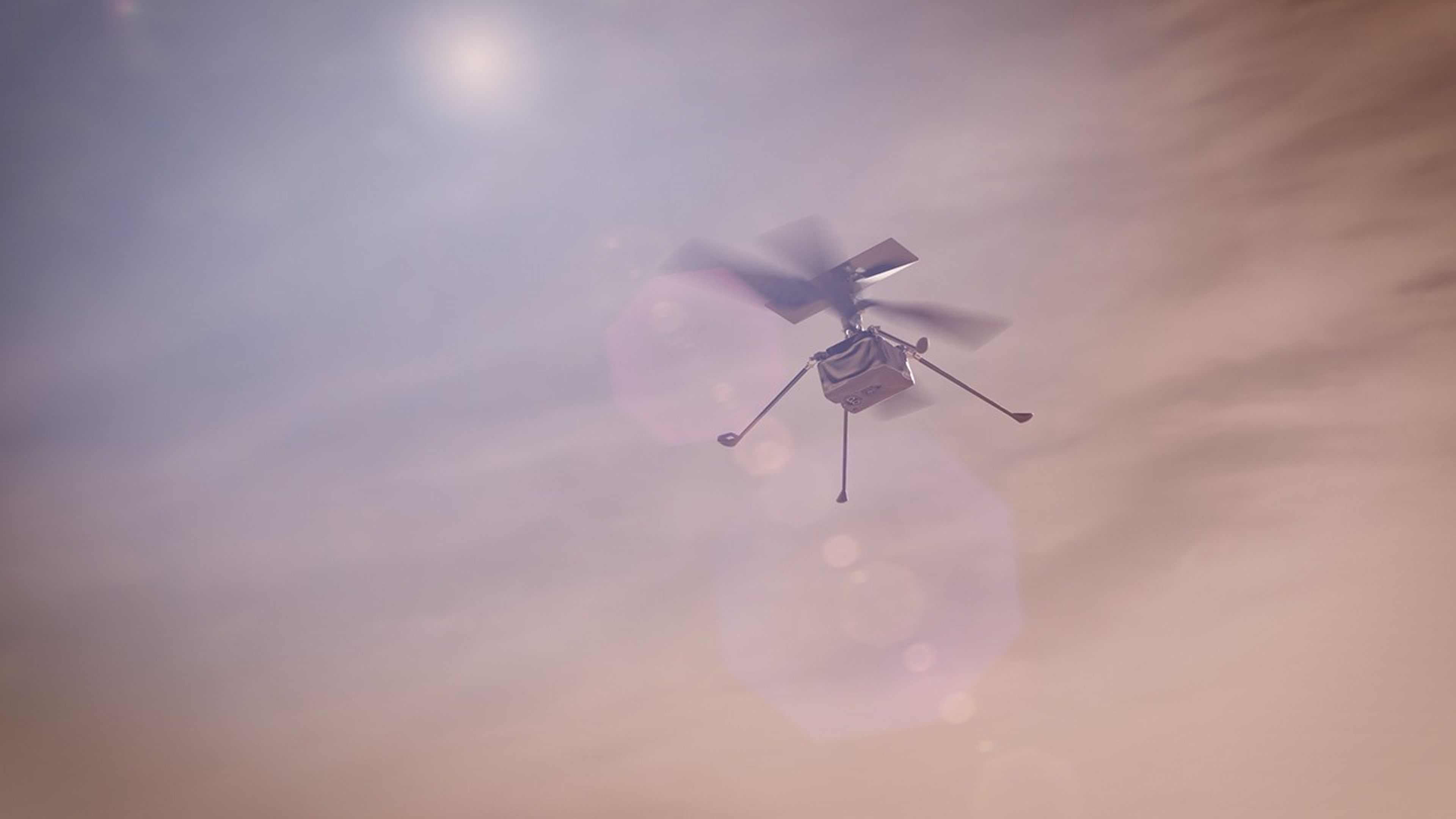
NASA’s SkyFall Mars Helicopters
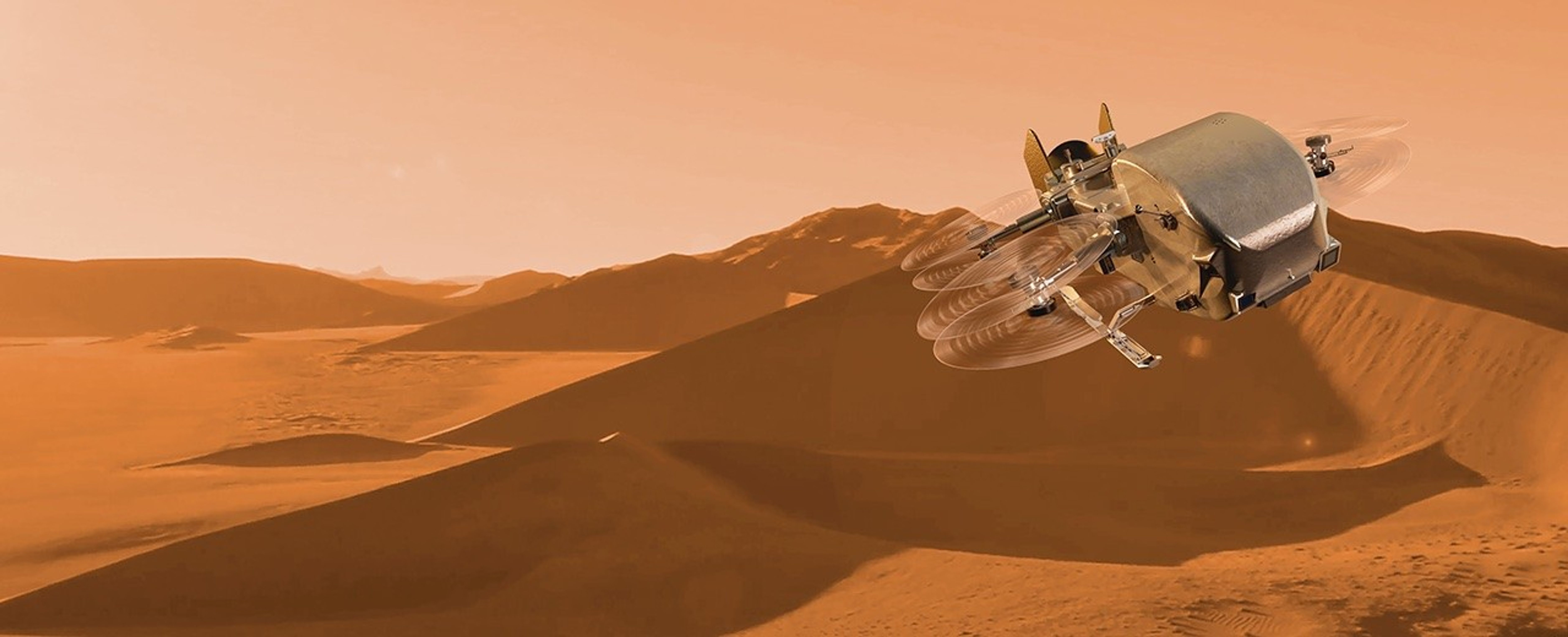
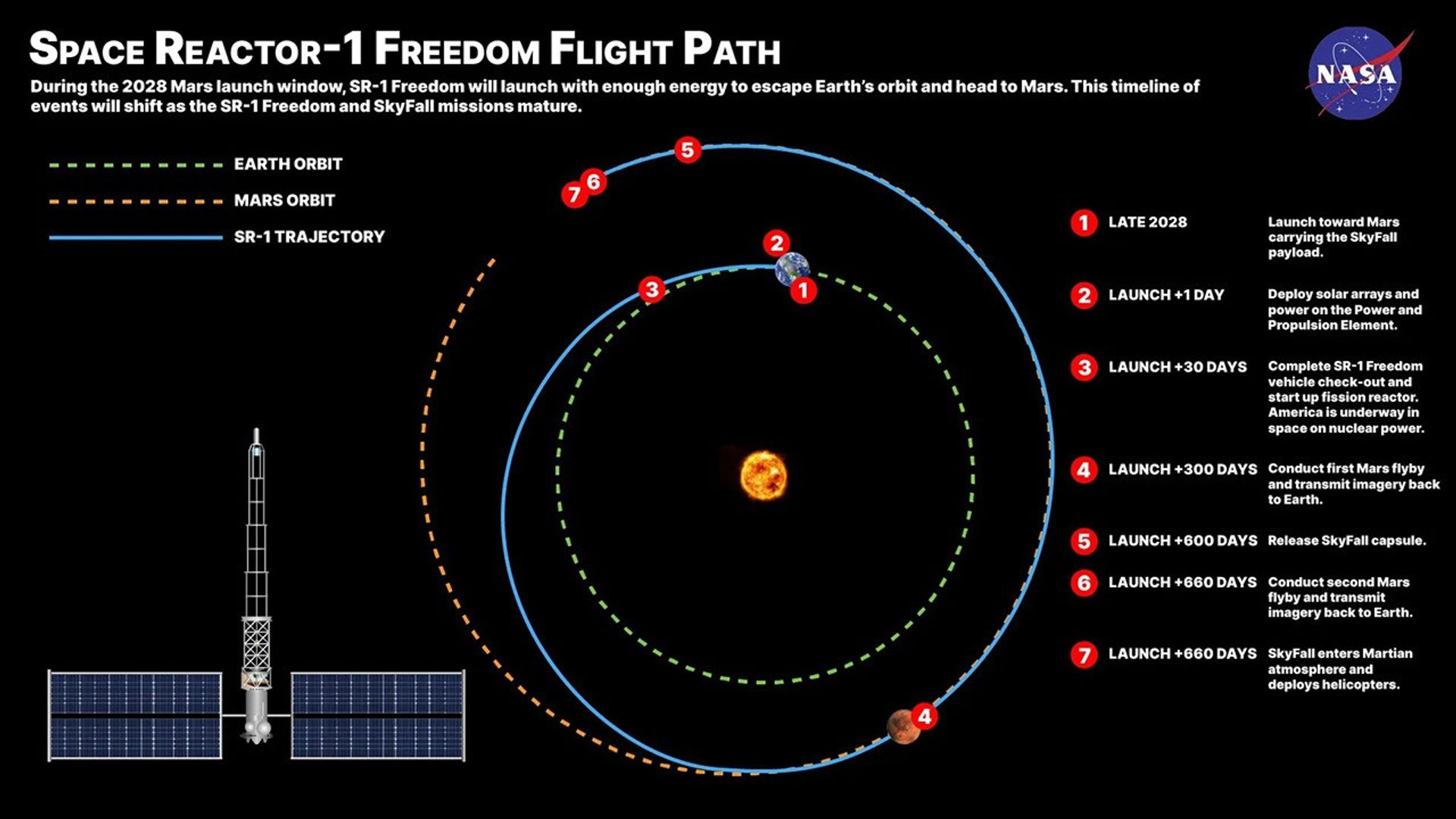
NASA’s SkyFall mission will use an innovative mid-air deployment, delivering a team of three Mars helicopters evolved from the Ingenuity design, to map subsurface ice and demonstrate scouting and aerial mapping of potential landing sites for human-scale exploration. SkyFall continues to build on the heritage of Ingenuity with enhanced payload capability, extended operational range, with no rover required for communications relay. NASA announced the mission as part of the agency’s “Ignition” event on March 24, 2026.
Learn More About SkyFallNASA Tests Featherweight Radar Antenna for SkyFall Mars Helicopters
When the trio of NASA’s SkyFall helicopters takes to the Martian skies, one of their tasks will be to hunt…
Read the Story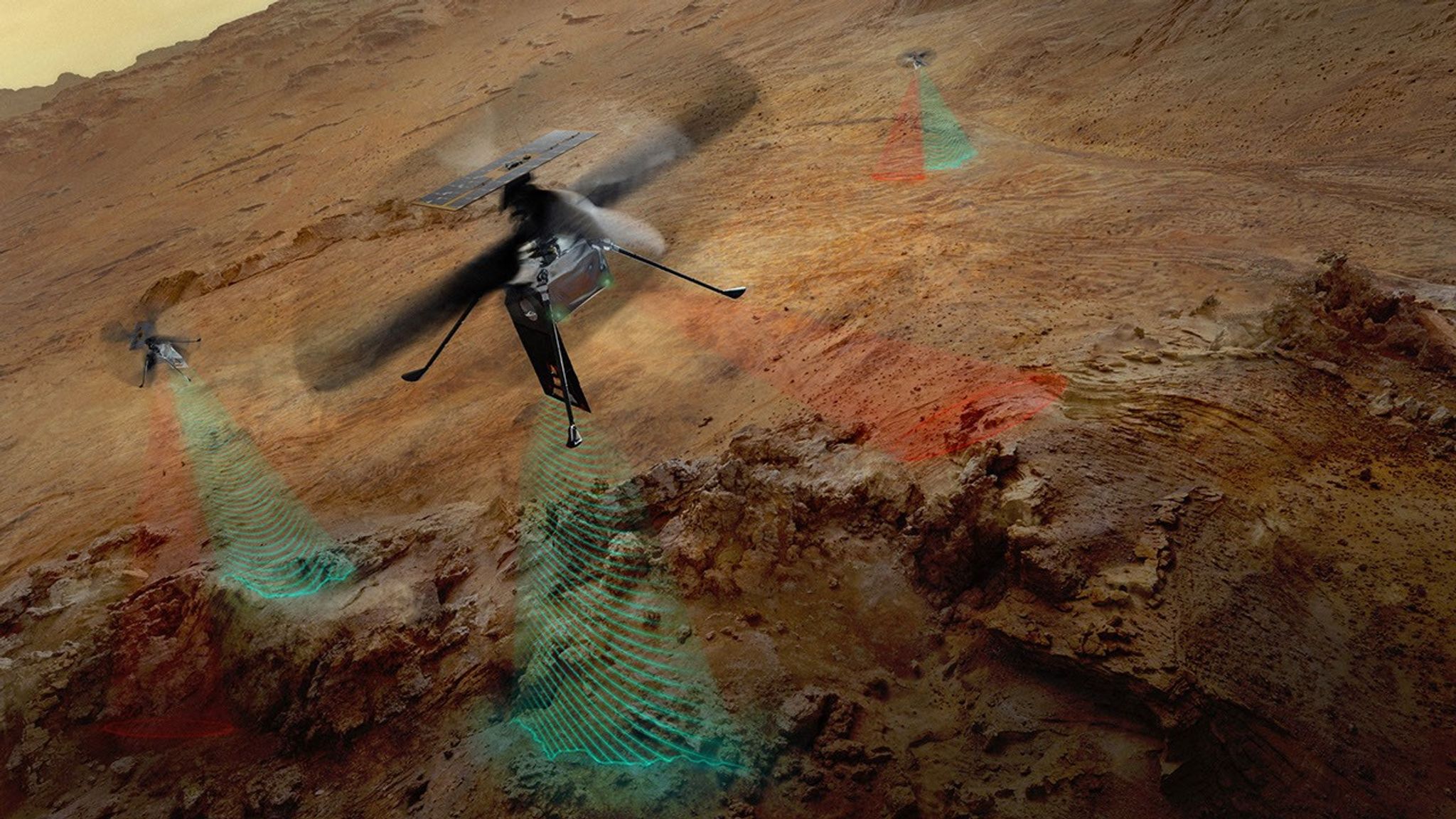
Key Facts
| Launch | Late 2028 |
| Landing | After cruise phase and initial Mars flyby in 2029, will land after second Mars approach in Fall 2030 |
| Landing Site | To be determined, following community workshops to evaluate candidate regions |
| Instruments | Optical cameras (visible and near-infrared wavelength), ground-penetrating radar, temperature sensors, radiation monitor |
| Dimensions | Height: 20.5 inches (52 centimeters) Mass: 11 pounds (5 kilograms) Fuselage Dimensions: 9.6 inches × 8.7 inches × 8.5 inches (24.5 centimeters × 22 centimeters × 21.5 centimeters) Rotor Blades: two counter-rotating blades, each 4.4 feet (1.35 meters) in diameter |
| Industry Partner | AeroVironment of Arlington, Virginia, will co-design and co-manufacture the SkyFall helicopters with NASA’s Jet Propulsion Laboratory. AV engineers previously worked with JPL to design and build the Ingenuity rotorcraft, and SkyFall continues that successful public-private collaboration. |
| Delivery System | Space Reactor-1 (SR-1) Freedom, humanity’s first fission-powered interplanetary spacecraft, will demonstrate Nuclear Electric Propulsion by delivering the SkyFall payload to the Red Planet. There, SR-1 Freedom will release SkyFall, which will enter the Martian atmosphere and deploy its helicopters mid-air. |
SkyFall Entry, Descent, and Landing
The Mars Entry, Descent, and Landing sequence (EDL) gets redefined with the SkyFall maneuver, in which rotorcraft are released midair during descent, enabling them to fly themselves safely to the Martian surface for the very first time.
SkyFall Science
The three SkyFall helicopters will carry an advanced instrument package featuring ground-penetrating radar and imagers, and they will be capable of measuring air temperature, wind speed, and direction. The radar will collect data about subsurface features that can be combined with data from the imagers, which could help map the terrain and characterize environments on Mars that are different from those we have explored before. If subsurface ice is detected, these measurements may help determine its extent and depth, which could help scientists understand potential formation mechanisms and implications for Mars’ climate history.
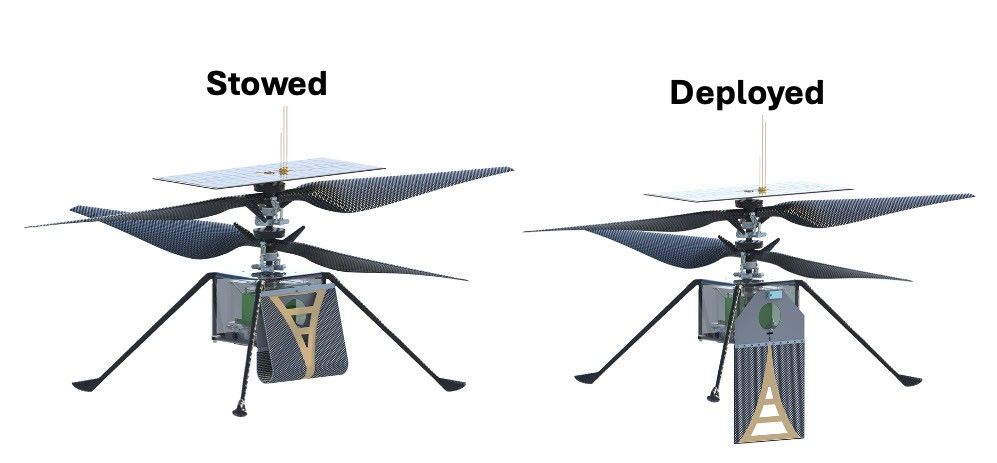
Each SkyFall helicopter is equipped with a suite of integrated operational and scientific instruments:
- Subsurface Mapping: A compact ground-penetrating radar (GPR) designed to characterize subsurface geological structures and detect the presence of ice between depths of 1.6 to 10 feet (0.5 to 3.0 meters).
- Visible Light Imagery: 13-megapixel color cameras to capture overlapping mid-flight views, generating centimeter-scale 3D terrain maps. This data is used to determine fine surface details and geological changes over time, while identifying small hazards to certify safe landing zones for future crewed Mars missions.
- Infrared Surface Mapping: Specialized near-IR cameras to analyze to analyze the composition of Martian regolith — loose rocks, dust, and other surface material — and characterize these features beyond the visual spectrum.
- Advanced Meteorology: Specialized sensors will profile ambient air temperatures. In addition, by leveraging the platform’s unique ability to hover, the helicopters will measure wind speed and direction across various elevations.
- Radiation Monitoring: A dedicated commercial off-the-shelf (COTS) Micro Dosimeter, with direct flight heritage on the Lunar Reconnaissance Orbiter (LRO), will systematically measure and record total surface ionizing radiation doses to assess long-term safety environments for human explorers.
- Atmospheric Dynamics: Combined readings — multi-altitude wind data with visual and infrared imaging — will provide insights about dust-transport mechanisms across the Martian surface.
Ground-Penetrating Radar
The Rundown on SkyFall
-
Where to Land?
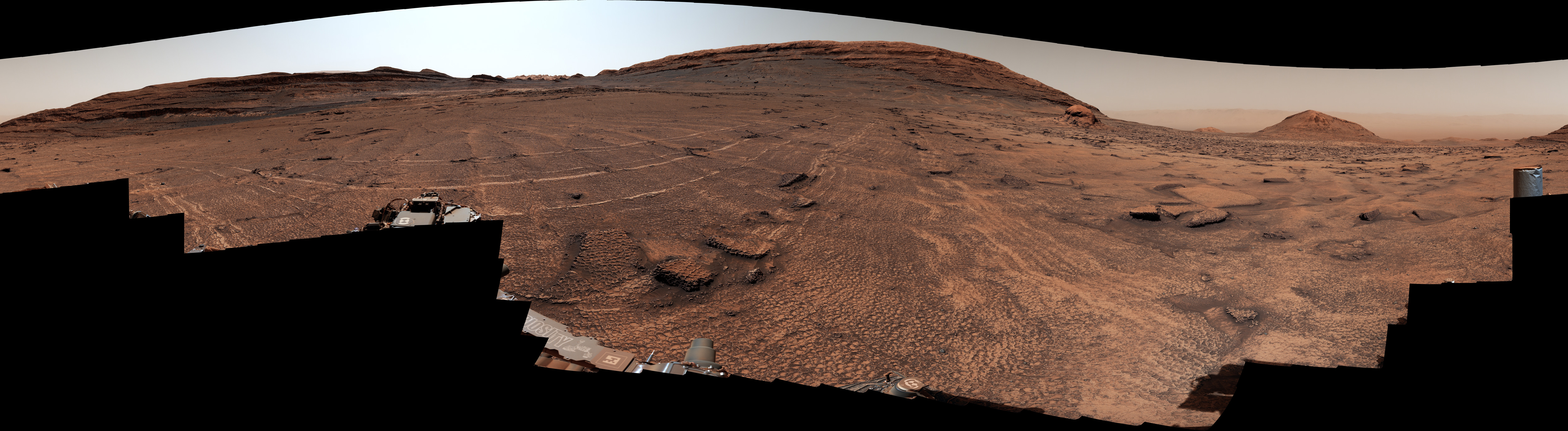
SkyFall’s landing site has not yet been selected. A landing site selection process is being planned to determine the best possible landing sites for SkyFall to maximize the scientific return of the helicopters and their payloads, keeping within the capabilities of the Entry, Descent, and Landing system. Flat, low-elevation areas, free of many geological obstacles on Mars are being targeted. Those with potentially interesting subsurface features either within the landing ellipse or nearby could be particularly valuable to investigate with the planned science payload.
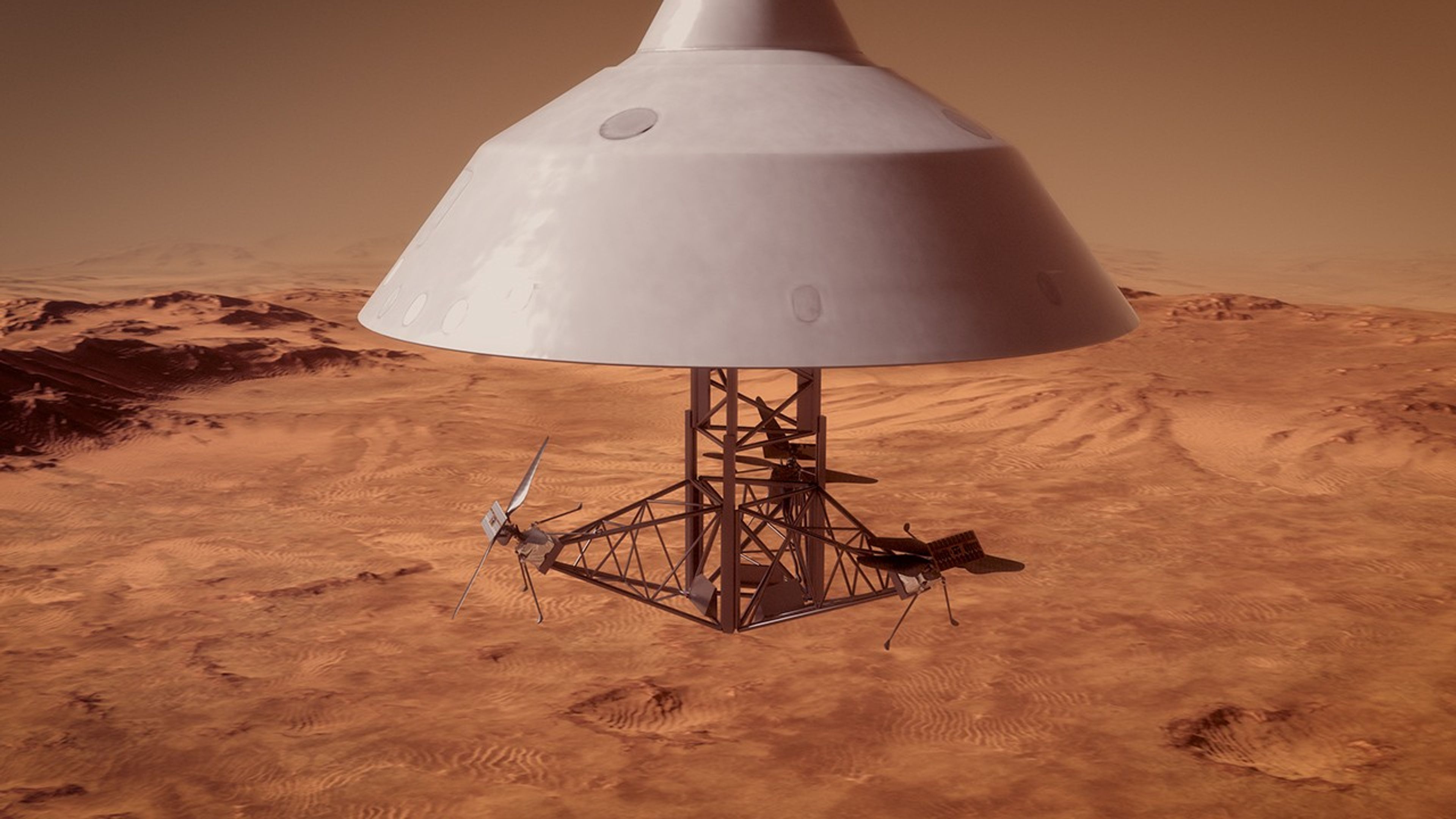 Artist's concept of the three SkyFall helicopters suspended beneath the backshell during their descent through the Martian atmosphere.NASA/JPL-Caltech
 -
But First, They’ll Fly
The mission design includes a daring mid-air deployment during initial descent — hence the name “SkyFall.” This eliminates the need and cost for a lander. A parachute and then braking rockets will slow the SkyFall descent stage, and the three aircraft will fly off and land individually.
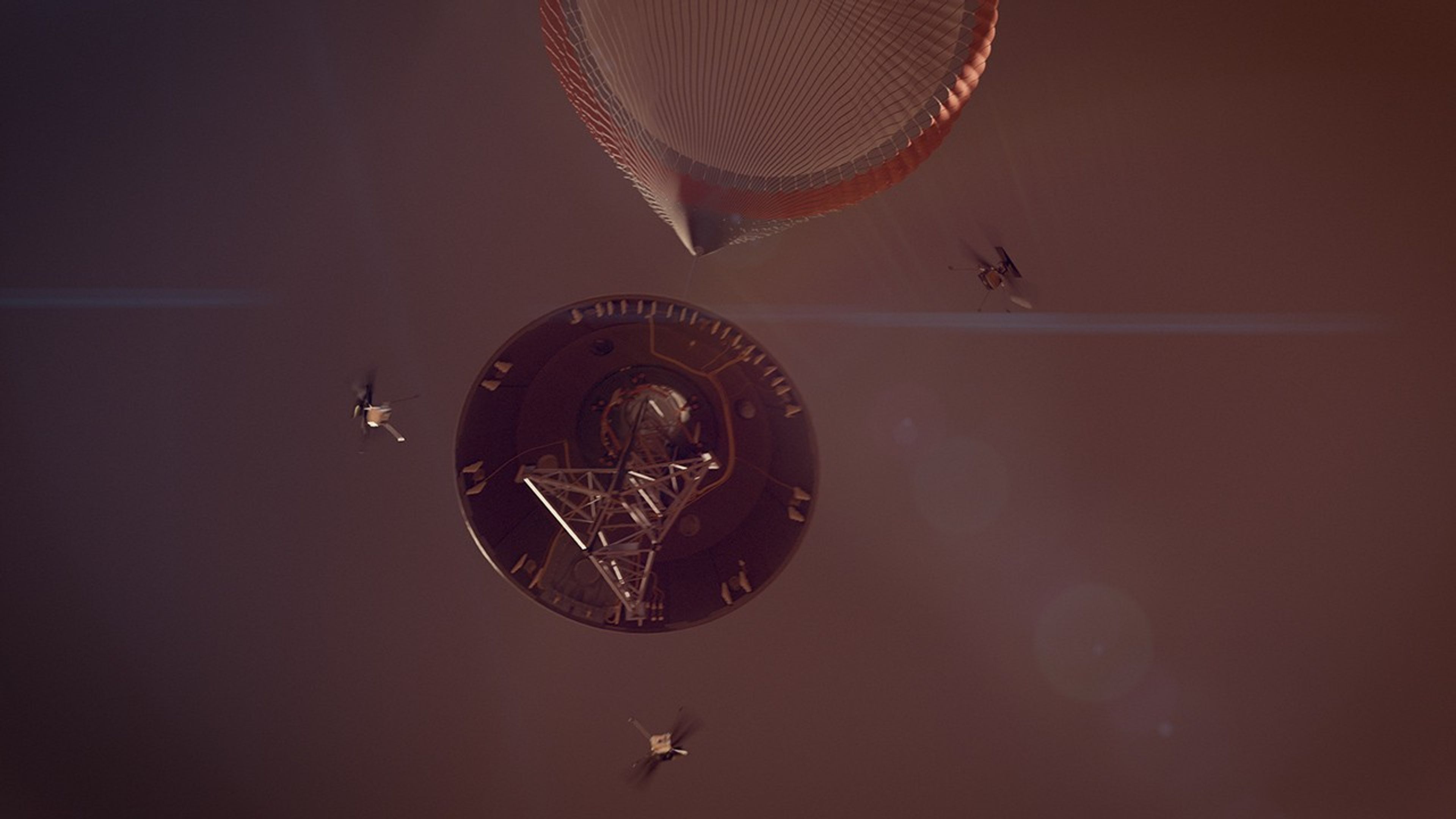 Artist's concept of the three helicopters for the SkyFall mission to Mars, flying away from the aeroshell that carried them into the Martian atmosphere.NASA/JPL-Caltech
 -
Ground Truth
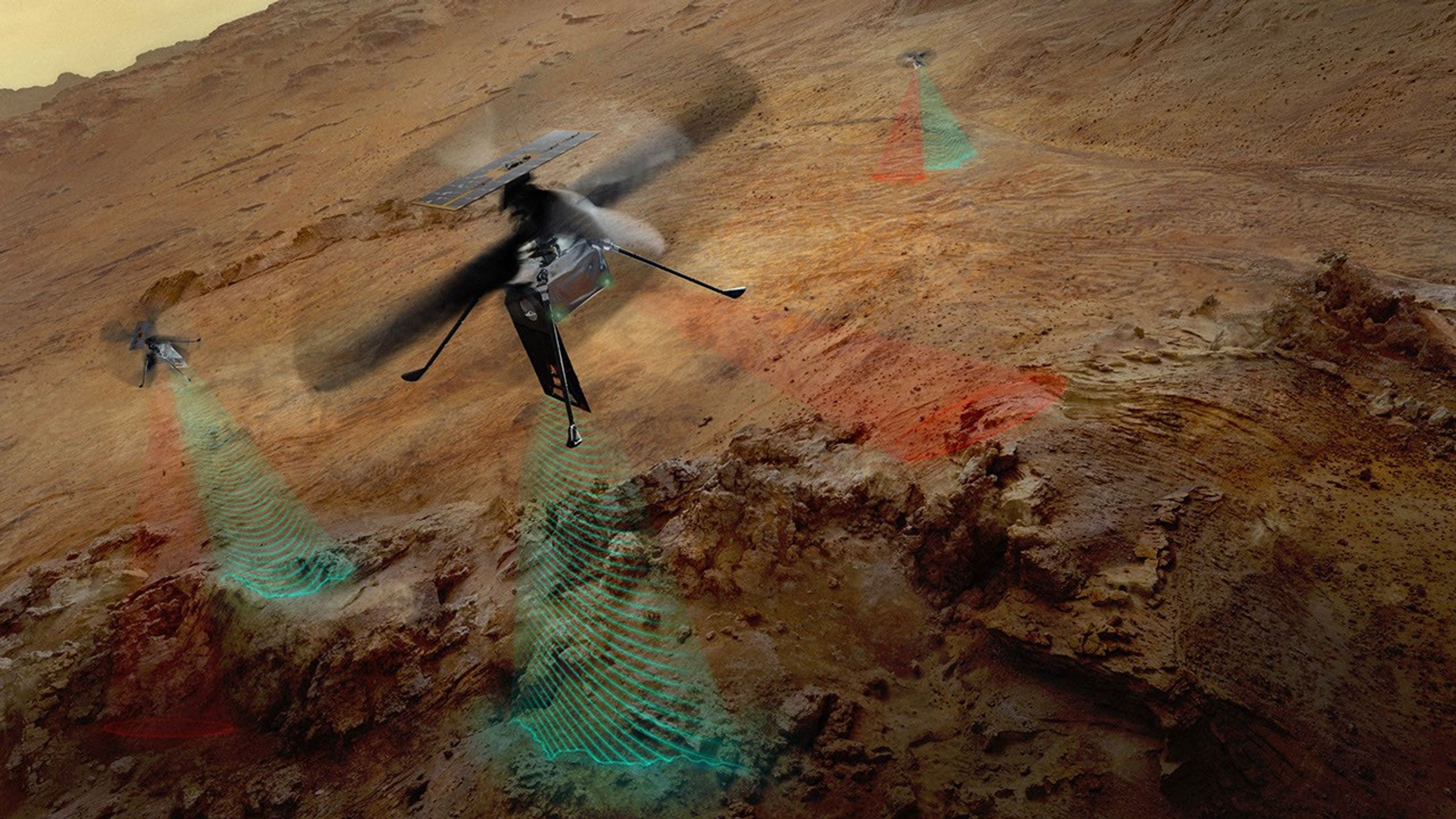
The ground-penetrating radar on each of the SkyFall helicopters will scan the upper 10 feet (3.0 meters) of the Martian crust — and even deeper under ideal conditions — to differentiate layered dust, rock, and ice, in effect “reading” the strata resulting from changes in the planet’s climate, and offering clues to why it turned from warm and wet to frozen desert. The radar will also reveal hidden unstable areas — underground voids, hollow lava tubes, and weak regolith layers — that could make a landing site treacherous for robotic or crewed missions. Future astronauts could use the subsurface ice to provide breathable oxygen and rocket fuel for the trip home. The SkyFall helicopters will independently transmit their findings to spacecraft orbiting Mars, unlike Ingenuity, which had to use the Perseverance rover as a relay station.
 In this artist’s concept illustration, a pair of SkyFall helicopters use their ground-penetrating radar while flying over Martian terrain, searching for underground ice deposits.NASA/JPL-Caltech
 -
Zone Coverage
During a single flight (approximately 2.5 minutes), one SkyFall helicopter is expected to cover about 0.6 to 1.2 miles of Martian surface (about 1 to 2 kilometers). With high-resolution visible-light and near-infrared cameras complementing ground-penetrating radar, the SkyFall helicopters will deliver surface and subsurface mapping — with a level of detail not possible from orbit, and covering a range faster than conventional rovers.
 Artist's concept, diagramming the three SkyFall helicopters spreading outward from their drop zone to explore the Martian surface.NASA/JPL-Caltech
 -
The Wright Stuff
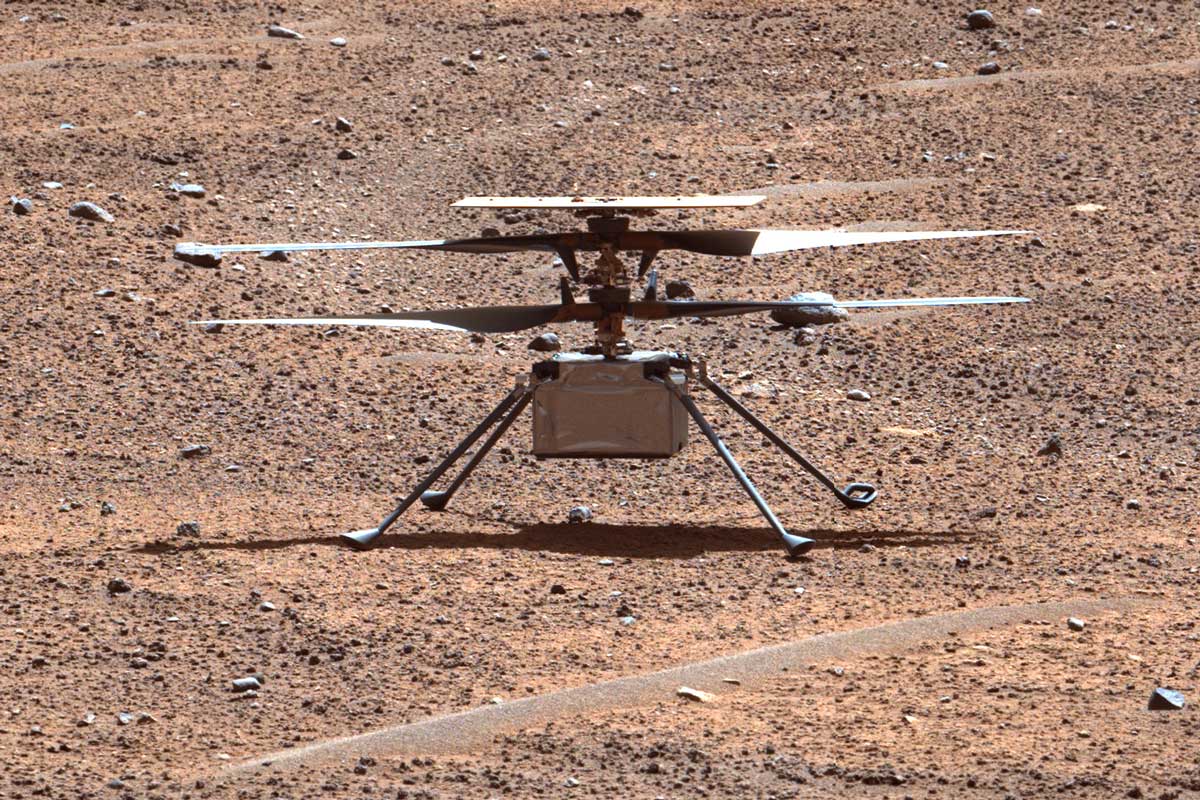
NASA’s Ingenuity Mars Helicopter made aviation and space exploration history when it became the first aircraft to fly on another planet, April 19, 2021. When that lightweight helicopter arrived on Mars, attached to the underside of the Perseverance rover, its goal was to survive a month and make up to five flights. Instead, it flew 72 times over 2½ years, proving that powered, controlled flight was possible in the thin Martian atmosphere. SkyFall builds on Ingenuity’s legacy and proven technology.
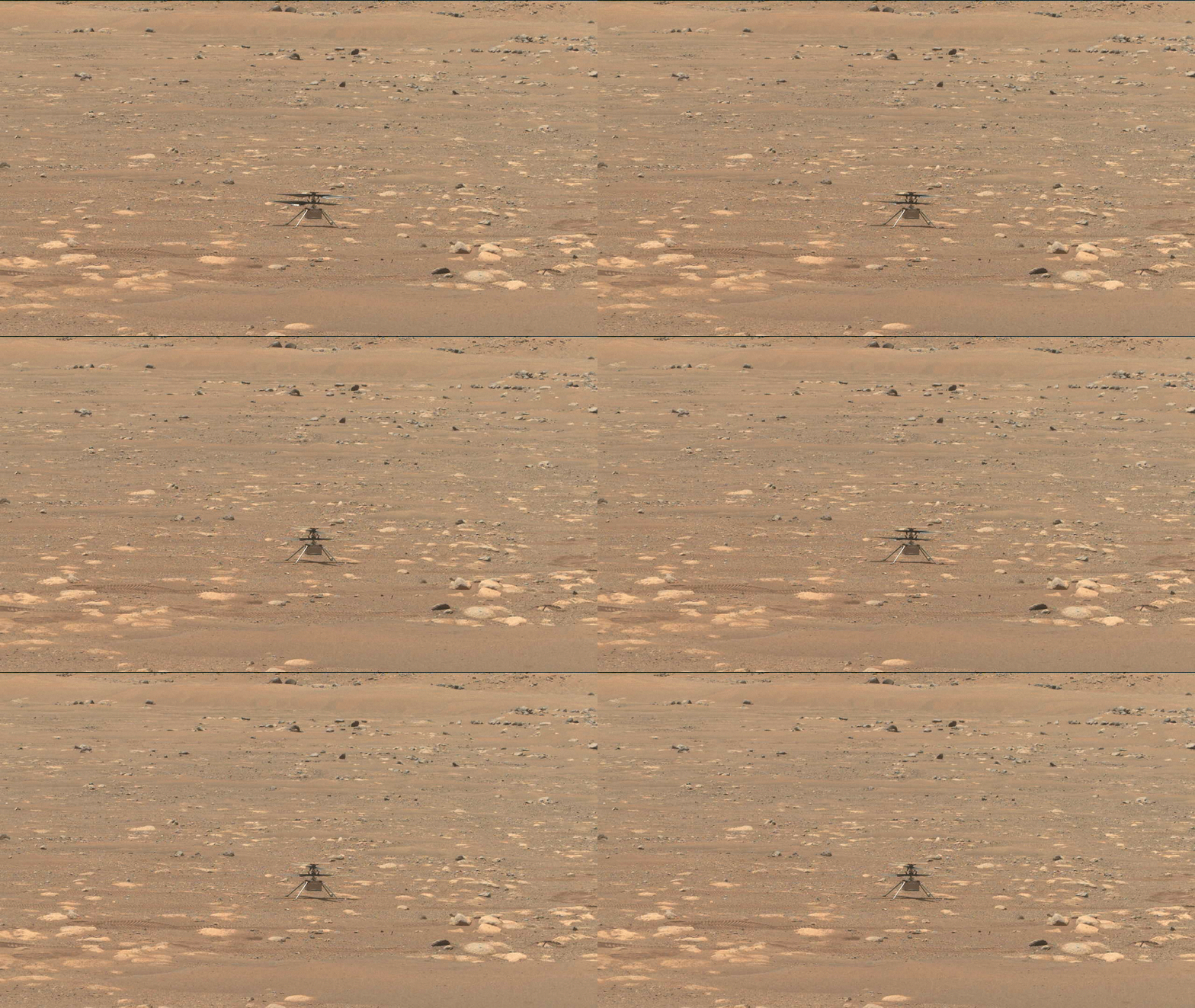 NASA’s Ingenuity helicopter does a slow spin test of its blades on April 8, 2021, the 48th Martian day, or sol, of the mission. This image was captured by the Navigation Cameras on NASA’s Perseverance Mars rover.NASA/JPL-Caltech
The Legacy of Ingenuity
After making history with its initial test flights, Ingenuity embarked on a new mission as an operations demonstration, serving as an aerial scout for mission scientists and rover planners. In its final phase, the helicopter entered a new engineering demonstration period where it executed experimental flight tests that further expanded the team’s knowledge of the vehicle’s aerodynamic limits. Designed to be a monthlong technology demonstration, Ingenuity broke expectations, going higher, farther, and faster than previously imagined. It flew for the last time on Jan. 18, 2024.
Learn More About IngenuityFlight Heritage
The SkyFall helicopters will utilize or adapt proven features and capabilities from the Ingenuity technology demonstration, including:
- Structure
- Rotors
- Motors
- Landing gear
- Flight software
- Autonomous navigation
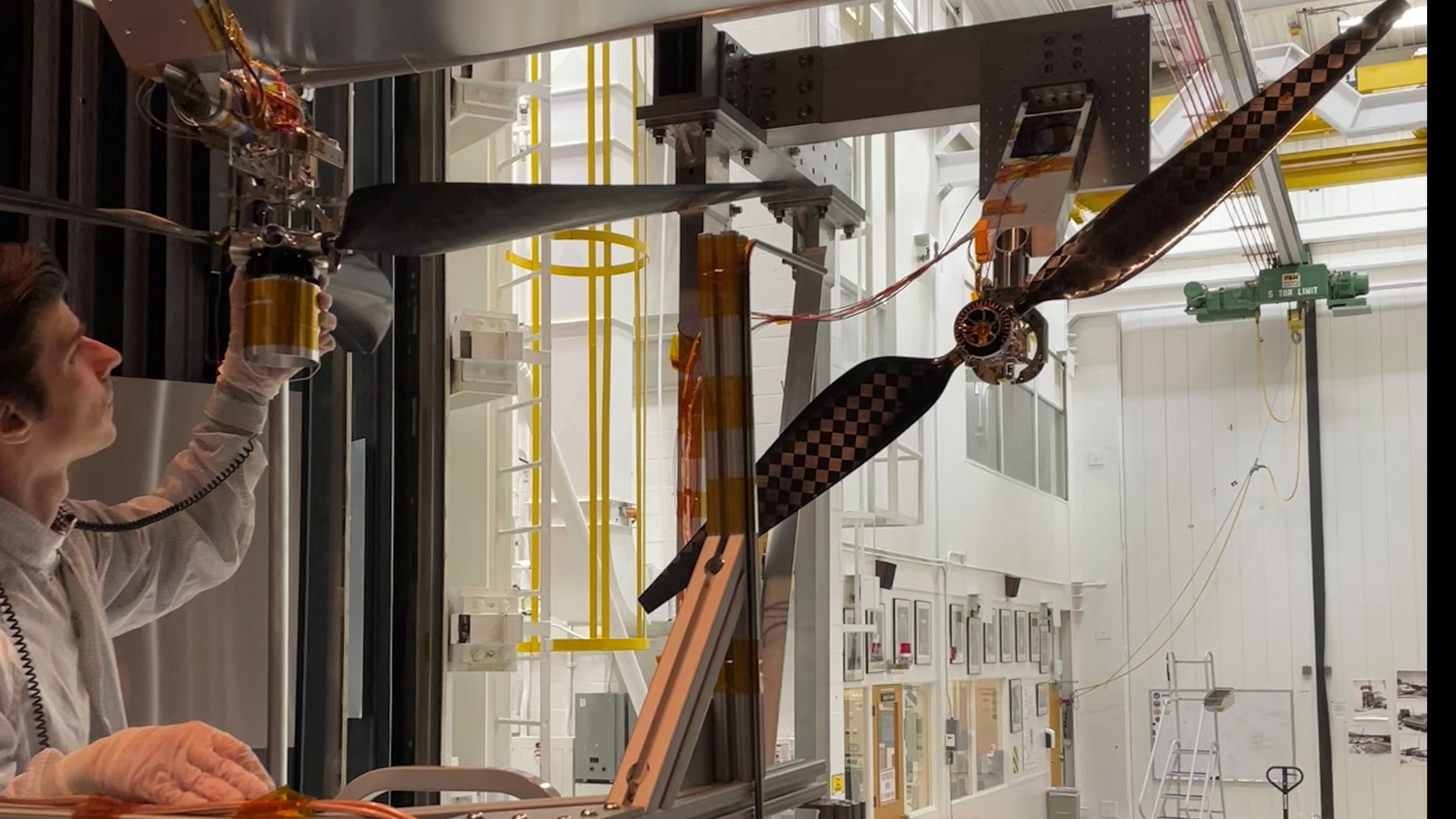
Significant improvements in the Ingenuity design were subsequently made through development work on a sample fetch helicopter design to scale up the lift capacity, partially by increasing the size and speed of the rotor blades. That carrying capability now allows the SkyFall helicopter to carry the ground-penetrating radar and other science instruments. A separate technology development that is enabling for SkyFall is an ultra low-mass direct-to-orbit communications radio, which allows the SkyFall helicopters to operate independently by transmitting commands to/from Earth via orbiters at Mars (as opposed to relaying via a rover or lander, as Ingenuity did). The lessons learned from Ingenuity’s 72 flights on Mars directly informed the helicopter team’s planning for surface operations in future missions.
No Easy Way to Fly
Flight on Mars is challenging because the Red Planet has an extremely thin atmosphere, with only 1% of the pressure at the surface compared to Earth. This means there are relatively few air molecules for a helicopter’s rotor blades to push against to lift the aircraft and fly. That’s why Ingenuity was designed to be light (its mass is 3.97 pounds, or 1.8 kilograms). That bantamweight body was paired with 4-foot-wide rotor blades (1.2 meters) that are much larger and spin much faster than those required for a helicopter of Ingenuity’s mass on Earth. The SkyFall rotor blades are even larger, spanning 4.6 feet (1.4 meters) tip-to-tip, because of its increased payload and the lessons learned from designing Mars sample retrieval helicopters..
Mars does give the helicopters a little help: The gravity there is only about one-third what it is on Earth (because of that, the 4-pound Ingenuity weighs only 1.5 pounds on Mars, or 1.8 kilograms vs. 0.68 kilograms.). That means slightly more mass can be lifted at a given spin rate by its rotor blades.
NASA Pushes Next-Gen Mars Helicopter Rotor Blades Past Mach 1
The rotor blades that will carry NASA’s next-generation helicopters to new Martian heights broke the sound barrier during March tests…
Read the Story