






















APOD
Astronomy Picture of the Day
Discover the cosmos! Each day a different image or photograph of our fascinating universe is featured, along with a brief explanation written by a professional astronomer.
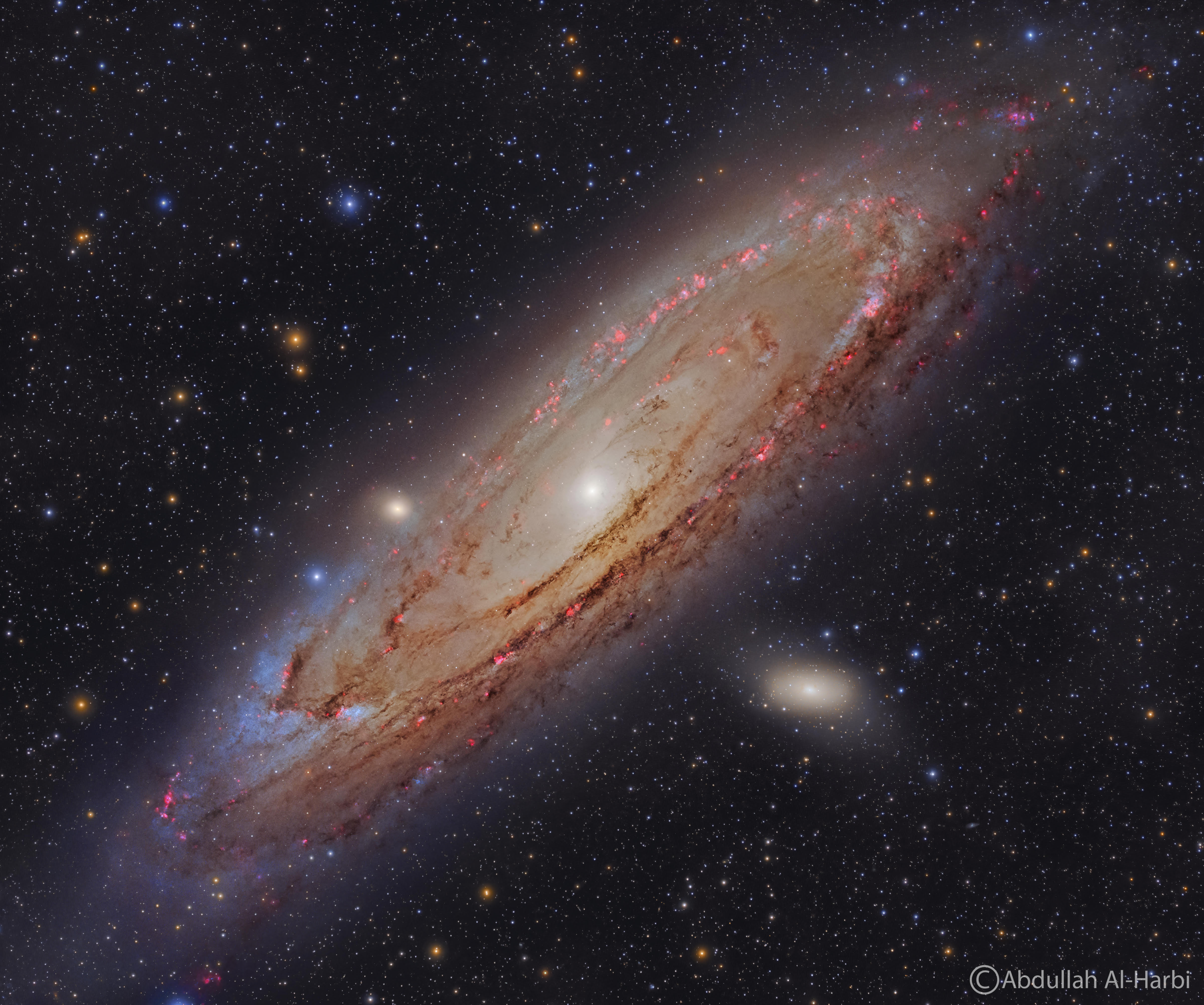
M31: The Andromeda Galaxy
Explanation: How far can you see? The most distant object easily visible to the unaided eye is M31, the great Andromeda Galaxy , over two million light-years away. Without a telescope, even this immense spiral galaxy appears as an unremarkable, faint, nebulous cloud in the constellation Andromeda . But a bright white nucleus, dark winding dust lanes, luminous blue spiral arms, and bright red emission nebulas are recorded in this stunning fifteen-hour telescopic digital mosaic of our closest major galactic neighbor . But how do we know this spiral nebula is really so far away? This question was central to the famous Shapley-Curtis debate of 1920 . M31's great distance was determined in the 1920s by observations that resolved individual stars that changed their brightness in a way that gave up their true distance. The result proved that Andromeda is just like our Milky Way Galaxy -- a conclusion making the rest of the universe much more vast than had ever been previously imagined .
| Date | March 22, 2023 |
|---|---|
| Credit | Image Credit & Copyright: Abdullah Al-Harbi |
| Authors & editors: | Robert Nemiroff (MTU) & Jerry Bonnell (UMCP) |
| A service of: |
ASD at NASA / GSFC, NASA Science Activation & Michigan Tech. U. |