






















APOD
Astronomy Picture of the Day
Discover the cosmos! Each day a different image or photograph of our fascinating universe is featured, along with a brief explanation written by a professional astronomer.
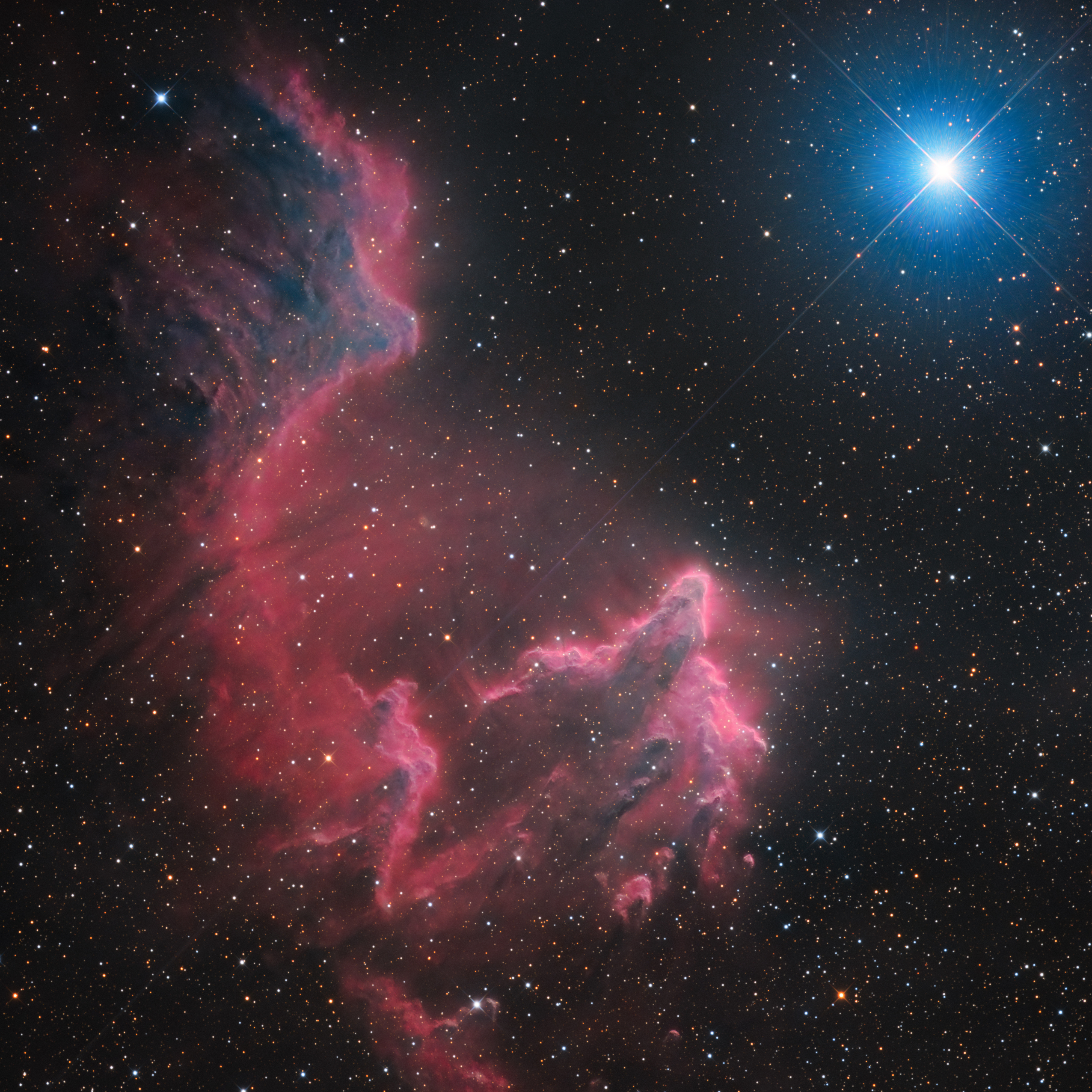
The Ghosts of Gamma Cas
Explanation: Gamma Cassiopeiae shines high in northern autumn evening skies. It's the brightest spiky star in this telescopic field of view toward the constellation Cassiopeia. Gamma Cas shares the ethereal-looking scene with ghostly interstellar clouds of gas and dust, IC 59 (top left) and IC 63. About 600 light-years distant, the clouds aren't actually ghosts. They are slowly disappearing though, eroding under the influence of energetic radiation from hot and luminous gamma Cas. Gamma Cas is physically located only 3 to 4 light-years from the nebulae. Slightly closer to gamma Cas, IC 63 is dominated by red H-alpha light emitted as hydrogen atoms ionized by the star's ultraviolet radiation recombine with electrons. Farther from the star, IC 59 shows proportionally less H-alpha emission but more of the characteristic blue tint of dust reflected star light . The cosmic stage spans over 1 degree or 10 light-years at the estimated distance of gamma Cas and friends .
| Date | October 28, 2023 |
|---|---|
| Credit | Image Credit & Copyright: Guillaume Gruntz , Jean-François Bax |
| Authors & editors: | Robert Nemiroff (MTU) & Jerry Bonnell (UMCP) |
| A service of: |
ASD at NASA / GSFC, NASA Science Activation & Michigan Tech. U. |