






















APOD
Astronomy Picture of the Day
Discover the cosmos! Each day a different image or photograph of our fascinating universe is featured, along with a brief explanation written by a professional astronomer.
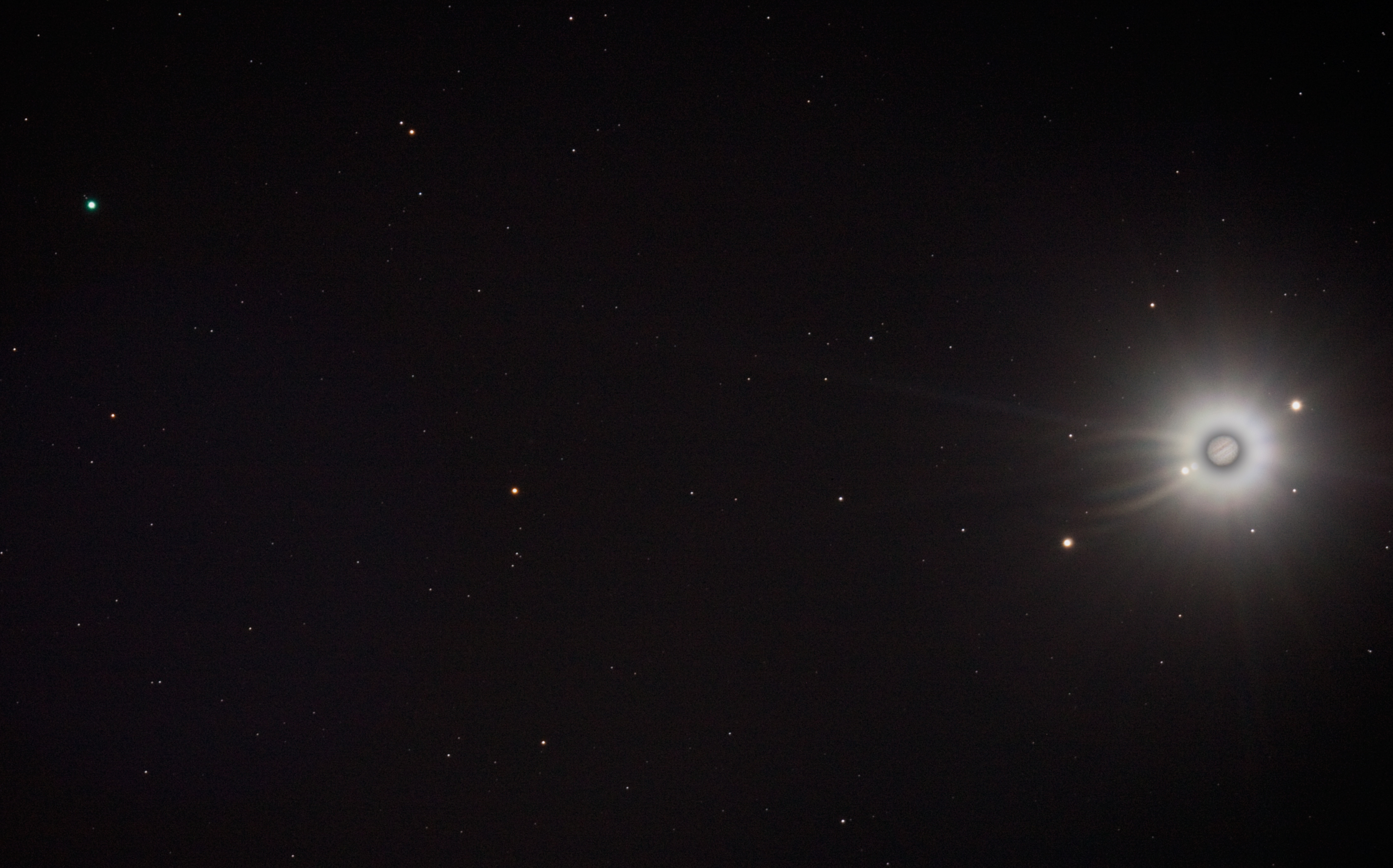
Two Planet Opposition
Explanation: In late September, two planets were opposite the Sun in Earth's sky, Jupiter and Uranus. Consequently closest to Earth, at a distance of only 33 light-minutes and 2.65 light-hours respectively, both were good targets for telescopic observers. Recorded on September 27, this well-planned composite of consecutive multiple exposures captured both gas giants in their remarkable celestial line-up accompanied by their brighter moons. The faint greenish disk of distant planet Uranus is near the upper left corner. Of the tilted planet's 5 larger moons , two can be spotted just above and left of the planet's disk. Both discovered by 18th century British astronomer Sir William Herschel and later named for characters in Shakespeare's A Midsummer Night's Dream, Oberon is farthest left, with Titania closer in. At the right side of the frame is ruling gas giant Jupiter, flanked along a line by all four of its Galilean satellites . Farthest from Jupiter is Callisto , with Europa and Io all left of the planet's disk, while Ganymede stands alone at the right.

| Date | October 8, 2010 |
|---|---|
| Credit | Credit & Copyright: Peter Knappert |
| Authors & editors: | Robert Nemiroff (MTU) & Jerry Bonnell (UMCP) |
| A service of: |
ASD at NASA / GSFC, NASA Science Activation & Michigan Tech. U. |