






















APOD
Astronomy Picture of the Day
Discover the cosmos! Each day a different image or photograph of our fascinating universe is featured, along with a brief explanation written by a professional astronomer.
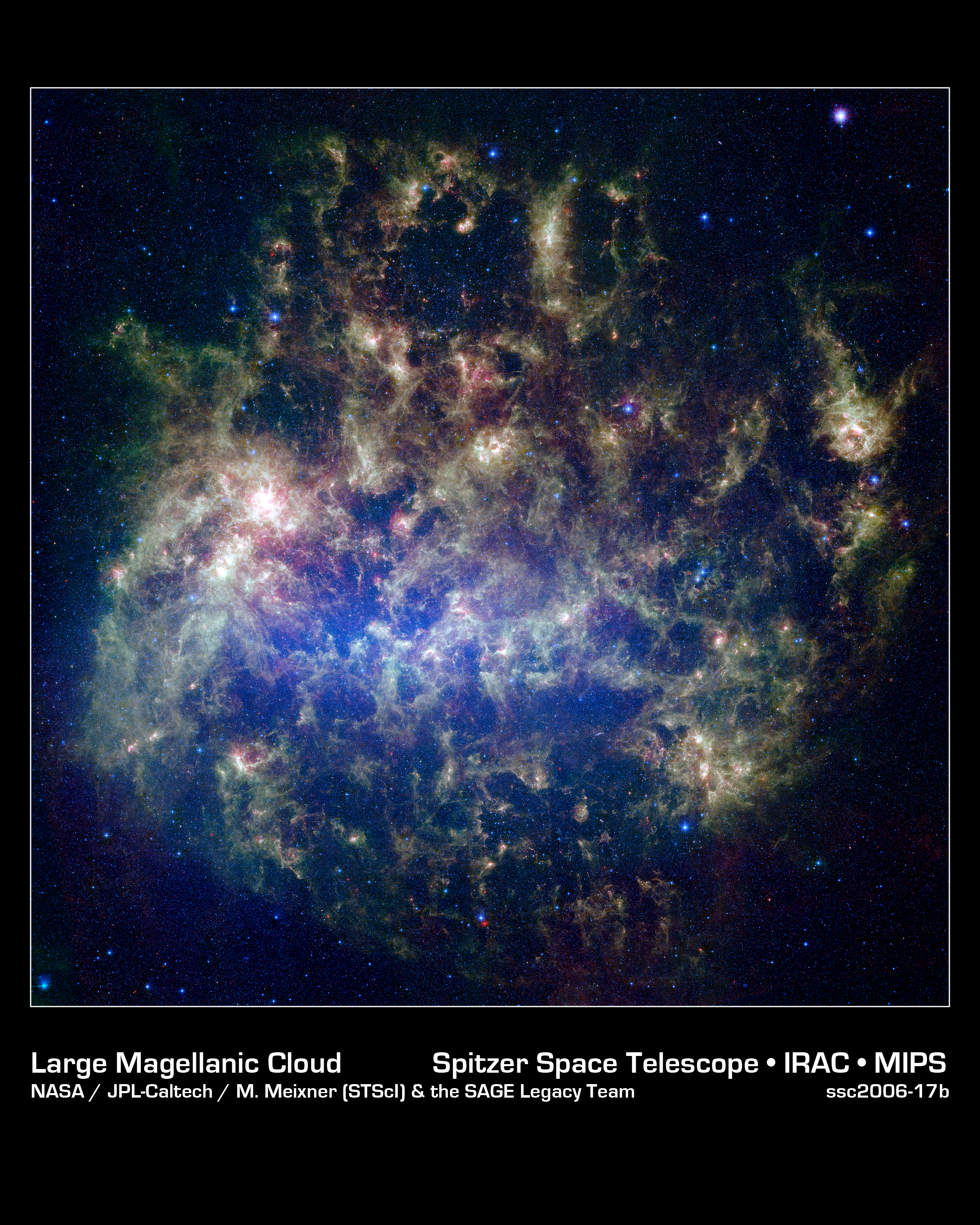
The Large Magellanic Cloud in Infrared
Explanation: Where does dust collect in galaxies? To help find out, a team of researchers took the most detailed image ever of gas clouds and dust in the neighboring Large Magellanic Cloud (LMC) galaxy. The composite image, shown above , was taken by the Spitzer Space Telescope in infrared light , which highlights the natural glow of the warm materials returned to the interstellar medium by stars. The above mosaic combines 300,000 individual pointings to create a composite 1,000-times sharper than any previous LMC image. Visible are vast clouds of gas and dust , showing in graphic detail that dust prefers regions near young stars (red-tinted bright clouds), scattered unevenly between the stars (green-tinted clouds), and in shells around old stars (small red dots). Also visible are huge cavern s cleared away by the energetic outflows of massive former stars. The faint blue (false-color) glow across the bottom is the combined light from the old stars in the central bar of the LMC. The LMC is a satellite galaxy to our own Milky Way Galaxy , spans about 70,000 light years , and lies about 160,000 light years away toward the southern constellation of the Swordfish ( Dorado ).
| Date | September 4, 2006 |
|---|---|
| Credit | Credit: NASA / JPL-Caltech / M. Meixner ( STScI ) & the SAGE Legacy Team |
| Authors & editors: | Robert Nemiroff (MTU) & Jerry Bonnell (UMCP) |
| A service of: |
ASD at NASA / GSFC, NASA Science Activation & Michigan Tech. U. |