






















APOD
Astronomy Picture of the Day
Discover the cosmos! Each day a different image or photograph of our fascinating universe is featured, along with a brief explanation written by a professional astronomer.
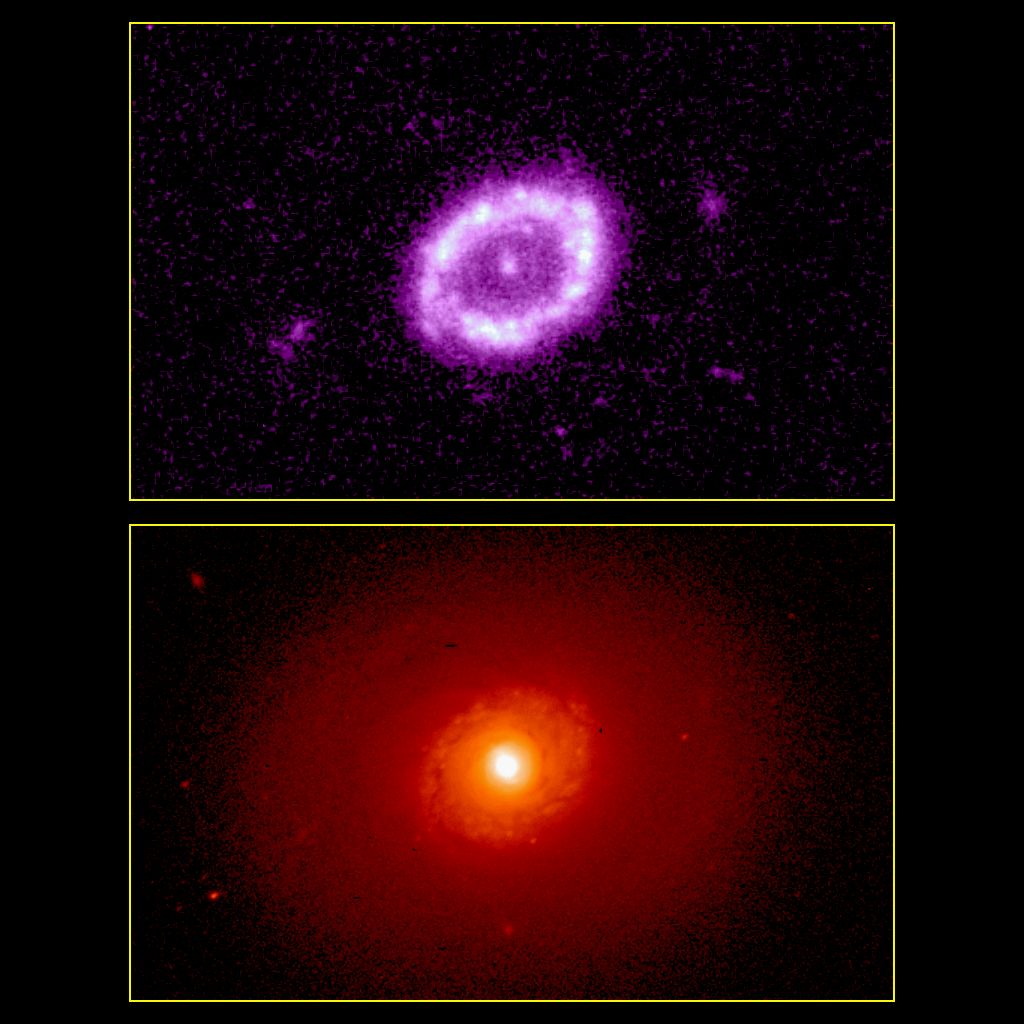
M94: Beyond the Blue
Explanation: Today's galaxy, M94 (NGC 4736), lies 15 million light-years away in the constellation Canes Venatici . In the red light image (left), its very bright nucleus and tightly wound spiral arms seem to slowly fade into a faint outer disk. But when viewed in wavelengths shorter than blue light - ultraviolet (UV) light - its appearance dramatically changes. While the red light image highlights the older, cooler stars of M94 , the UV picture (right), from the shuttle-borne Ultraviolet Imaging Telescope, is dominated by clusters of massive, hot stars a mere 10 million years young . These UV bright young star clusters are mostly arranged in a stunning ring nearly 7,000 light-years wide around the galactic nucleus. What controls this star forming activity? Exploring wavelengths beyond the blue , astronomers now have evidence that star forming activity in galaxies like M94 can be orchestrated by the symmetric structure of the galaxies themselves instead of the titanic galaxy-galaxy collisions suspected in yesterday's case of the Cartwheel galaxy.
| Date | June 13, 2001 |
|---|---|
| Credit | Credit: W. Waller ( Tufts University ), et al., UIT Project , NASA |
| Authors & editors: | Robert Nemiroff (MTU) & Jerry Bonnell (UMCP) |
| A service of: |
ASD at NASA / GSFC, NASA Science Activation & Michigan Tech. U. |