




















APOD
Astronomy Picture of the Day
Discover the cosmos! Each day a different image or photograph of our fascinating universe is featured, along with a brief explanation written by a professional astronomer.

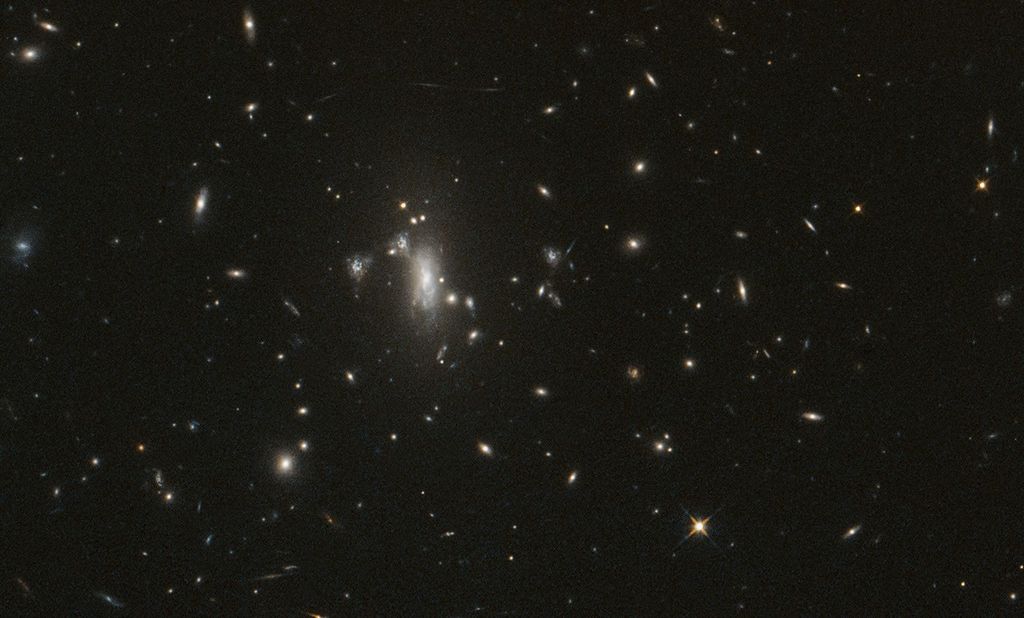
Star Forming Region Hubble-V
Explanation: How did stars form in the early universe? Astronomers are gaining insight by studying NGC 6822 , a nearby galaxy classified as irregular by modern standards but appearing more typical of galaxies billions of years ago . Inspection of NGC 6822 shows several bright star groups, including two dubbed Hubble-X and Hubble-V. Pictured above , the Hubble Space Telescope has resolved Hubble V into the energetic stars that are lighting up the surrounding gas. Each star in the central dense knot of Hubble V shines brighter than 100,000 Sun s. The Hubble V gas cloud spans about 200 light years and lies about 1.5 million light-years away toward the constellation Sagittarius .
| Date | December 25, 2001 |
|---|---|
| Credit | Credit: C. R. O'Dell ( Vanderbilt ) et al. , L. Bianchi ( JHU ) et al. , Hubble Heritage Team , NASA |
| Authors & editors: | Robert Nemiroff (MTU) & Jerry Bonnell (UMCP) |
| A service of: |
ASD at NASA / GSFC, NASA Science Activation & Michigan Tech. U. |