




















APOD
Astronomy Picture of the Day
Discover the cosmos! Each day a different image or photograph of our fascinating universe is featured, along with a brief explanation written by a professional astronomer.

Fomalhaut Dust Disk Indicates Planets
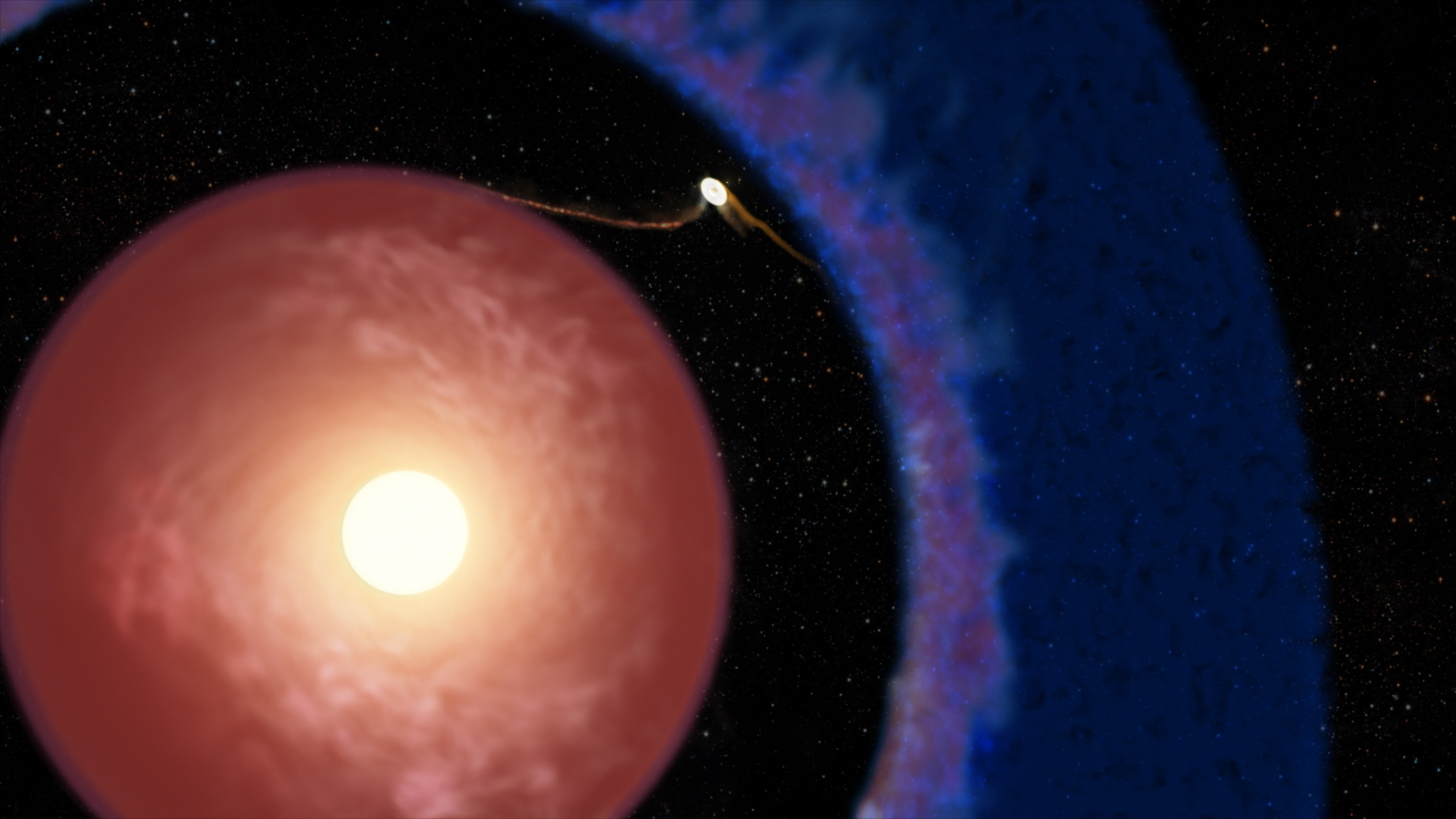
Explanation: One of the brightest stars on the sky likely has planets. Fomalhaut , actually the 17th brightest star in the night sky, is a mere 22 light-years away but only a fraction of the age of our Sun . Recent observations in far infrared light with a detector cooled to near zero kelvins indicate a dust disk surrounding Fomalhaut that has both a hole in the center and a warped edge. Now the hole in the center indicates that dust has fallen onto interior planets -- possibly like the Earth -- while the warp at the edge indicates the gravitational pull of a planet like Jupiter or Saturn . The discovery image was taken with the SCUBA instrument through the James Clerk Maxwell Telescope in Hawaii , USA . The above illustration shows what the Fomalhaut dusty planetary system might look like from near the large planet.
| Date | October 11, 2002 |
|---|---|
| Credit | Drawing Credit: David A. Hardy , ROE , ATC , NSF , NASA |
| Authors & editors: | Robert Nemiroff (MTU) & Jerry Bonnell (UMCP) |
| A service of: |
ASD at NASA / GSFC, NASA Science Activation & Michigan Tech. U. |