


























APOD
Astronomy Picture of the Day
Discover the cosmos! Each day a different image or photograph of our fascinating universe is featured, along with a brief explanation written by a professional astronomer.

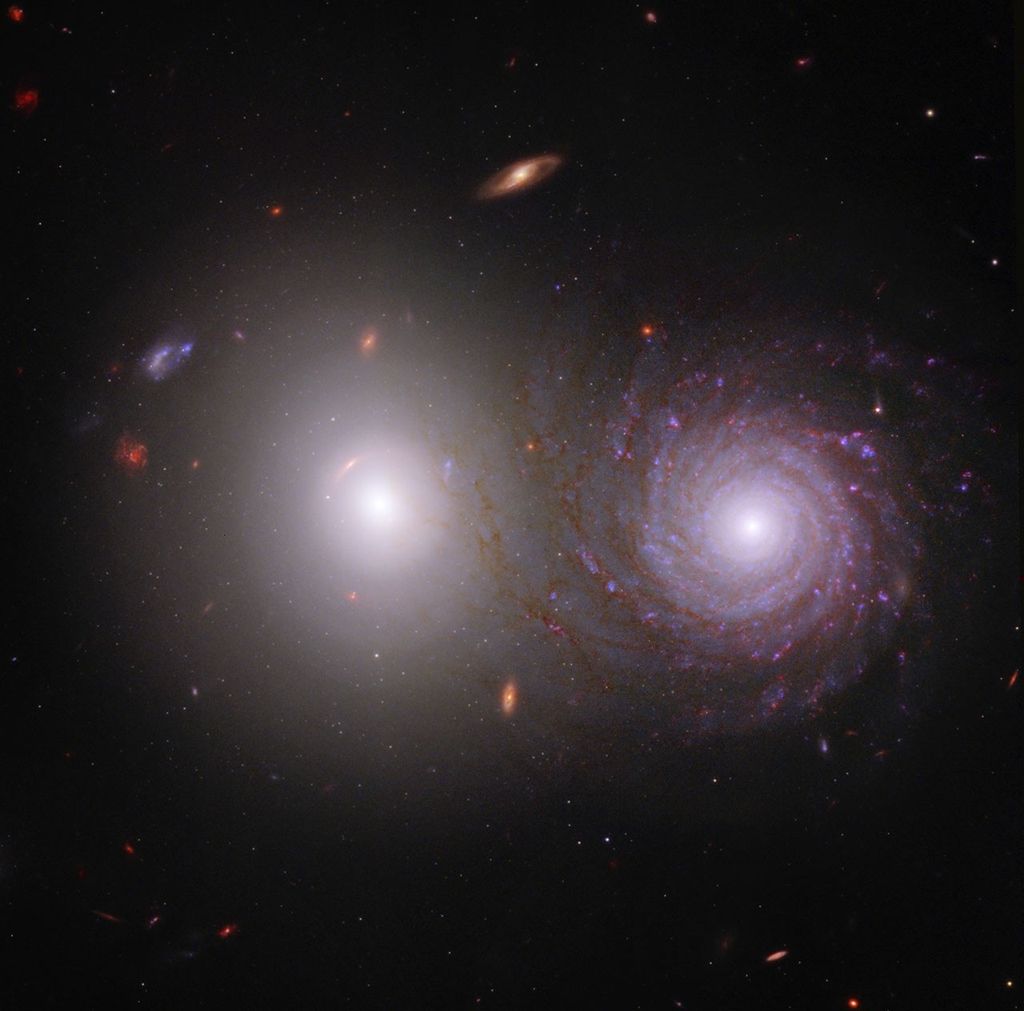
The Large Cloud of Magellan
Explanation: Magellan and his crew had plenty of time to study the southern sky during their famous voyage around the world. As a result, two fuzzy cloud like objects, nestled among the southern constellations of Doradus and Tucana are now known as the Clouds of Magellan. The Magellanic Clouds are small irregular galaxies , satellites of our larger Milky Way spiral galaxy. The Large Magellanic Cloud (LMC) pictured above is the closest galaxy to our own Milky Way, at a distance of about 180,000 light years. The Magellanic Clouds are joined to the Milky Way by a stream of cold hydrogen gas whose origin is still controversial. An unusual effect called gravitational lensing has recently been detected in a few LMC stars, and there is hope this could tell us important information about the true composition of our universe.
| Date | September 18, 1995 |
|---|---|
| Credit |
Credit: Photograph made from plates taken with the UK Schmidt Telescope. Color photography by David Malin. Copyright: Anglo-Australian Telescope Board |
| Authors & editors: | Robert Nemiroff (MTU) & Jerry Bonnell (UMCP) |
| A service of: |
ASD at NASA / GSFC, NASA Science Activation & Michigan Tech. U. |