













Suggested Searches

NASA’s Eyes

Learn more about NASA's Eyes software, which turns your browser into a spacecraft to explore hundreds of planets, moons, and over 170 real NASA missions and their data in stunning, interactive 3D. Visit frequently to get all the latest news, updates, tutorials and features. 

NASA’s Eyes software: September release notes

On September 30, 2026, a new version of Eyes on Asteroids was released. This release added a new “Impact” tab on the asteroid information panel, as well as a “Watch” button to see the impact at the time it happened. In addition, for any of the 42,580 Near-Earth Objects (NEOs), there is now a “Watch” button to see the closest approach to Earth, but only if the asteroid comes within 0.05 Astronomical Units (7,479,894 kilometers or 4,647,790 miles). Usually, those close approaches will still be far away, and this tool give you a way to visualize that in a 3D environment. Please note that the time range represented in Eyes on Asteroids only goes ten years into the future in order to keep accuracy at a high level. So if a close approach is more than ten years from now, we do not show it in 3D.
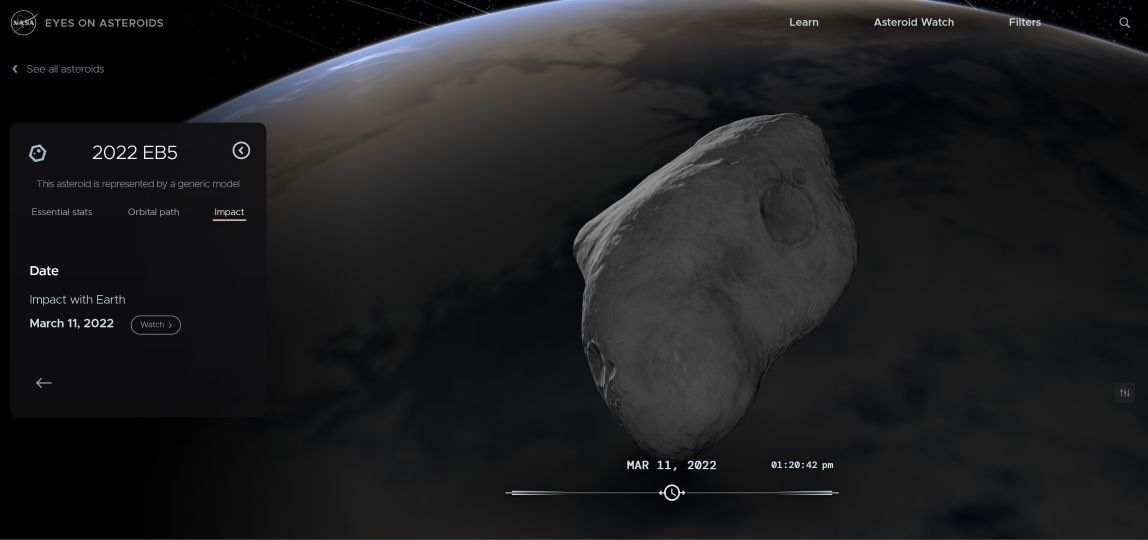
An image take from the web application Eyes on Asteroids showing the asteroid 2022 EB5 above the Earth as it heads towards an impact on March 11, 2022.
Any asteroid that actually impacted on Earth in the past will have an Impact tab in the information panel, as well as a Watch button to see the actual incident.

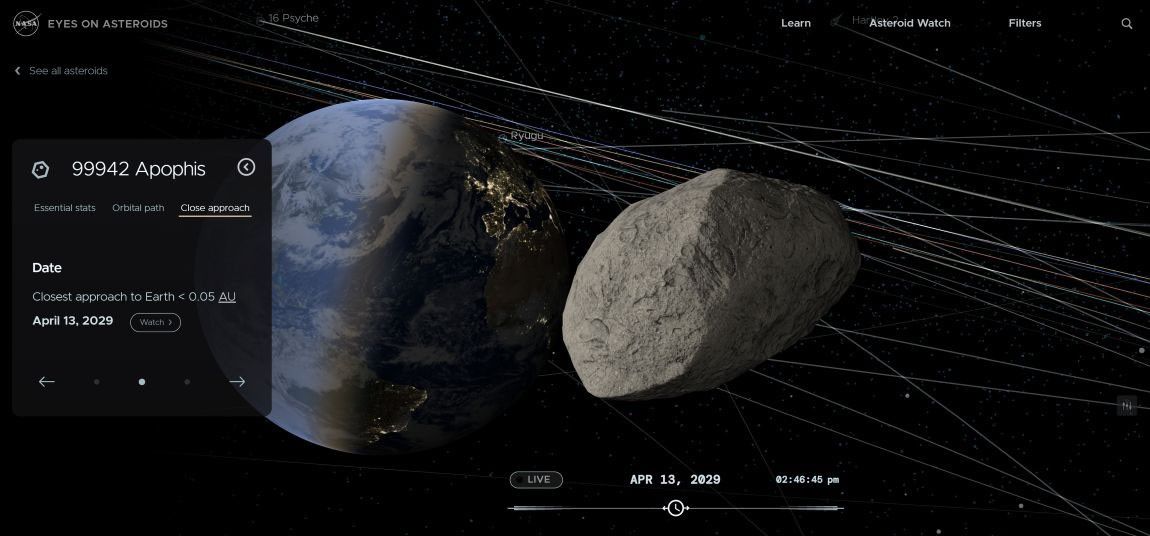
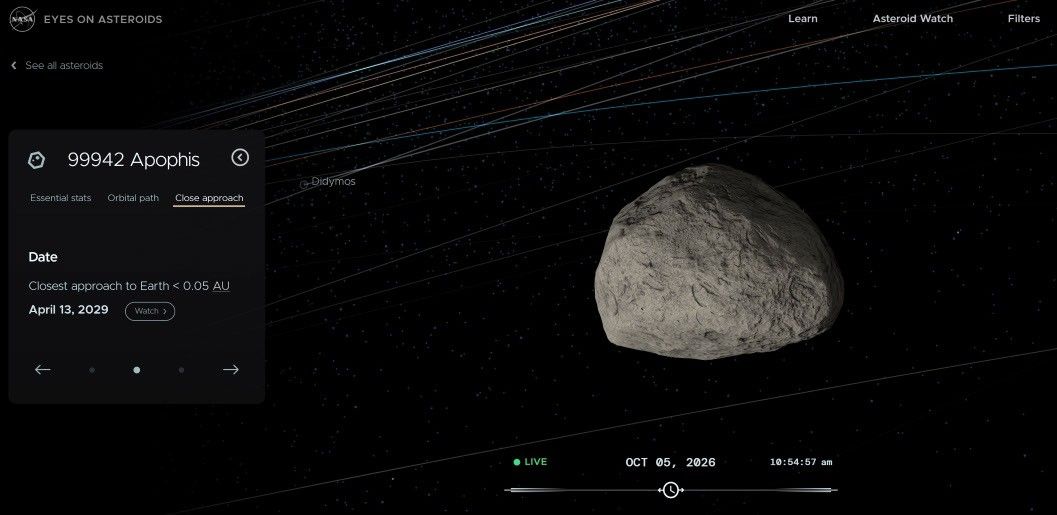
An image from Eyes on Asteroids showing the Apophis asteroid and an information panel on the left, which includes a new "Watch" button to see the future close approach of the asteroid in 3D.
For an asteroid like Apophis, you can see the closest approach to Earth in the future, but only if the distance is less than 0.05 AU.

An image from Eyes on Asteroids showing the asteroid Apohis near Earth at the date of closest approach in 2029.
Once the Watch button is clicked, the user is taken to the actual time of close approach.

This release also features an updated story in the “Learn” section, titled “How NASA Protects Earth”. This has a new slide that features NEO Surveyor, which is launching in 2027 and will specifically look for darker asteroids that are harder to spot.
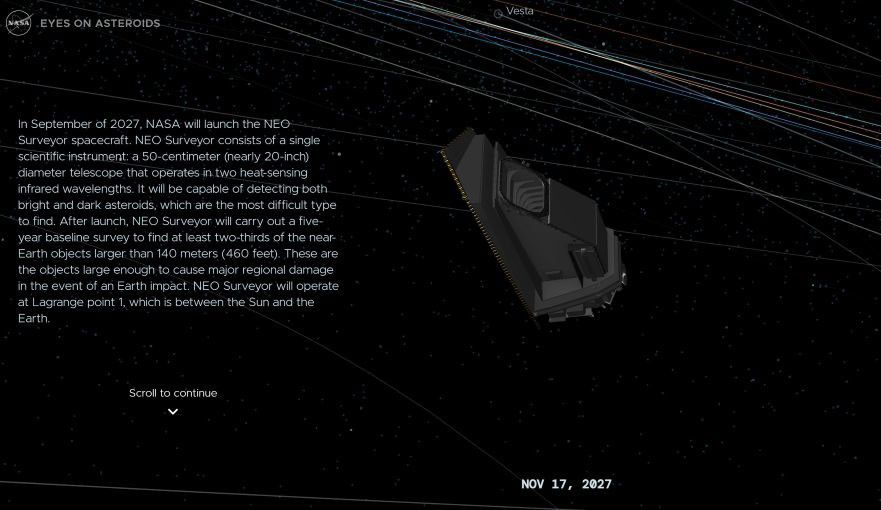
An image from slide 7 of the Eyes on Asteroids interactive learning feature that shows NEO Surveyor in space in November of 2027, along with text explaining the mission's purpose.

There are dozens of other bugfixes and improvements in this release as well. Please do explore!