



















Auroras on Uranus
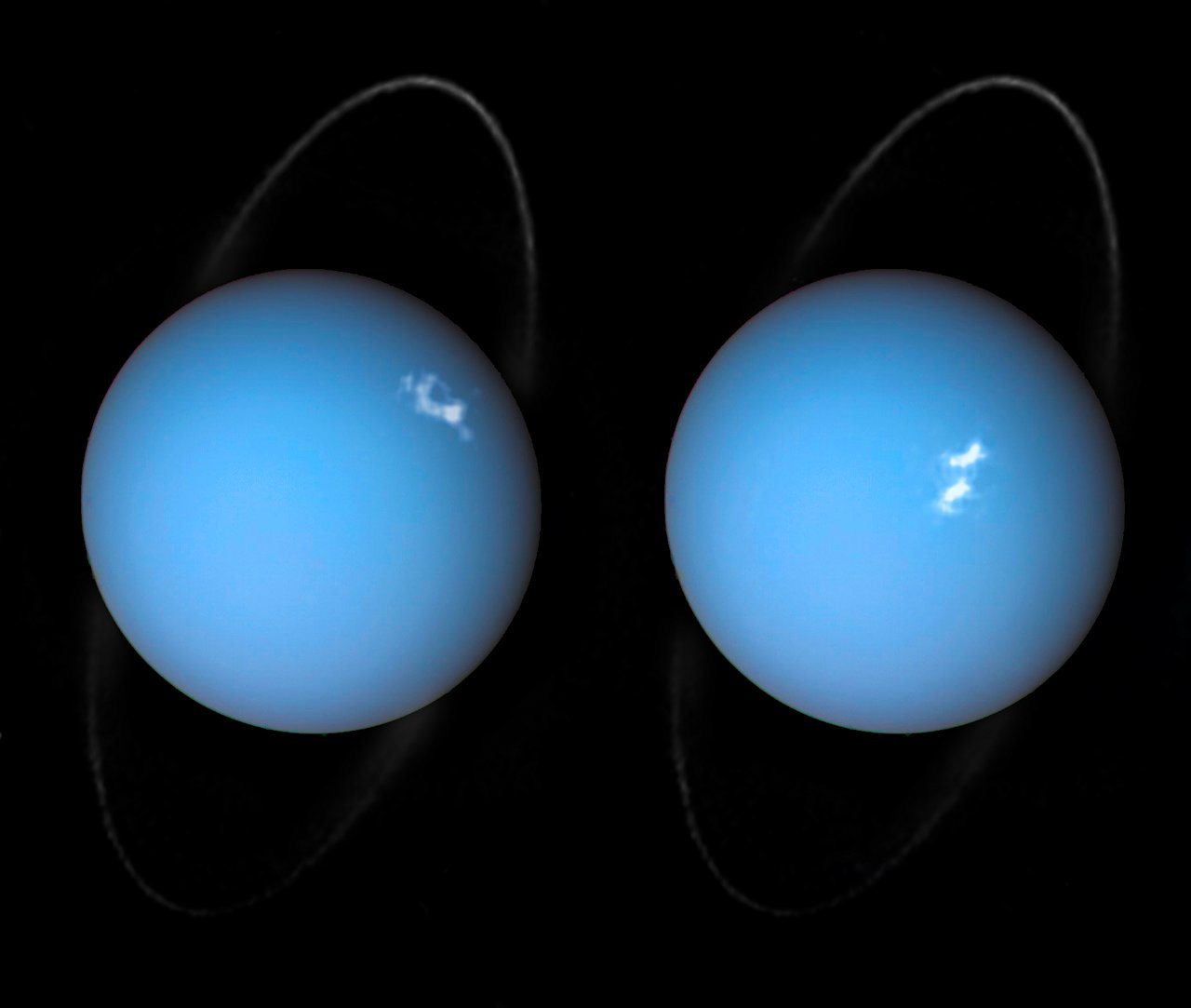
The auroras on Jupiter and Saturn are well-studied, but not much is known about the auroras of the giant ice planet Uranus. In 2011, the Hubble Space Telescope became the first Earth-based telescope to snap an image of the auroras on Uranus. In 2012 and 2014 a team led by an astronomer from Paris Observatory took a second look at the auroras using the ultraviolet capabilities of the Space Telescope Imaging Spectrograph (STIS) installed on Hubble. The team tracked the interplanetary shocks caused by two powerful bursts of solar wind travelling from the Sun to Uranus, then used Hubble to capture their effect on Uranus’ auroras — and found themselves observing the most intense auroras ever seen on the planet. By watching the auroras over time, they collected the first direct evidence that these powerful shimmering regions rotate with the planet. This is a composite image of Uranus by Voyager 2 and two different observations made by Hubble — one for the ring and one for the auroras.
Image Credit: ESA/Hubble & NASA, L. Lamy/Observatoire de Paris
- X
https://science.nasa.gov/image-detail/amf-gsfc_20171208_archive_e000100/
TakenDecember 8, 2017
ProducerGSFC
Image CreditESA/Hubble & NASA, L. Lamy/Observatoire de Paris
Size1280x1083px
PIA NumberGSFC_20171208_Archive_e000100
