

















1 min read
NGC 1333 (Spitzer)
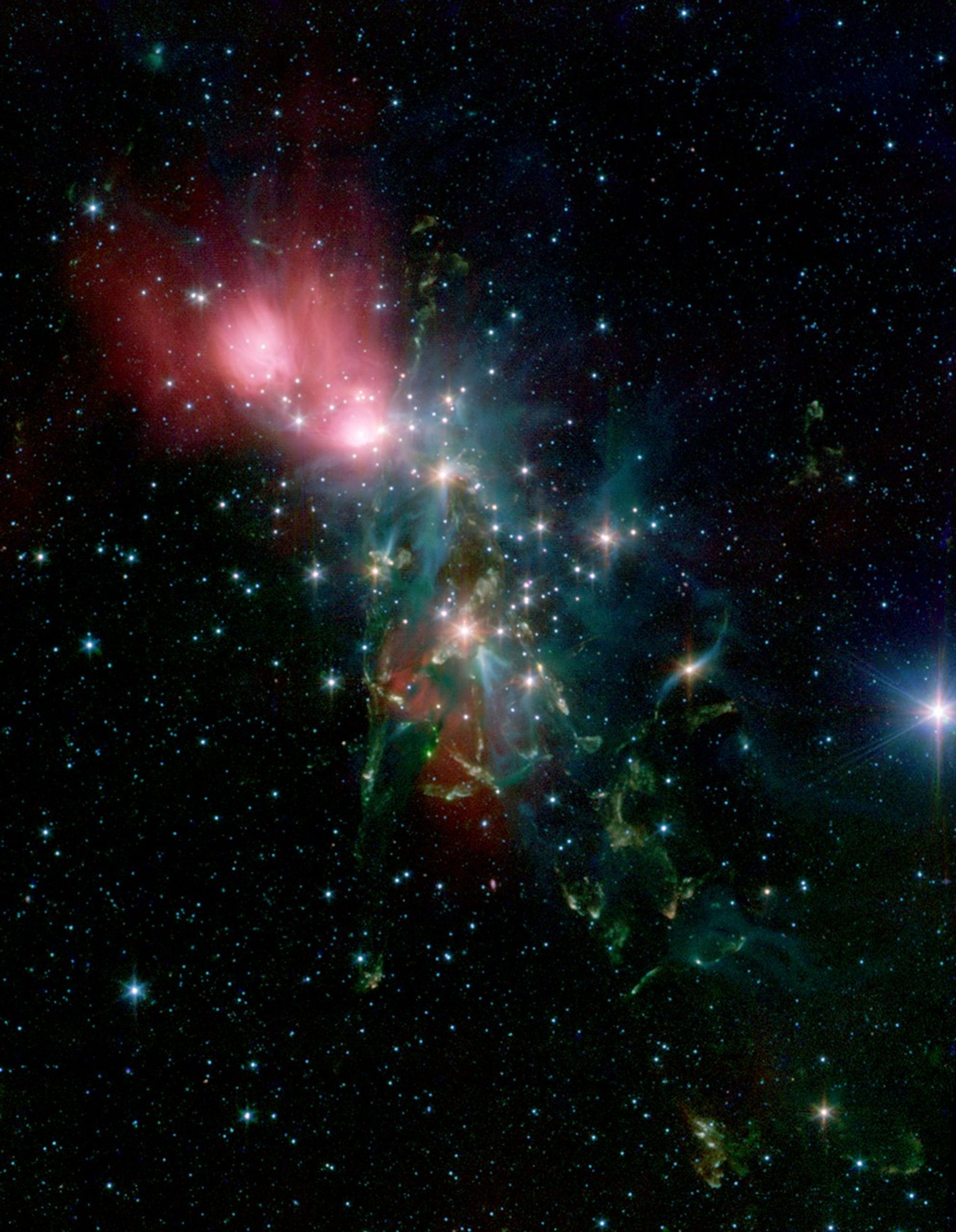
Scientists will use Webb to search the nearby stellar nursery NGC 1333 for its smallest, faintest residents. It is an ideal place to look for very faint, free-floating objects, including those with planetary masses. This image was captured by the Spitzer Space Telescope.
About the Object
- R.A. PositionR.A. PositionRight ascension – analogous to longitude – is one component of an object's position.3h 29m 02s
- Dec. PositionDec. PositionDeclination – analogous to latitude – is one component of an object's position.+31° 22' 12"
- ConstellationConstellationOne of 88 recognized regions of the celestial sphere in which the object appears.Perseus
- DistanceDistanceThe physical distance from Earth to the astronomical object. Distances within our solar system are usually measured in Astronomical Units (AU). Distances between stars are usually measured in light-years. Interstellar distances can also be measured in parsecs.1,000 light-years
About the Data
- Data DescriptionData DescriptionProposal: A description of the observations, their scientific justification, and the links to the data available in the science archive.
Science Team: The astronomers who planned the observations and analyzed the data. "PI" refers to the Principal Investigator.Spitzer IRAC observations. Blue=3.6 microns, Green=4.5 microns, Orange=5.8 microns, Red=8.0 microns
- Object NameObject NameA name or catalog number that astronomers use to identify an astronomical object.NGC 1333
- Object DescriptionObject DescriptionThe type of astronomical object.Star-forming region
- Release DateDecember 18, 2019
- Science ReleaseNASA’s Webb Telescope to Search for Young Brown Dwarfs and Rogue Planets
- CreditImage: NASA, Caltech, R.A. Gutermuth (CfA)
Share
Details
Last Updated
Aug 28, 2025
Contact
Media
Laura Betz
NASA’s Goddard Space Flight Center
Greenbelt, Maryland
laura.e.betz@nasa.gov
Image Credit
NASA, Caltech, R.A. Gutermuth (CfA)