










Description
Map Projected Browse Image
Click on the image for larger version
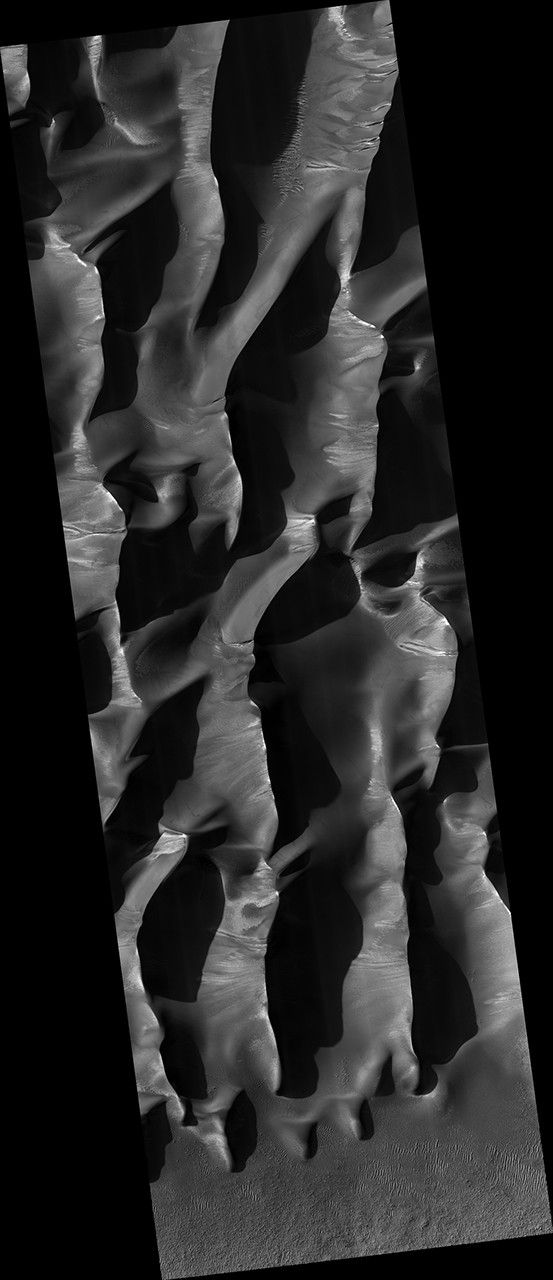
The giant sand dunes in Kaiser Crater experience gully erosion of the steep slip faces every year in late winter as the sun warms these slopes and seasonal carbon dioxide frost sublimates (meaning it changes from a solid to gas).
Some of these gullies produce a variety of colors that are highlighted on the west-facing (illuminated) slopes, where the gullies appear to be glowing in the winter light.
The University of Arizona, Tucson, operates HiRISE, which was built by Ball Aerospace & Technologies Corp., Boulder, Colo. NASA's Jet Propulsion Laboratory, a division of the California Institute of Technology in Pasadena, manages the Mars Reconnaissance Orbiter Project for NASA's Science Mission Directorate, Washington.