










Science and Technology Interest Group
Artificial Intelligence and Machine Learning Science and Technology Interest Group
The NASA Cosmic Origins Program AI/ML Science and Technology Interest Group (AI/ML STIG) addresses the critical need to upskill the astronomy community with AI literacy. We provide structured, domain-specific AI education through stackable, bite-sized modular training designed for astronomical research contexts.
About AI/ML STIG
Building AI Literacy for Astronomical Research
Astrophysics is an emerging technology for big-data science, and the use of Artificial Intelligence (AI) and Machine Learning (ML) technology will be inevitable in the coming decades.
The AI and ML Science and Technology Interest Group (AI/ML STIG) is motivated by the awareness that upskilling the scientific community could have a transformative impact to counter critical challenges facing astronomical research today.
By providing structured, domain-specific AI education, the AI/ML STIG aims to accelerate NASA's competitive advantage in AI-enabled space science, build the interdisciplinary workforce essential for next-generation astronomical discoveries, create a model for other NASA programs facing similar upskilling challenges, and establish NASA’s leadership in responsible AI adoption to maximize the science return from its missions by the community. The modular, community-driven approach ensures scalability while maintaining the rigor and domain relevance essential for meaningful scientific advancement. This STIG serves as a focal point for addressing these challenges through community townhalls for discussions and organizing short tutorials to address specific astronomical AI applications, modules, and foundational concepts.
Stay Connected
Subscribe to the AI/ML STIG Email List
To join the list, send an email to AI-ML-STIG-join@lists.nasa.gov with Subject="join"
To unsubscribe, send an email to AI-ML-STIG-leave@lists.nasa.gov with Subject="leave"
Your email address will be used only for the purpose of subscription to the selected email distribution list. For further information, read the NASA Web Privacy Policy.
STIG Leadership
| Yuan-Sen Ting, Co-Chair | The Ohio State University |
| Digvijay (Jay) Wadekar, Co-Chair | University of Texas at Austin |
| Artem Poliszczuk | Stanford |
| Tri Nguyen | Northwestern University |
| Ce Sui | The Ohio State University |
| Julie Rolla | NASA Jet Propulsion Laboratory (JPL) |
Senior Consultants
| Kelle Cruz | City University of New York |
| Bhuvnesh Jain | University of Pennsylvania |
| Moritz Munchmeyer | University of Wisconsin Madison |
News & Events
Meetings, conferences, seminars, workshops, and other news and events for the STIG

Finetuning and Reinforcement Learning. Speaker: Moritz Münchmeyer, University of Wisconsin, Madison
Transformers, Attention, and Pre-Training. Speaker: Josh Nguyen, University of Pennsylvania
Hands-On Session II: Agentic Coding and Research Tools. Speaker: Serat Saad, The Ohio State University
Hands-On Session I: Agentic Coding and Research Tools. Speaker: Christopher Stubbs, Harvard University
Foundations of LLM Agents and State of the Art. Speaker: Josh Speagle, University of Toronto
Open Science and AI at NASA. Speaker: Steven M. Crawford, NASA HQ
AI/ML STIG
Artificial Intelligence and Machine Learning Science and Technology Interest Group
Building AI Literacy for the Future of Astronomy
Download Poster PDF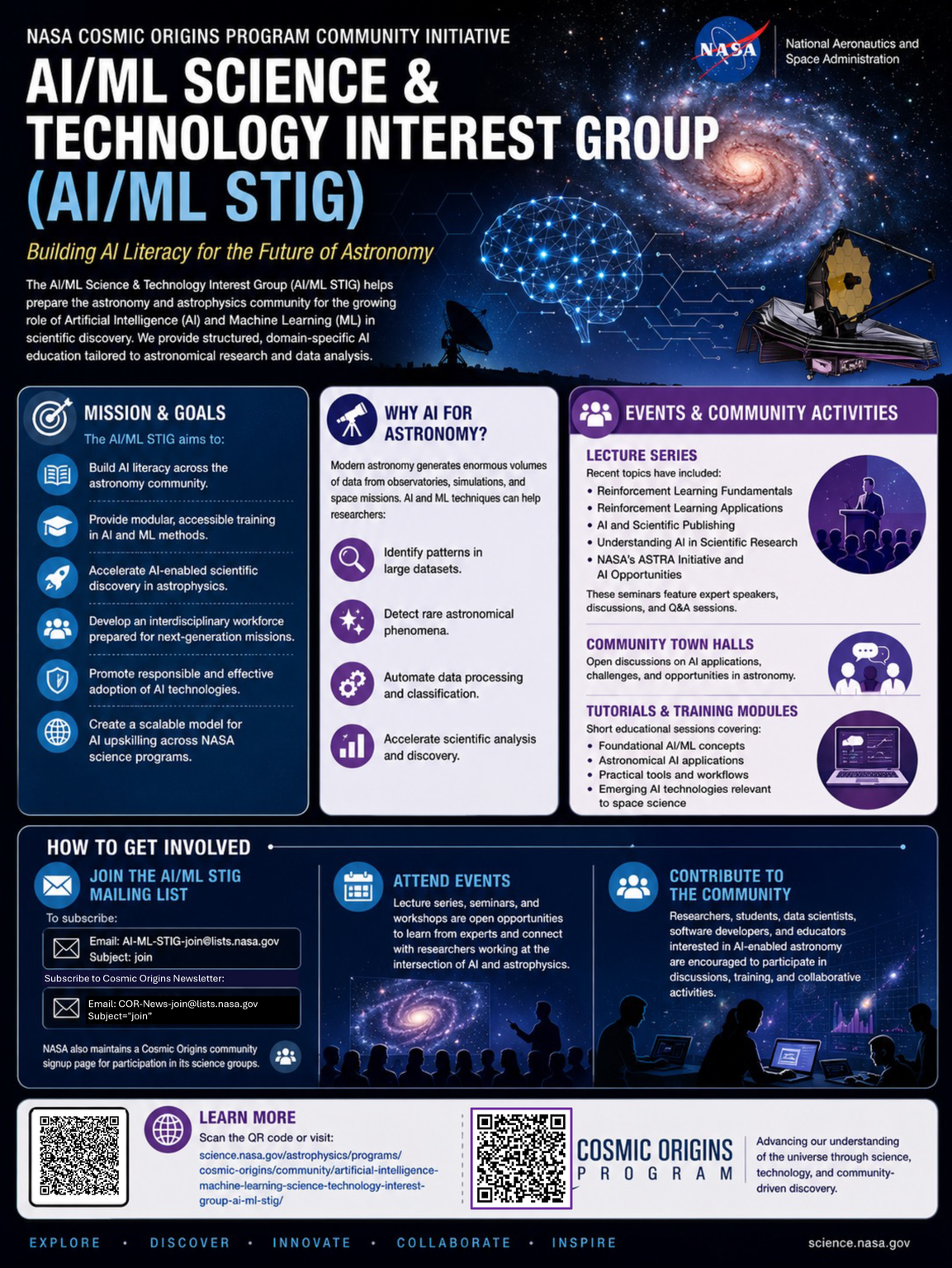
Additional Resources

News Straight to Your Inbox
Subscribe to your community email news list
We will never share your email address.