










IR STIG Seminar
Infrared Science and Technology Integration Group
DATE
Nov 02, 2021
TIME
1:00 pm EST
COMMUNITY
IR STIG
TYPE
Seminar
NRC Q-band/Band-5 receiver development for the ngVLA
Dr. Sara Salem Hesari (Herzberg Institute of Astrophysics/National Research Council of Canada)
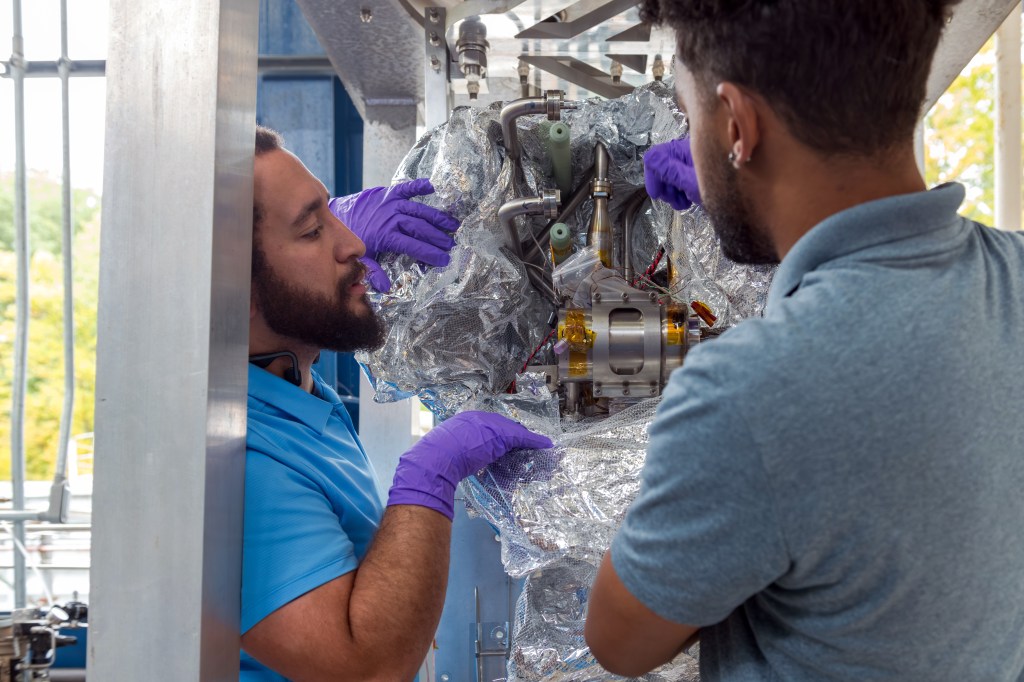
The Radio Instrumentation Team (RIT) at NRC Herzberg in Victoria, Canada, is currently developing a dual linear polarization, single-feed Q-band cryogenic radio astronomy receiver in order to develop and demonstrate all of the important technologies needed for the front-end development for the next generation Very Large Array (ngVLA) project lead by NRAO. The specific target is the ngVLA Band-5 receiver, which covers the frequency range of 30.5 to 50.5 GHz.
The specification of the Q-band receiver is aligned with ngVLA Band 5 requirements. This receiver is designed to achieve a receiver noise temperature of less than 20K in 70% of the bandwidth and better than 25K in the rest of the operating bandwidth, aligned with the ngVLA band-5 receiver requirement. The receiver system consists of a cryostat with a cooled feed horn, a turnstile OMT plus two noise couplers for calibration, two cryogenic low noise amplifiers with noise temperature lower than 14K, IR filters, and a vacuum window to create a low-loss transmission of electromagnetic fields into the cryostat.
Short Bio: Dr. Salem Hesari received her PhD from The University of Victoria and is now a Research Scientist at the NRC Herzberg Astronomy and Astrophysics Research Centre. Her work in radio astronomy is centered around providing astronomers with powerful new tools to explore our Universe.

News Straight to Your Inbox
Subscribe to your community email news list
We will never share your email address.
