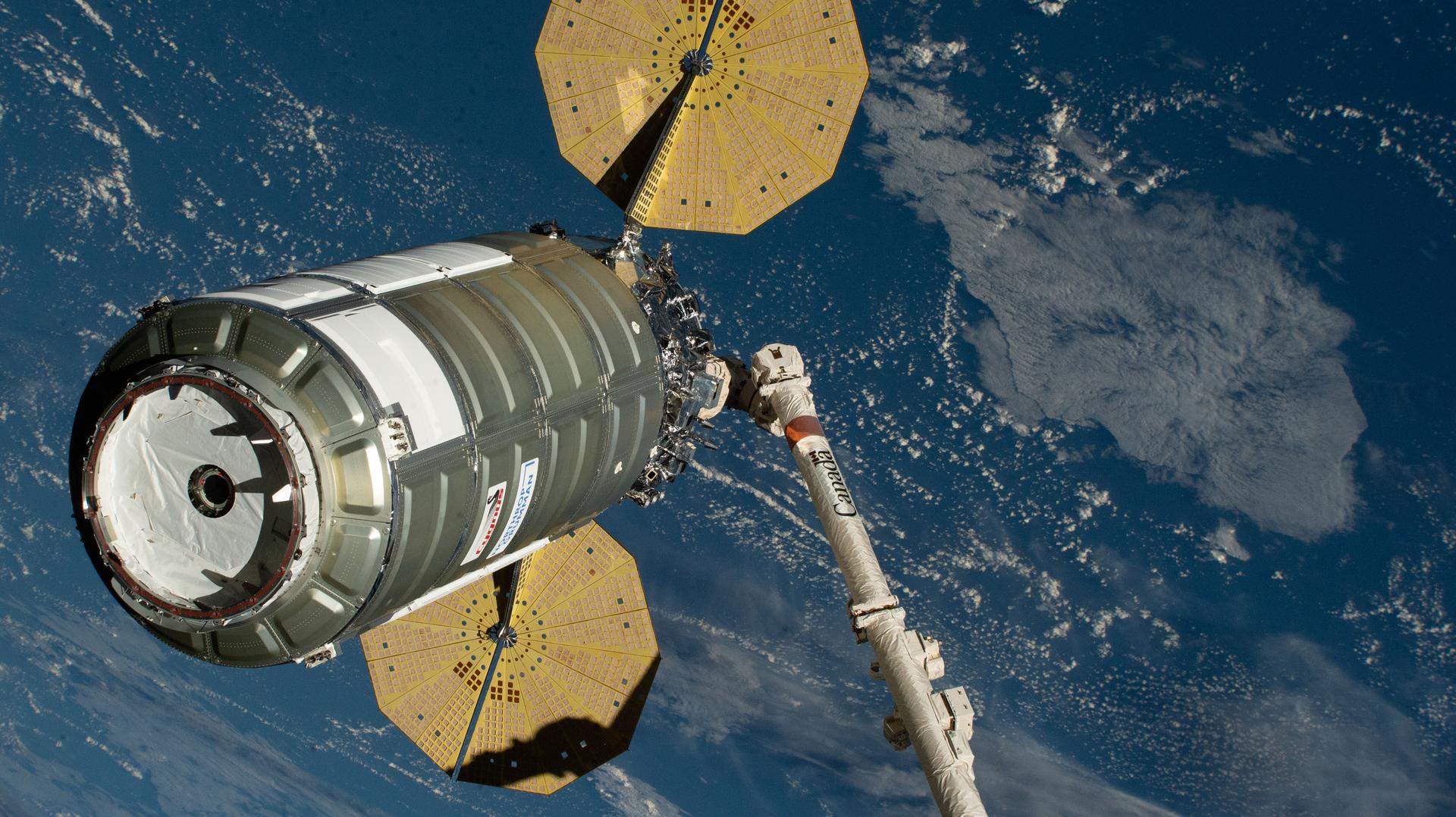














Teams continue to progress through in-orbit preparations for the robotic servicing spacecraft designed to boost NASA’s Neil Gehrels Swift Observatory to a higher altitude.
Spacecraft Commissioning On Track for Mission to Boost NASA’s Swift


Teams continue to progress through in-orbit preparations for the robotic servicing spacecraft designed to boost NASA’s Neil Gehrels Swift Observatory to a higher altitude.
![An educational diagram illustrating how measurement uncertainty can distort data regarding Earth's magnetosphere, featuring a detailed space visualization alongside two comparative line graphs. Top Right: Earth is shown surrounded by a complex network of blue magnetic field lines.Far Right: A bright blue, curved line denotes the "Bow shock," which transitions into an orange-red turbulent region labeled the "Magnetosheath." Spacecraft Locations: The "WIND" spacecraft is positioned far to the left in the "Solar wind" stream, connected to a label reading "Measured solar wind strength." The "THEMIS" spacecraft sits closer to Earth inside the magnetosheath, labeled "Corrected solar wind strength. Left Graph: Plots "Earth's response [mV/m]" against "Measured solar wind strength [mV/m]." A blue line initially follows a linear path but then flattens out, marked with the text "illusion of saturation due to measurement uncertainty."Right Graph: Plots "Earth's response [mV/m]" against "Corrected solar wind strength [mV/m]." A pink line continues steadily upward diagonally, labeled as the "True linear response."](https://science.nasa.gov/wp-content/uploads/2026/07/sivadas-2026-explanation-figure-v5-1.jpg?w=900)
For decades, scientists have thought that there is a ceiling to how intensely Earth responds to solar storms. However, a NASA-led paper published Wednesday in Nature suggests this upper limit is an illusion. If so, it means solar storms could have far worse effects on our technology than previously thought. Observations have suggested that electric […]

10 crew members now occupy the International Space Station following the arrival of NASA astronaut Anil Menon and Roscosmos cosmonauts Pyotr Dubrov and Anna Kikina aboard the Soyuz MS-29 spacecraft on Tuesday. The expanded Expedition 74 crew will stay that way until the end of the month when another three crewmates depart the orbital outpost after an eight-month space research mission.

At 4:30 p.m. EDT, the hatch opened between the International Space Station and the Soyuz MS-29 spacecraft. NASA astronaut Anil Menon and Roscosmos cosmonauts Pyotr Dubrov and Anna Kikina have entered the station, where they will spend the next eight months living and working before returning to Earth in April 2027.

NASA’s live hatch-opening coverage is underway on NASA+, Amazon Prime, and the agency’s YouTube channel. Hatch opening is scheduled to begin at 3:55 p.m. EDT. After, NASA astronaut Anil Menon and Roscosmos cosmonauts Pyotr Dubrov and Anna Kikina will enter the International Space Station, where they will spend about eight months before returning to Earth in April 2027.

At 1:52 p.m. EDT, the Soyuz MS-29 spacecraft docked with the International Space Station’s Prichal module. NASA astronaut Anil Menon and Roscosmos cosmonauts Pyotr Dubrov and Anna Kikina launched earlier at 10:47 a.m. (7:47 p.m. Baikonur time) from the Baikonur Cosmodrome in Kazakhstan.

The Soyuz MS-29 spacecraft is on track to automatically dock with the International Space Station’s Prichal module at about 1:56 p.m. EDT today.

To prepare their spacecraft for Venus, NASA's DAVINCI scientists traveled to the most Venus-like place on Earth.

The Soyuz MS-29 spacecraft reached orbit after its 10:47 a.m. EDT (7:47 p.m. Baikonur time) launch from the Baikonur Cosmodrome in Kazakhstan, carrying NASA astronaut Anil Menon and Roscosmos cosmonauts Pyotr Dubrov and Anna Kikina to the International Space Station.