














Suggested Searches

Blogs

    NASA Satellites Show Mangrove Forest Rebound

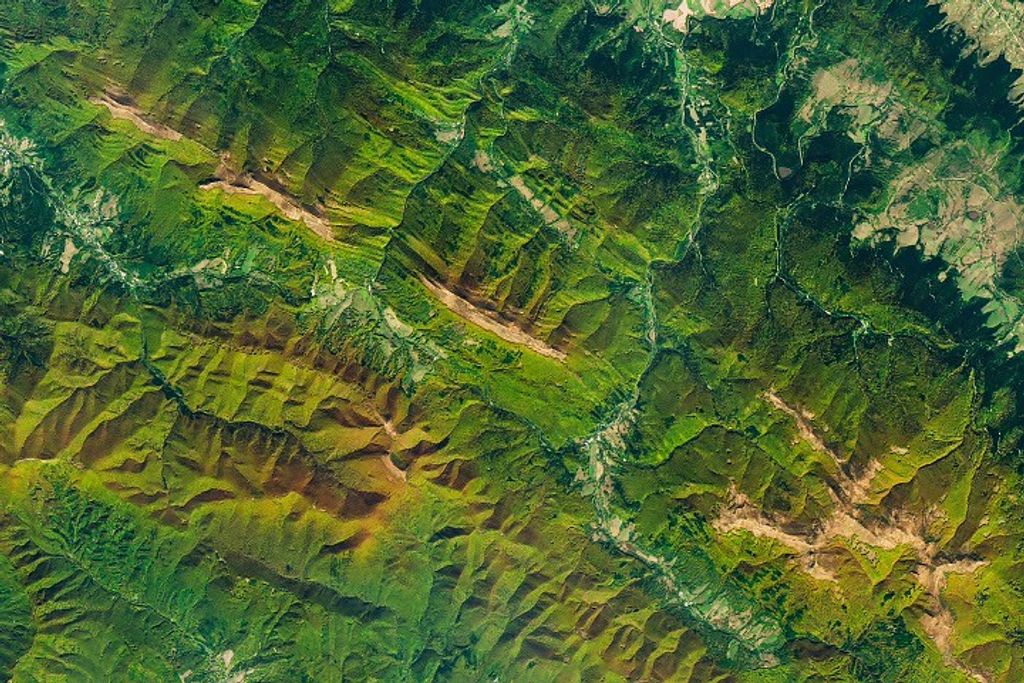
    Before and after satellite images show increased coverage of mangrove forests.

    NASA satellite images show that mangrove forests, which protect shorelines, support coastal ecosystems, and store large amounts of carbon along saltwater coasts, are more resilient than scientists once believed. Four decades of Landsat observations reveal that mangrove forest coverage shifted from long-term decline to expansion, with the rebound beginning in 2010. The forests have long […]

    Read Full Post

    Final Artemis III SLS Booster Segments En Route to NASA Kennedy

    The final booster motor segments for NASA’s SLS (Space Launch System) rocket that will help propel Artemis III astronauts on their journey to space shipped from Northrop Grumman’s Railyard Shipping Facility in Corinne, Utah on June 2. The eight booster motor segments are on their way to NASA’s Kennedy Space Center in Florida where they […]

    Read Full Post

    Hello, World! NASA Shares New Home for Roman Space Telescope Updates

    The complete observatory in a clean room

    We’re kicking off the inaugural Roman blog post with a launch update: NASA’s Nancy Grace Roman Space Telescope is officially slated to launch Aug. 30, eight months ahead of schedule and even earlier than previously targeted. With less than three months to go, the Roman team now is finishing up final tasks. Engineers are currently […]

    Read Full Post

    NASA’s Juno Reveals New Insights into Cosmic Ray Origins

    An artist's concept shows a planet at the top center with a blue band arcing around it in a horseshoe shape. The blue band is labeled the magnetosheath. The inner part of this blue band, closest to the planet, is labeled the magnetopause. The outer edge of the blue band is labeled the bow shock. Just outside the blue band, to the lower left of it, is a purple wedge-shaped area labeled the foreshock. On the far left is a red shaded area with red arrows pointing from left to right, appearing to push against the magnetosheath (blue region) and foreshock (purple) region, labeled the stellar wind.

    Particles traveling close to the speed of light near Jupiter were captured by NASA’s Juno mission, providing new evidence for how and where high-energy particles, including cosmic rays, form. Astronomers have sought the origins of cosmic rays since their discovery more than 100 years ago. These energetic particles can come from many sources, including supernovas […]

    Read Full Post

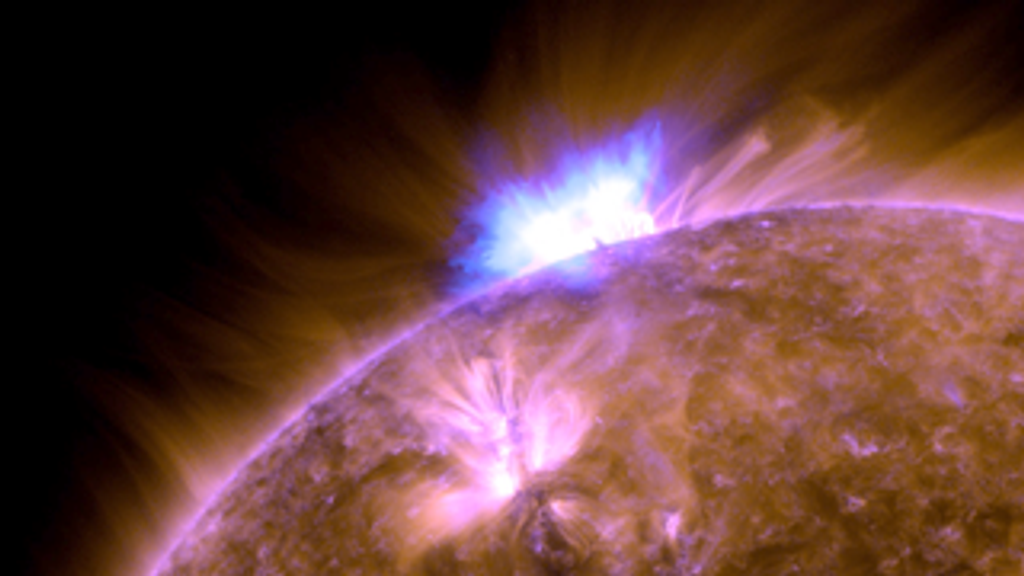
    Strong Flare Erupts from Sun 

    The Sun, shown against the black backdrop of space. The Sun is colorized in red, with dark freckles spotting it and some brighter, more orange areas representing active regions. Toward the upper right, there is a bright white region, showing a flash shaped like an X. This is the solar flare.

    The Sun emitted strong solar flare, peaking at 7:28 a.m. ET on June 3. NASA’s Solar Dynamics Observatory, which watches the Sun constantly, captured an image of the event. Solar flares are powerful bursts of energy. Flares and solar eruptions can impact radio communications, electric power grids, navigation signals, and pose risks to spacecraft and […]

    Read Full Post

    Bacteria, Cartilage, and Metal Tops Tuesday’s Research Aboard Station

    Microbiology,  biotechnology, and physics were the dominant research themes aboard the International Space Station on Tuesday as the Expedition 74 crew explored how microgravity affects bacteria, cartilage growth, and metallic structure. Scientific hardware maintenance rounded out the schedule for the orbital residents to ensure continuous experimental operations.

    Read Full Post

    NASA’s Eyes software: May release notes

    A new version of Eyes on the Earth was released on May 11, 2026, that has a share/embed feature prominently placed on the home screen. It also has a new SWOT video courtesy of our friends at SVS that shows changes in volume of the rivers of the world over the course of a year, […]

    Read Full Post