























After Latest Swing Past Sun, NASA’s Parker Solar Probe Checks in
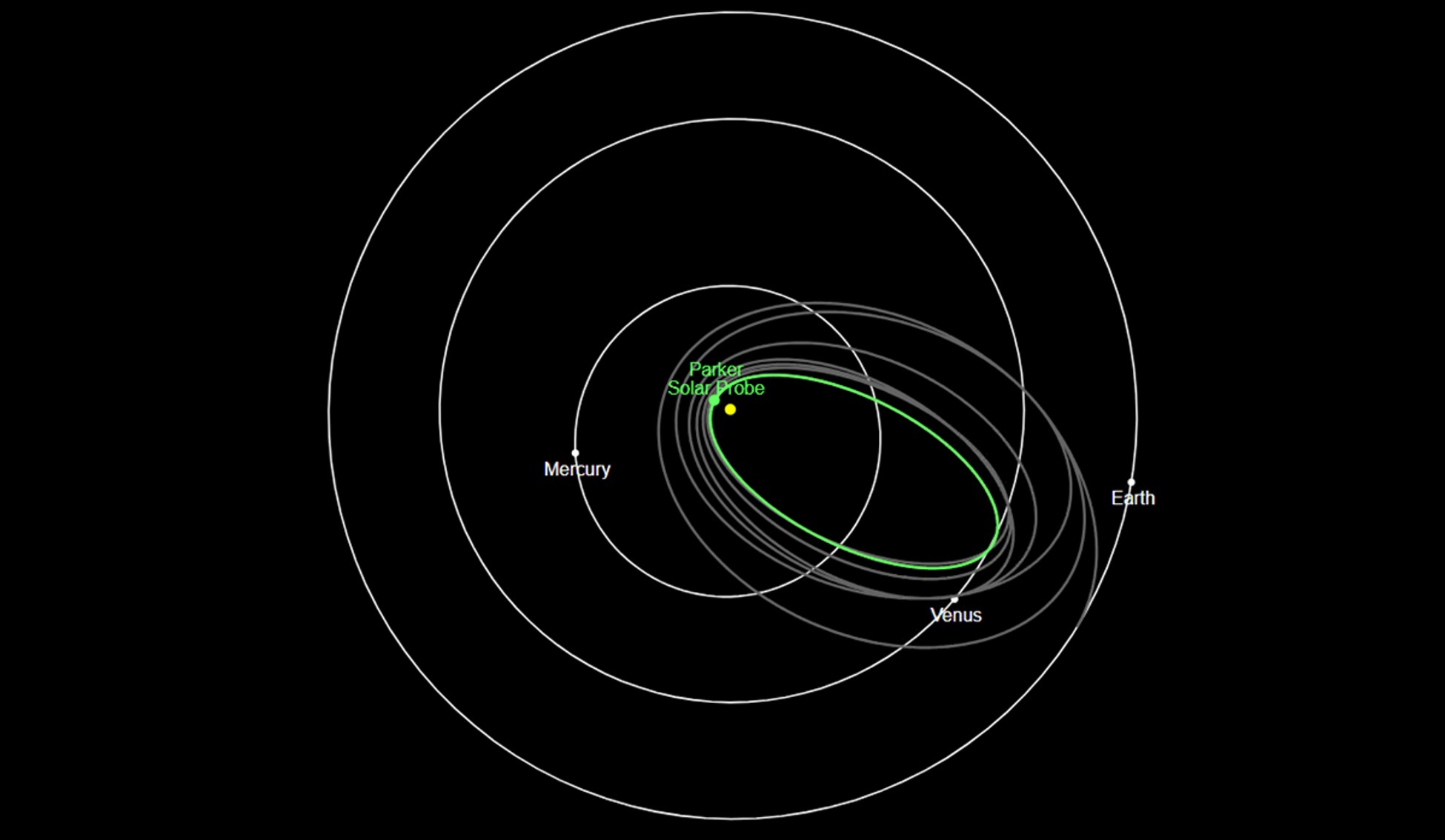
NASA’s Parker Solar Probe completed its 29th close approach to the Sun on Sept. 4, again matching its record speed and distance from the solar surface. This time, the spacecraft trained its camera on structures and activity near the Sun’s north pole.
The spacecraft transmitted a beacon tone indicating that its systems were operating normally on Sept. 7. Flying around the Sun on a trajectory that limited communications with Earth, Parker had been out of contact and operating autonomously, as planned, for nine days centered around closest approach.
The flyby, which brought Parker to within 3.8 million miles of the Sun at a top speed of 430,000 miles per hour, allowed the spacecraft to race through and sample almost 40% of the solar circumference within one day during this encounter. During this solar encounter, which started Aug. 30 and ended Sept. 9, Parker’s four scientific instrument packages gathered data from inside the Sun’s atmosphere, or corona.
Parker will begin returning detailed spacecraft telemetry on Friday, Sept. 11, with science data transmission set to run from Sunday, Sept. 13 through Sunday, Sept. 27.
The spacecraft’s observations of the solar wind and solar events, such as coronal mass ejections and the aftermaths of flares, are critical to advancing humanity’s understanding of the Sun and the phenomena that drive high-energy space weather events that pose risks to astronauts, satellites, air travel, and even power grids on Earth. Understanding the fundamental physics of space weather enables more reliable forecasts, helping protect astronauts during future deep-space missions to the Moon and Mars.
Parker Solar Probe launched in August 2018. At the time, the Sun was near the minimum of its 11-year activity cycle. In 2024, representatives from NASA, the National Oceanic and Atmospheric Administration, and the international Solar Cycle Prediction Panel announced that the Sun had reached its solar maximum period. Parker’s 29 encounters with the Sun reflect this change over time, sampling the Sun’s atmosphere from quiet to very active periods. Parker Solar Probe will remain in this orbit around the Sun and continue making observations into the declining phase of solar activity.
The Parker Solar Probe mission has been extended into 2029 as a result of the 2026 Heliophysics Senior Review.
Parker Solar Probe was developed as part of NASA’s Living With a Star program to explore aspects of the Sun-Earth system that directly affect life and society. The program is managed by the agency’s Goddard Space Flight Center in Greenbelt, Maryland, for NASA’s Science Mission Directorate in Washington. Johns Hopkins Applied Physics Laboratory (APL) in Laurel, Maryland manages Parker Solar Probe for NASA and designed, built, and operates the mission.
