







Suggested Searches

Blogs

    NASA’s Parker Solar Probe Observes Interstellar Comet 3I/ATLAS

    Comet 3I/ATLAS appears as a small point of light near the center of the frame against a processed background of stars

    NASA’s Parker Solar Probe observed interstellar comet 3I/ATLAS from Oct. 18 to Nov. 5, 2025, with its WISPR (Wide-Field Imager for Solar Probe) instrument. The spacecraft snapped around 10 images of the comet per day. During this period, Parker Solar Probe was speeding away from the Sun following its 25th solar flyby on Sept. 15.  […]

    Read Full Post

    Second Scientific Balloon for NASA Launches from Antarctica

    The second scientific balloon flight for NASA’s Antarctic scientific balloon campaign has reached its float altitude of 120,000 feet after lifting off from the agency’s facility located near the U.S. National Science Foundation’s McMurdo Station on the Ross Ice Shelf at 5:56 a.m. NZST, Saturday, Dec. 20 (11:56 a.m., Friday, Dec. 19 in U.S. Eastern […]

    Read Full Post

    Brain Research, Heart Health Wrap Up Work Week Aboard Station

    The Expedition 74 crew explored how living in space affects the brain and blood circulation on Friday to ensure crews stay healthy and ensure long-term mission  success. The International Space Station residents also focused on spacewalking tools and science hardware maintenance wrapping up the week.

    Read Full Post

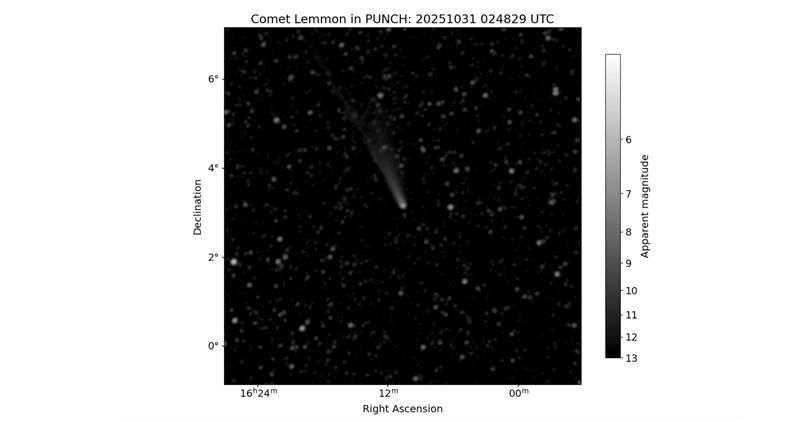
    NASA’s PUNCH Spies Comet Lemmon

    A black-and-white image shows a comet against a background of stars. At the top is a date and time stamp that reads 20251031 024829 UTC. Along the bottom and left sides are markers showing Right Ascension and Declination coordinates, respectively. A faint white tail stretches up and to the left away from the comet's bright white head, or coma, at the center of the image.

    In late 2025, as comet Lemmon (C/2025 A6) swept past the Sun and brightened in Earth’s night skies, NASA’s Earth-orbiting PUNCH (Polarimeter to Unify the Corona and Heliosphere) mission was watching the comet blaze through its field of view, providing a natural tracer of the Sun’s effects across the inner solar system. Discovered in January […]

    Read Full Post

    Expedition 74 Advancing Space Health and AI Research on Station

    The Expedition 74 crew’s research schedule was filled with biomedical duties and artificial intelligence on Thursday to promote crew health and spark innovation on and off the Earth. Spacesuit tailoring and advanced science hardware maintenance rounded out the day for the seven residents aboard the International Space Station.

    Read Full Post

    NASA Instrument Reveals New Ability to Gather Nighttime Light Data

    A darkened image of the continental US with spots of light ranging in intensity and color.

    NASA’s Tropospheric Emissions: Monitoring of Pollution instrument, or TEMPO, is known for measuring trace gases like nitrogen dioxide, ozone, and formaldehyde in the air we breathe. Now TEMPO has a new trick. It can see in the dark. Since launching in 2023, TEMPO data has set a record at the Atmospheric Science Data Center (ASDC) […]

    Read Full Post

    NASA’S PUNCH Releases Refined Images of Eruptions from the Sun

    The video displays a composite view of panels taken with several space-based images arranged in a clover-like layout. A black disk in the center is the coronagraph surrounded by an amber-hued background of space. Throughout the video, coronal mass ejections are represented by the white, wispy structures surrounding the black disk in the center and expanding outward, gradually becoming more diffuse as it travels across the field of view. Some regions in the video appear as black geometric shapes where no image data is available. A timestamp at the top advances continuously, indicating the real-time progression of the solar events. A white orb moving away from the center at the left is the planet Mercury. A white orb at the right of the frame represents the planet Venus. A small white orb with a “tail” at the top is comet C/2025 A6 (Lemmon).

    NASA’s PUNCH (Polarimeter to Unify the Corona and Heliosphere) mission has released processed images of huge eruptions from the Sun, known as coronal mass ejections (CMEs), that occurred from Oct. 21 to Nov. 12. This release marks the first time PUNCH observations can be used to continuously trace solar eruptions from the Sun’s outer atmosphere […]

    Read Full Post

    NASA’s Europa Clipper Observes Comet 3I/ATLAS

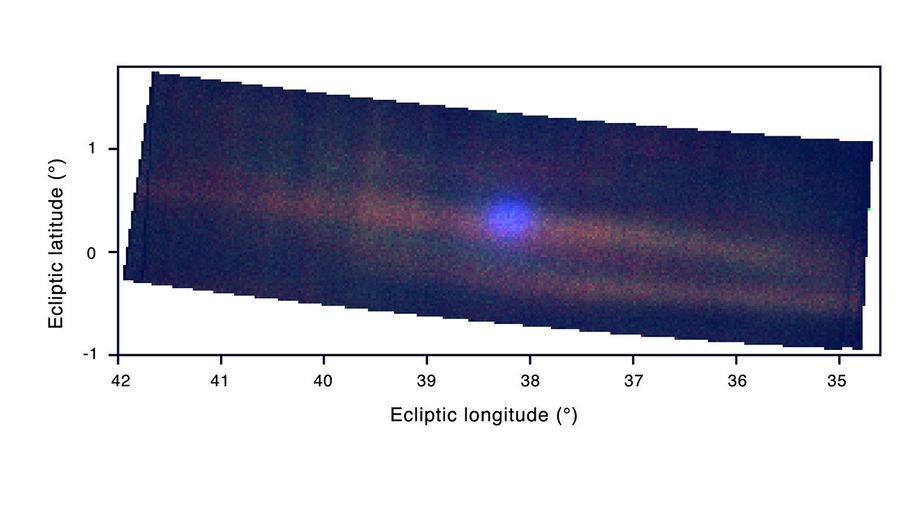
    Interstellar comet 3I/ATLAS is seen in this composite image captured on Nov. 6 by the Europa Ultraviolet Spectrograph instrument on NASA’s Europa Clipper spacecraft, from a distance of around 102 million miles (164 million kilometers).

    NASA’s Europa Clipper mission observed the interstellar comet 3I/ATLAS on Nov. 6 from a distance of about 102 million miles (164 million kilometers). Captured over a period of seven hours, the data gathered by the spacecraft’s Europa Ultraviolet Spectrograph (Europa-UVS) instrument will help scientists determine the composition and distribution of elements in the comet’s coma […]

    Read Full Post

    NASA’s Parker Solar Probe Completes 26th Closest Approach to Sun

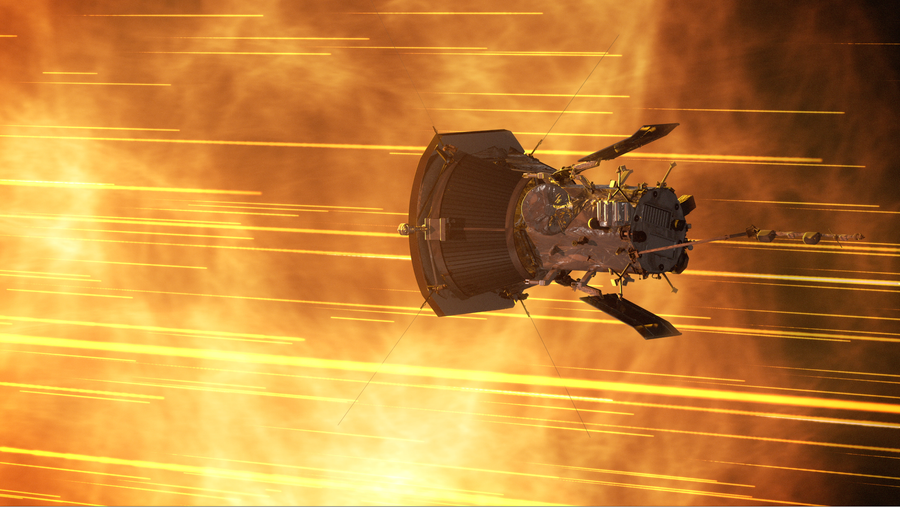
    NASA's Parker Solar Probe -- with its heat shield facing forward and twin solar panels partially extended -- flies through particles in space.

    NASA’s Parker Solar Probe completed its 26th close approach to the Sun on Dec. 13, again matching its record distance of 3.8 million miles (6.2 million kilometers) from the solar surface. The spacecraft checked in with flight controllers at the Johns Hopkins Applied Physics Laboratory (APL) in Laurel, Maryland — where Parker Solar Probe was […]

    Read Full Post