



























NASA Roman Space Telescope: First Stage Fueling at 6:30 a.m. EDT
After receiving a “go” from the NASA team, the SpaceX launch director verified Falcon Heavy is ready to begin propellant-loading operations at Launch Complex 39A at NASA’s Kennedy Space Center in Florida.
First-stage RP-1, a highly refined kerosene, is now underway. First-stage liquid oxygen, or LOX, will follow in about five minutes. Together, the propellants will feed the 27 Merlin engines on Falcon Heavy’s three first-stage cores, which combine to generate 5 million pounds of thrust.
The U.S. Space Force’s 45th Weather Squadron predicts a 70% “go” for launch.
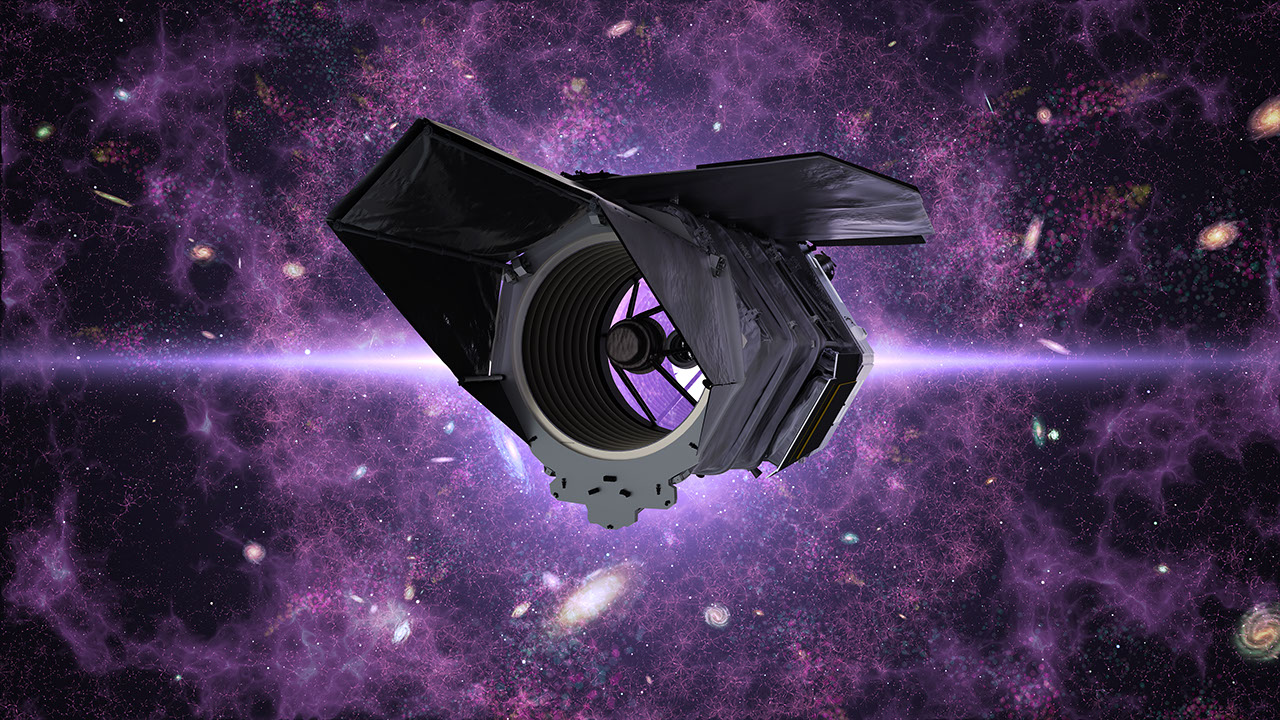
NASA’s Nancy Grace Roman Space Telescope will reveal the cosmos in ways that have never been possible before. By observing billions of cosmic objects, Roman will explore how planets, stars, and galaxies form and develop over time.
Roman is more than 42 feet (12.7 meters) long, about the size of a tour bus, and more than 14 feet (4.4 meters) wide when fully deployed. The spacecraft weighs about 18,000 pounds, about the mass of a Tyrannosaurus rex. Equipped with six solar array panels facing the Sun to provide a total of four kilowatts of power, Roman will use minimal fuel to power itself to orbit in second Sun-Earth Lagrange point 2 or L2.
Roman will study dark matter, first identified more than 80 years ago by Swiss-American astronomer Fritz Zwicky. He observed that galaxies in the Coma cluster were moving so quickly they should have been flung away into space, yet they remained gravitationally bound to the cluster by unseen matter. Roman will provide the most comprehensive 3D map of the distribution of galaxies and galaxy clusters across the universe.
Euclid, an ESA (European Space Agency) mission also studies dark matter in L2, but on a larger scale. Roman will focus on a smaller area, but with greater depth and precision to unveil the cosmos when it was 2 billion years old, revealing a larger number of fainter galaxies. Both survey areas will overlap, allowing scientists to compare and improve some of Euclid’s larger data.
Roman also will study the mystery of dark energy and why it’s causing the universe to expand faster over time. After the big bang sent the universe’s contents hurtling apart, scientists thought the expansion would gradually slow down. Instead, galaxies are racing away at an ever-increasing clip, swept apart by an unseen power dubbed dark energy.
The observatory will use several different techniques to probe dark energy to gather unprecedented data to bring us closer than ever before to figuring out the unseen forces at play in the universe.
Researchers are eager to study thousands of exoplanets Roman will discover to learn how closely they resemble Earth. The observatory will monitor 200 million stars toward the center of our galaxy.
When Roman begins operations, it will downlink approximately 1.4 terabytes of data per day to ground stations in New Mexico, Australia, and Japan. These locations are spread out so the Roman team will consistently be able to communicate with the spacecraft. The observatory is a five-year long mission with the option to extend an additional five years.
To learn more about Roman and its mission:
