

























NASA Heliophysics Spacecraft Witness Comet’s Demise
On April 4, comet C/2026 A1 (MAPS) plunged toward the Sun — flying about twice as far from our star as the Moon is from Earth.
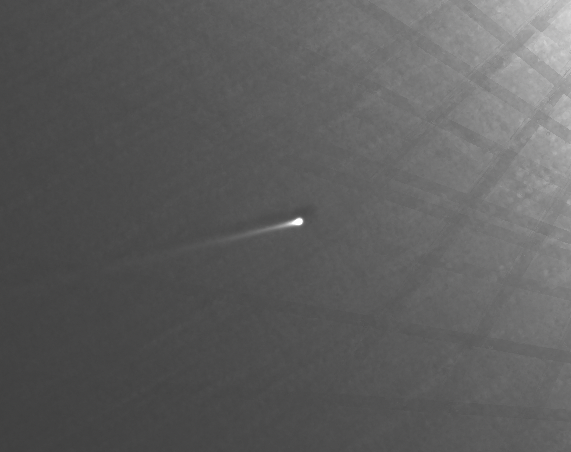
Comet watchers held their collective breath, waiting to see whether comet MAPS would survive its sweltering passage by the Sun. The SOHO (Solar and Heliospheric Observatory) spacecraft — a joint NASA and ESA (European Space Agency) mission — and other NASA missions soon revealed that it did not.
The coronagraph instrument on SOHO, which blocks out the Sun with a disk to reveal relatively faint features and objects (like comets) near the star, showed the comet approaching the Sun seemingly intact before it disappeared behind the coronagraph’s disk. However, a few hours later, SOHO saw nothing but a cloud of dust come out from the other side of the disk. The comet had disintegrated.
“The comet was clearly destroyed — likely several hours before its closest approach to the Sun,” said Karl Battams of the U.S. Naval Research Laboratory, the principal investigator for SOHO’s coronagraph, called LASCO (Large Angle and Spectrometric Coronagraph).
From SOHO’s view, it appears that the comet plunged directly into the Sun. However, another view from NASA’s STEREO (Solar Terrestrial Relations Observatory) mission, which watched the comet approach the Sun from a different angle (54.5 degrees from the Sun-Earth line), showed how comet MAPS was swinging around the Sun as it met its demise.
NASA’s PUNCH (Polarimeter to Unify the Corona and Heliosphere) mission — designed to study how the Sun’s outer atmosphere becomes the solar wind that travels across the solar system — also tracked comet MAPS before its fatal flyby.
The SOHO, STEREO, and PUNCH spacecraft are part of NASA’s heliophysics mission fleet, which consists of strategically placed spacecraft that study the Sun and its influence across the solar system from multiple perspectives. Their observations of the comet highlight the value of the fleet’s diverse viewpoints, maximizing the information scientists can collect during such events. Watching how comets break apart when exposed to the scorching heat of the Sun provides clues about cometary structure and the conditions of the early solar system when comets formed.
Comet MAPS was discovered on Jan. 13, 2026, by a telescope in Chile belonging to the MAPS program led by amateur astronomers Alain Maury, Georges Attard, Daniel Parrott, and Florian Signoret. It belonged to a family of comets, called Kreutz sungrazing comets, which all have similar orbits that take them very close to the Sun and are thought to be pieces of a larger comet that broke apart centuries ago.
by Vanessa Thomas
NASA’s Goddard Space Flight Center, Greenbelt, Md.
