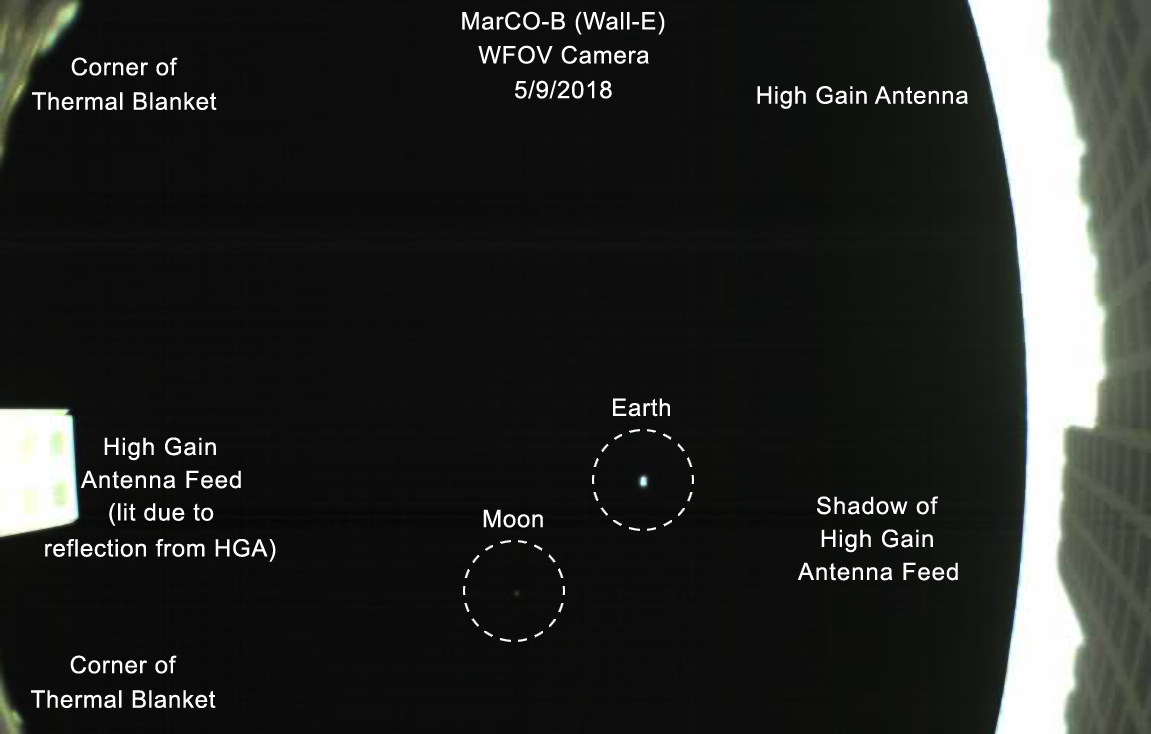

















In 1990, NASA’s Voyager 1 spacecraft took a classic portrait of Earth from several billion miles away. Now a class of tiny, boxy spacecraft—known as CubeSats—have just taken their own version of a “pale blue dot” image, capturing Earth and the Moon in one shot.
NASA set a new distance record for CubeSats on May 8, 2018, when the Mars Cube One (MarCO) mission reached 1 million kilometers (620,000 miles) from Earth. Most CubeSats never go beyond Earth orbit, but the MarCO pair will hopefully traverse tens of millions of kilometers.
One of the CubeSats, called MarCO-B, used a fisheye camera to snap its first photo on May 9, 2018. That photo was part of a process used by the engineering team to confirm that the spacecraft’s high-gain antenna has properly unfolded. (Click here for an annotated view of the image.)
As a bonus, the photo captured Earth and its Moon as tiny specks floating in space. “Consider it our homage to Voyager,” said Andy Klesh, MarCO’s chief engineer at the Jet Propulsion Laboratory. “CubeSats have never gone this far into space, so it is a big milestone. Both of our CubeSats are healthy and functioning properly. We are looking forward to seeing them travel even farther.”
The MarCO CubeSats were launched on May 5 along with NASA’s InSight lander, a spacecraft that will touch down on Mars in November 2018 and study the planet’s deep interior for the first time. MarCO will follow along behind InSight during its cruise to Mars. Should the CubeSats make it all the way to the Red Planet, they will radio back data about InSight as it enters the atmosphere and descends to the surface.
References & Resources
NASA image courtesy of NASA/JPL-Caltech. Story by Andrew Good, NASA’s Jet Propulsion Laboratory.